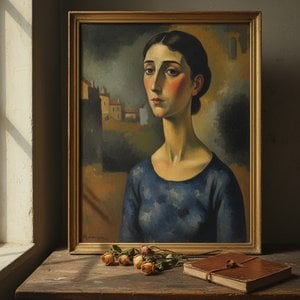
The Enigmatic Figure: An Introduction to “Nu couché de dos”
Amedeo Modigliani's "Nu couché de dos" (Reclining Nude from the Back), painted in 1917, isn’t merely a depiction of a female nude; it’s a carefully constructed tableau of introspection and subtle sensuality. Captured during a period of intense creative ferment for the artist – a time marked by both profound artistic breakthroughs and personal hardship – this work embodies Modigliani's signature style: elongated forms, simplified features, and an almost unsettling stillness. The painting immediately draws the viewer in with its quiet intensity, inviting contemplation rather than overt display. It’s a portrait not of physical beauty as traditionally defined, but of a soul at rest, yet subtly aware.
The genesis of this piece lies within Modigliani's unique artistic environment. He was working under the patronage of Leopold Zborowski, a Polish poet and art dealer who provided him with a studio, models, and a vital lifeline during a period of considerable instability. This arrangement fostered an atmosphere of experimentation and collaboration, allowing Modigliani to push the boundaries of his style and explore new avenues for representing the human form. The painting’s creation coincided with a pivotal moment in Modigliani's career – a time when he was actively seeking to move beyond the influence of earlier masters and forge his own distinct visual language.
A Symphony of Line and Form: Technique and Style
Modigliani’s technique is immediately recognizable. He employs long, fluid lines to define the figure's contours, exaggerating the neck and limbs in a manner that creates an almost ethereal quality. The forms are deliberately simplified – reduced to their essential shapes while retaining a remarkable sense of volume. The elongated proportions, characteristic of his work, contribute significantly to the painting’s dreamlike atmosphere. Notice how the curves of the body flow seamlessly into one another; there are no sharp edges or abrupt transitions, creating a feeling of harmonious balance.
The color palette is deliberately muted and earthy – ochre, beige, brown, and subtle hints of red—reflecting Modigliani’s preference for understated tones. This restrained use of color allows the forms themselves to take center stage, while the dark background and cushions provide a dramatic contrast, emphasizing the figure's delicate flesh tones. The application of paint is remarkably smooth, suggesting an oil-on-canvas technique executed with meticulous care. Brushstrokes are visible but subtle, contributing to a sense of tactile richness.
Symbolism and Emotional Resonance
Beyond its formal qualities, “Nu couché de dos” resonates with layers of symbolic meaning. The reclining pose itself suggests vulnerability and introspection—a moment of quiet contemplation away from the demands of the world. The woman’s gaze, directed directly at the viewer, is particularly arresting. It's not a seductive or overtly provocative look; rather, it conveys a sense of detached awareness, as if she is observing us with a gentle curiosity. The slightly downturned mouth adds to this impression of quiet melancholy.
The elongated neck and limbs—a hallmark of Modigliani’s style—contribute to the painting's ethereal quality, evoking a sense of timelessness and spiritual depth. Some art historians interpret these features as reflecting Modigliani’s own preoccupation with mortality and his fascination with ancient cultures, particularly those of Africa and Greece, which he saw as sources of profound artistic inspiration. The overall effect is one of poignant beauty—a reminder of the fragility and transience of human existence.
A Legacy of Longing: Historical Context and Artistic Influence
“Nu couché de dos” stands as a crucial work within Modigliani’s oeuvre, representing a pivotal moment in his artistic development. It exemplifies his departure from traditional academic approaches to the nude figure, embracing instead a more stylized and emotionally resonant representation of the human form. The painting's creation coincided with a period of intense experimentation in European art, marked by the rise of Cubism, Futurism, and Expressionism—movements that challenged conventional notions of perspective, space, and representation.
Modigliani’s influence extends far beyond his own lifetime. His distinctive style—characterized by elongated forms, simplified features, and a hauntingly beautiful aesthetic—has inspired generations of artists. Reproductions of “Nu couché de dos” continue to be highly sought after by collectors and interior designers alike, serving as elegant reminders of Modigliani’s enduring legacy.
Pytania i odpowiedzi
Jaki dominujący odcień przenika „Nu couche de dos” – Amedeo Modigliani?
Dominującym odcieniem dzieła „Nu couche de dos” – Amedeo Modigliani jest Golden Yellow Range. Odcień ten stanowi bazową tonację palety barw.
W jaki sposób "Nu couche de dos" balansuje światło i cień?
Zarejestrowane wartości dla „Nu couche de dos” – Amedeo Modigliani to: jasność balanced, luminancja Soft Shadow.
Czy mogę zobaczyć „Nu couche de dos” – Amedeo Modigliani na własnej ścianie przed zakupem?
Dzieło „Nu couche de dos” – Amedeo Modigliani możesz zobaczyć na własnej ścianie dzięki stronie Podgląd w AR, wykorzystując rozszerzoną rzeczywistość na kompatybilnym urządzeniu.



 Podgląd w skali 1:1
 Zamów ręcznie malowaną reprodukcję
 Wyślij jako kartkę
 Udostępnij
 Szczegóły dzieła
 Przewodnik

 Pobierz obraz
 Podobne obiekty
 RTG
RTG Pokaz slajdów
 Statystyki
 Rozwiń treść






































 Opcja ze szkłem jest dostępna wyłącznie w rozmiarach poniżej 110 cm