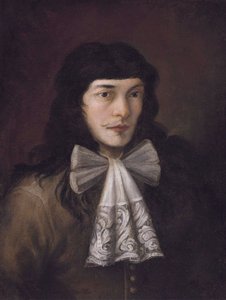
Misty Solitude: Alessandro Magnasco’s “Praying Monks” – A Glimpse into Italian Baroque Melancholy
Alessandro Magnasco’s “Praying Monks,” a remarkably intimate work measuring just 53 x 43 cm, offers far more than a simple depiction of religious observance. It's a profound meditation on faith, isolation, and the subtle, unsettling beauty of decay – hallmarks of the artist’s uniquely evocative style. Painted around 1730-1735, during his period in Milan, this piece transcends mere representation; it’s a carefully constructed mood, a visual poem steeped in the melancholic spirit that defined Magnasco's artistic vision.
The scene unfolds within a rugged, almost primordial landscape – two weathered rocks dominate the composition, providing an anchoring presence to the figures. The monks themselves are rendered with a remarkable degree of realism and psychological depth. The central monk, kneeling in a posture of supplication, is not idealized; his face bears the marks of hardship and contemplation. His hands, clasped together in prayer, convey both humility and a quiet intensity. To his left, another monk, slightly elevated, mirrors this gesture, while a third figure lies prone, seemingly lost in a state of reverie or perhaps despair. Magnasco masterfully uses light and shadow to create a sense of depth and atmosphere – the muted palette, dominated by greys and browns, reinforces the painting’s somber tone.
The Artist's Vision: A Shift Towards Personal Expression
Magnasco’s artistic journey is one marked by intriguing transitions. Initially working as a collaborator within established Milanese workshops, he gradually developed a distinctive style characterized by nervous brushstrokes, fragmented forms, and an unsettling sense of unease. This shift reflects a move away from the polished conventions of the Baroque towards a more intensely personal expression – a willingness to explore darker themes and unconventional subjects. His early years in Florence under Grand Duke Cosimo III undoubtedly broadened his artistic horizons, but it’s within Milan that Magnasco truly blossomed, forging a style uniquely his own.
Interestingly, Magnasco's biography reveals a man who often shunned the limelight, preferring to depict scenes from the fringes of society – vagabonds, hermits, and even thieves. This fascination with marginalized figures speaks to a deeper concern with human vulnerability and the complexities of existence. The monks in “Praying Monks” are not presented as paragons of virtue; they are individuals grappling with their faith, their solitude, and perhaps, their own inner demons.
Symbolism and Context: Echoes of Gethsemane
The setting itself is laden with symbolic weight. The rocks, ancient and weathered, evoke a sense of timelessness and resilience – mirroring the monks’ spiritual journey. There's a subtle connection to depictions of Jesus in the Garden of Gethsemane, suggesting a shared experience of suffering and contemplation. Magnasco doesn’t offer a narrative; instead, he presents three distinct responses to adversity: defiance (the raised arms), acceptance (the bowed head), and escape (the prone figure). This ambiguity invites viewers to project their own interpretations onto the scene.
Furthermore, the painting's style aligns with the broader artistic trends of the late Baroque and early Rococo periods. The sketchy brushwork, rapid execution, and emphasis on emotional expression were characteristic features of this era. However, Magnasco’s work possesses a particularly haunting quality – an almost palpable sense of melancholy that sets it apart from many of his contemporaries.
A Reproduction for the Soul: Bringing “Praying Monks” to Your Space
WahooArt is proud to offer meticulously hand-painted reproductions of Alessandro Magnasco’s “Praying Monks.” Each reproduction captures the artist's unique style and atmospheric intensity, allowing you to bring this evocative work into your home or office. The subtle nuances of color, the delicate brushstrokes, and the overall sense of quiet contemplation are faithfully reproduced with exceptional detail. This is more than just a print; it’s an opportunity to connect with a profound artistic vision – a glimpse into the soul of a master who dared to explore the darker corners of the human experience.
Consider this piece not merely as decoration, but as a source of reflection and contemplation. Magnasco's "Praying Monks" invites us to pause, to consider our own place in the world, and to find solace in the shared human struggle for meaning and connection.



 Zobacz w skali 1:1
 Kup ręcznie malowany obraz
 Wyślij
 Udostępnij
 Szczegóły
 Przewodnik

 Pobierz plik obrazu
 Podobne obiekty
 RTG
RTG Pokaz slajdów
 Statystyki


 Czytaj więcej






































 Opcja ze szkłem jest dostępna wyłącznie w rozmiarach poniżej 110 cm