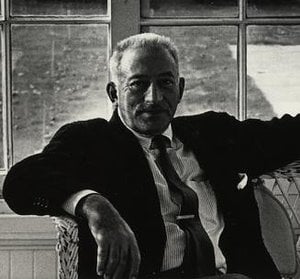
Biografia artysty
A Pioneer of Abstract Expressionism: The Life and Art of Adolph Gottlieb
Adolph Gottlieb, born in New York City on March 14, 1903, emerged as a pivotal figure in the burgeoning landscape of American Abstract Expressionism. His journey was one of constant exploration—a relentless pursuit to distill universal human experiences into a visual language that resonated with both ancient symbolism and modern anxieties. Growing up as the son of Jewish immigrants, Gottlieb’s early life instilled within him a sensitivity to cultural displacement and the search for meaning in a rapidly changing world, themes that would profoundly shape his artistic vision. He received foundational training at the Art Students League and Parsons The New School for Design, but it was his subsequent travels through Europe during the 1920s that truly ignited his aesthetic sensibilities. Immersing himself in the art and philosophies of Germany and France, he absorbed influences from Constructivism and Surrealism, laying the groundwork for his future innovations.
Early Life and Education
Gottlieb’s artistic development wasn't immediate; it was a gradual evolution away from representational forms toward abstraction. Initially grappling with traditional techniques, he began to experiment with fragmented imagery and symbolic motifs, hinting at the deeper psychological currents that would define his mature style. He studied at Parsons School of Design and Cooper Union, honing his skills in drawing and painting before embarking on a transformative European adventure. From 1920 to 1921 he traveled in France and Germany for a year, absorbing inspiration from avant-garde movements and immersing himself in the artistic milieu of Paris. He attended lectures at the Académie de la Grande Chaumière and visited museums extensively, cultivating an appreciation for diverse artistic traditions—a habit that would inform his later work. His formative years instilled within him a profound awareness of cultural context and the importance of questioning established conventions.
The European Influences: Constructivism and Surrealism
His travels in Europe during the 1920s proved particularly influential, exposing Gottlieb to the radical ideas of Constructivism and Surrealism. He encountered artists like Piet Mondrian and Kazimir Malevich—whose geometric abstraction challenged traditional notions of perspective and representation—and whose emphasis on pure form resonated with Gottlieb’s own artistic aspirations. Simultaneously, he absorbed the dreamlike imagery and psychological exploration characteristic of Surrealist painters such as René Magritte and Salvador Dalí. These encounters broadened his intellectual horizons and fueled his desire to push beyond conventional boundaries—a impulse that would become central to his artistic practice. He meticulously studied the works of European masters, analyzing their compositional strategies and stylistic innovations, recognizing them as models for his own creative endeavors.
The Founding of “The Ten” and Collaborative Experimentation
In 1935 Gottlieb joined forces with fellow artists Mark Rothko, John D. Graham, Barnett Newman, Milton Avery, David Smith, Ilya Bolotowsky, Louis Harris, Joseph Solman, Louis Schanker and Ben-Zion to form “The Ten,” later known as the New York Artists Painters group. This collective was instrumental in establishing a distinctly American voice within the international art scene, challenging European dominance and fostering a spirit of experimentation. Recognizing that artistic progress often arises from collaborative dialogue, Gottlieb embraced the opportunity to engage in shared creative endeavors—a practice he would continue throughout his career. The Ten’s commitment to abstraction and exploration of psychological themes reflected the broader intellectual currents of the era—a period marked by anxieties about fascism and uncertainty regarding the future of civilization.
The Pictographs: Symbolism and Universal Themes
Gottlieb's most celebrated series, *The Pictographs* (1940–52), embodies this exploration. These paintings feature biomorphic shapes and symbolic forms arranged within rectangular fields—resembling ancient hieroglyphs or tribal markings—creating a compelling dialogue between modernity and ancient traditions. He deliberately drew inspiration from diverse sources—classical mythology, Amerindian art, African motifs—creating a visual language that transcended cultural boundaries. The *Pictographs* weren’t merely abstract compositions; they were attempts to tap into universal archetypes, exploring themes of myth, ritual, and the human condition. Gottlieb meticulously crafted each image with careful consideration for its symbolic resonance—a testament to his belief in art's capacity to communicate profound truths about existence. He sought to capture not merely the visual appearance of the desert, but its emotional essence—a sense of vastness, isolation, and spiritual power.
## Legacy and Historical Significance
Throughout his career, Adolph Gottlieb exhibited widely in both the United States and Europe, gaining recognition for his unique contribution to American art. His work is now represented in major museum collections worldwide, including the Museum of Modern Art (MoMA) in New York City and the Tate Modern in London—a testament to its enduring power and influence. He received numerous awards and accolades, solidifying his place as a leading figure in the Abstract Expressionist movement. Gottlieb’s legacy extends beyond his individual paintings; he played a vital role in shaping the landscape of postwar American art, paving the way for future generations of artists to explore abstraction, symbolism, and cultural influences. His unwavering dedication to conveying universal themes through a distinctive visual language cemented his place as one of the most significant abstract painters of the 20th century. He wasn’t merely creating aesthetically pleasing images; he was attempting to grapple with fundamental questions about human existence—questions that continue to resonate with audiences today. Adolph Gottlieb's work remains a powerful reminder of art’s capacity to transcend cultural boundaries and speak to the deepest aspects of the human spirit.



 Zobacz w skali 1:1
 Przełącz na wersję drukowaną
 Wyślij
 Udostępnij
 Szczegóły
 Przewodnik

 Pobierz plik obrazu
 Podobne obiekty
 RTG
RTG Pokaz slajdów
 Statystyki


 Czytaj więcej