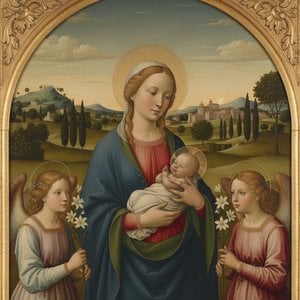
The Quiet Hand of the Late Renaissance
In the narrow streets of Castelfranco Veneto, the beginnings of a painter's life were shaped by the light and shadows of the late-Renaissance period. Born in 1592, Pietro Damini moved through the artistic circles of Venice, finding his way under the guidance of Giovanni Battista Novelli. His brushwork was not one of sudden, loud gestures, but of a steady, practiced hand that sought to translate the weight of devotion into color and form. He spent his years working through the complexities of religious imagery, focusing on the quiet gravity of the sacred.
His presence in the art of the era is felt most strongly in the churches of Padua. There, his work took on a physical permanence, intended to sit within the stone walls of sacred spaces. He did not paint for the fleeting gaze of a passerby, but for the steady, prayerful eyes of those entering the Basilica of St Anthony or the sanctuary of San Clemente. His work carries the stillness of a man who understood that a painting is a vessel for a specific, heavy kind of grace.
Works and Devotional Subjects
The subjects Damini chose were central to the spiritual life of his time. He focused on the weight of the divine, often depicting the intersection of the earthly and the celestial through specific, recognizable scenes. His hands were busy with the textures of cloth, the pale skin of saints, and the dramatic tension of the cross.
- The scene of Christ giving keys to Peter, created for San Clemente in Padua.
- A Crucifixion intended for the Basilica of St Anthony in Padua.
- An image of Saint Prosdocimus.
A Legacy in Padua
By the time of his death in 1631, Damini had left behind a body of work that anchored the religious landscape of his region. His life was tied to the movement of art from the training grounds of his teacher to the altars of Padua. He remained a painter of the late-Renaissance, a man whose contribution was measured in the quiet endurance of his canvases. His paintings, such as those held in the National Gallery of Art, Washington, D.C., remain as physical traces of a life spent observing the sacred through the lens of oil and pigment.
Spørsmål og svar
Hvor kan jeg finne statistikk om verkene til Pietro Damini?
Det finnes en Besøksstatistikk-side for Pietro Damini, som viser statistikk over kunstnerens verk på denne nettsiden.
Kan jeg bla gjennom verkene til Pietro Damini etter kunstretning?
Siden Alle kunstretninger grupperer Pietro Damini sine kunstverk etter kunstretning.
Kan jeg bla gjennom Pietro Damini sine verk etter fargepalett?
Siden Etter fargepalett grupperer Pietro Damini sine kunstverk etter fargepalett.
Hvor finner jeg Pietro Damini sine kunstverk gruppert etter teknikk?
Pietro Damini sine verk kan utforskes etter medium på Pietro Damini sin Alle medier-side.