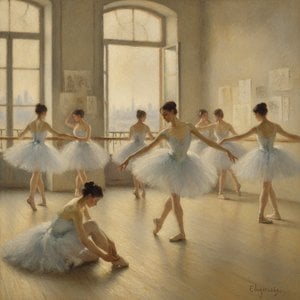
A Life Shaped by the Great Capitals
Born in Berlin in 1821, Philipp Arons began his path through the halls of the Royal Prussian Academy of Arts. Between 1840 and 1844, he sat before the easel under the guidance of Eduard Dage, absorbing the disciplined techniques of his era. Yet, the pull of broader horizons eventually led him away from his German roots toward the light of France. In Paris, he sought the wisdom of Léon Cogniet and François-Gabriel Lepole, refining a hand that could capture both the dignity of a sitter and the quietude of a scene.
His travels were not merely for study but for living. A period spent in Rome from 1844 to 1848 allowed him to breathe the air of antiquity, an experience that surely informed his later compositions. By 1852, he found himself drawn back to the streets of Paris before the currents of his life pulled him toward the professional demands of Berlin. He moved through these great centers of culture, a man of likely Jewish origin, building a reputation as a painter who could navigate both the grandiosity of portraiture and the humble details of daily existence.
The Art of the Portrait and the Genre
In Berlin, Arons found his footing as a sought-after portraitist. He possessed a particular talent for documenting the nobility, most notably through his work for the Tyszkiewicz family. His brush captured the likeness of figures such as Countess Maria Tyszkiewicz in 1875, preserving their presence with an eye for character. These commissions required a steady hand and a deep understanding of social grace.
Beyond the formal settings of the aristocracy, his interests wandered into the realm of genre painting. He found beauty in the mundane and the industrious, turning his attention to scenes such as Mending a fishing net or the rhythmic movement of Coachman with two horses. These works reveal an artist interested in the textures of life—the coarse weave of a net or the muscular tension of a beast at work. He often worked with oil on linen, a medium that allowed him to layer his observations with depth and weight.
The Quiet Years in Rinteln
As the decades passed, the bustling energy of Berlin and Paris began to fade from his daily life. In 1891, Arons moved to the smaller town of Rinteln on the Weser. This final chapter of his life was far removed from the academic rigor of his youth, yet it was here that he remained a painter until his death in 1902. His legacy remains found in the quiet corners of collections, where his portraits and genre scenes continue to tell stories of a man who moved between the high courts of Europe and the simple, honest labors of the common folk.
Spørsmål og svar
Kan jeg bla gjennom verkene til Philipp Arons etter kunstretning?
Bla gjennom Philipp Arons sine verk etter kunstretning på Philipp Arons sin Alle kunstretninger-side.
Kan jeg sortere Philipp Arons sine kunstverk etter farge?
På Sorter etter farge-siden er Philipp Arons sine kunstverk organisert etter farge.
Hvilke farger brukte Philipp Arons oftest?
Fargeprofilen til Philipp Arons sine verk vises på kunstnerens Fargepalettens sjel-side.
Hva er fødestedet og fødselsåret til Philipp Arons?
Philipp Arons ble født i Berlin i 1821.