A Brief Life Illuminated: The World of Paulus Potter
Paulus Potter, a name inextricably linked to the heart of the Dutch Golden Age, lived a life tragically short yet profoundly impactful on the world of art. Born in Enkhuizen on November 20, 1625, and baptized that very same day, his artistic journey began within a family already steeped in creative tradition. His father, Pieter Symonsz Potter, was a highly respected painter specializing in the intricate craft of gilded leather hangings and charming genre scenes – capturing everyday life with remarkable detail and warmth. His mother, Aaltje Paulusdr Bartsius, held familial ties to Willem Bartsius, another esteemed artist whose legacy continued through his family. This rich artistic heritage undoubtedly provided young Paulus with an invaluable foundation upon which to build his own distinctive style. The family’s relocation first to Leiden in 1628, and then to the bustling metropolis of Amsterdam in 1631, proved pivotal, offering him access to a wider world of artistic influence and opportunity – a vibrant hub where talent flourished and new ideas were constantly being exchanged. It was in Amsterdam that he began his formal training under his father’s guidance, though some scholars suggest potential influences from the masterful Claes Moeyaert, whose atmospheric landscapes would subtly shape Potter's early development.From Delft Guilds to Hague Landscapes
Potter’s ambition quickly propelled him towards recognition within the established artistic circles of the Dutch Republic. He joined the prestigious Guild of Saint Luke in Delft, a significant step for any aspiring artist seeking legitimacy and professional standing. However, it was his move to The Hague around 1649 that truly marked a turning point in his career and personal life. Establishing himself near the renowned landscape painter Jan van Goyen proved incredibly influential; Van Goyen’s mastery of atmospheric effects – the way light danced across surfaces, creating an illusion of depth and distance – would subtly permeate Potter's own style. This period also witnessed a significant shift in his personal circumstances. In July 1650, he married Adriana van Balckeneynde, a union that opened doors to influential circles thanks to her father’s position as a prominent building contractor. Through this connection, Potter found himself introduced to members of Dutch high society, including the esteemed Amalia of Solms-Braunfels, who would become a patron of his work and appreciate his artistic vision. A brief return to Amsterdam in May 1652, at the invitation of physician and art enthusiast Nicolaes Tulp – who commissioned a portrait of his son Dirck – offered further recognition and solidified his position within the artistic community. Sadly, this period of burgeoning success was tragically cut short by illness; Paulus Potter succumbed to tuberculosis on January 17, 1654, at the young age of twenty-eight, leaving behind a legacy of breathtaking landscapes and captivating animal paintings.The Pastoral Vision: Style and Major Works
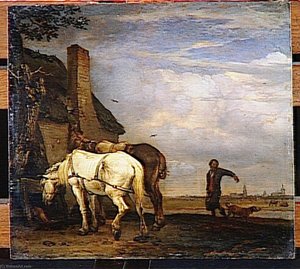
Paulus Potter carved a unique niche for himself within the vibrant landscape of Dutch Golden Age painting – he became celebrated for his captivating depictions of animals – particularly cattle – seamlessly integrated into expansive, meticulously rendered landscapes. His compositions are often characterized by a strikingly low horizon line, an artistic choice that dramatically emphasizes the scale and grandeur of nature, dwarfing even the majestic beasts he portrayed. *The Young Bull*, created around 1647, remains his most iconic work, now housed in the Mauritshuis in The Hague. Initially met with some critical reservation – a small group of critics questioned the painting’s composition – it later gained widespread acclaim as a pioneering example of Romanticism’s nascent sensibility – a profound emotional connection to the natural world. Beyond this masterpiece, Potter produced other notable paintings such as *Figures with Horses by a Stable* (1647), *Punishment of a Hunter* (circa 1647), *Two Pigs in a Sty* (1649), and *Wolf-hound* (approximately 1650–1652). He also demonstrated his versatility through numerous etchings, often focusing on the detailed portrayal of cattle and other animals. Potter’s work is characterized by an incredible attention to detail, capturing the texture of fur, the musculature of animals, and the subtle nuances of light and shadow with remarkable precision.Influences and Artistic Development
Potter's artistic development was shaped by a confluence of influences. His father, Pieter Symonsz Potter, provided him with an early foundation in painting techniques and a love for depicting everyday life. However, his move to The Hague and his proximity to Jan van Goyen proved particularly formative. Van Goyen’s mastery of atmospheric effects – the way light danced across surfaces, creating an illusion of depth and distance – would subtly permeate Potter's own style. Furthermore, the influence of Claes Moeyaert, a Flemish painter known for his atmospheric landscapes, is often noted in Potter’s early works. Potter’s artistic journey can be seen as a progression from realistic genre scenes to increasingly dramatic landscape compositions featuring animals. He skillfully blended these influences into a distinctly personal style characterized by its emotional intensity and profound connection to the natural world.Legacy and Lasting Influence
Though his life was tragically brief, Paulus Potter's artistic legacy endures. His work stands as a testament to his exceptional talent and unique vision. The influence of Jan van Goyen is readily apparent in Potter’s landscapes, particularly in the subtle atmospheric effects and commitment to realistic representation. However, Potter transcended mere imitation; he infused his scenes with an emotional depth that resonated deeply with viewers then, and continues to do so today. He is now recognized as a precursor to the Romantic movement – anticipating its emphasis on the sublime power of nature and the emotional response it evokes. Despite producing approximately 100 paintings during his short career, his impact was considerable. His work enjoyed renewed appreciation in the 19th century for its naturalism and profound emotional resonance. Even today, Potter is honored with a statue in his birthplace of Enkhuizen – depicting him sketching a goat – a fitting tribute to an artist who dedicated his life to capturing the beauty and majesty of the natural world.Key Artistic Characteristics
- Low Horizon Lines: Potter consistently employed low horizon lines in his compositions, creating a sense of vastness and emphasizing the scale of the landscape.
- Realistic Animal Depiction: He was renowned for his meticulous attention to detail when rendering animals, capturing their anatomy and behavior with remarkable accuracy.
- Atmospheric Effects: His landscapes frequently feature subtle atmospheric effects – light, shadow, and mist – that contribute significantly to the overall mood and realism of each scene.
- Subtle Color Palette: Potter typically favored a muted color palette dominated by earth tones, reflecting the natural hues of the Dutch countryside. This restrained approach further enhances the sense of authenticity and harmony within his paintings.