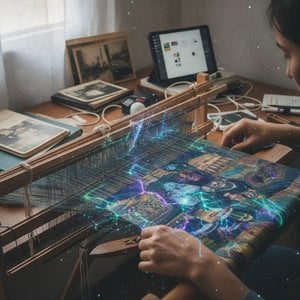
Maud Fredin-Fredholm: A Pioneer of Scandinavian Textile and Ceramic Art
Maud Fredin-Fredholm (1919–2013) stands as a cornerstone figure in mid-century Scandinavian design, celebrated primarily for her transformative contributions to textile artistry and collaborative ventures with ceramic manufacturers. Born in Gothenburg, Sweden, she possessed an innate artistic spirit that blossomed into a prolific career marked by innovation and a deep connection to Swedish folk traditions. Her legacy resides not merely in aesthetically pleasing patterns but also in establishing a distinctive visual language that continues to inspire designers today.Early Life and Artistic Beginnings
Details about Maud Fredin-Fredholm’s early life remain somewhat elusive, yet anecdotal evidence suggests she cultivated her passion for design from a young age—a dedication that would ultimately propel her toward remarkable achievements. Her formative years instilled within her a profound appreciation for craftsmanship and artistic exploration. Like many artists of her era, Fredin-Fredholm absorbed the principles of Bauhaus, recognizing its emphasis on functionality combined with artistic expression. This foundational understanding profoundly shaped her aesthetic sensibilities and fueled her desire to translate cultural heritage into contemporary visual forms.Textile Designs: Knäckebröd and Snurran – Icons of Scandinavian Style
Fredin-Fredholm’s fame rests principally upon her iconic textile designs, particularly the ‘Knäckebröd’ (Crispbread) and ‘Snurran’ (Spinner) motifs. These patterns—characterized by bold geometric forms and vibrant hues—became synonymous with Scandinavian aesthetic sensibilities during the 1950s and 60s. The ‘Knäckebröd,’ resembling the traditional Swedish crispbread, embodies a playful juxtaposition of organic shapes against a striking chromatic backdrop – a deliberate contrast to the prevailing minimalist trends of the time. Similarly, the ‘Snurran,’ referencing the spinning wheel used in Swed ish rural life—a symbol of industriousness and heritage—captures the essence of tradition while maintaining a modern sensibility. Her collaboration with Rörstrand and Bobergs Fajansfabrik ensured that these designs weren’t confined to fabric; they flourished on ceramic surfaces, amplifying their visual impact and cementing Fredin-Fredholm's position as a pivotal figure in shaping Scandinavian design history. The resulting ceramics showcased her masterful ability to distill complex cultural references into elegant geometric compositions.Collaboration and Ceramic Innovation
Recognizing the potential to extend her artistic vision beyond woven fabrics, Maud Fredin-Fredholm demonstrated remarkable versatility by forging fruitful partnerships with ceramic manufacturers like Rörstrand and Bobergs Fajansfabrik. She skillfully adapted her distinctive motifs—particularly those derived from Swedish folk art—to ceramic creations. This endeavor resulted in a captivating fusion of tradition and innovation, where bold colors and geometric forms breathed new life into familiar shapes. Her ceramics achieved considerable acclaim for their aesthetic merit and contributed significantly to the broader evolution of Scandinavian ceramic design. The collaboration fostered experimentation and pushed boundaries within the field, establishing Fredin-Fredholm as an influential figure who championed artistic dialogue across disciplines.Legacy and Historical Significance
Maud Fredin-Fredholm’s influence extends far beyond her immediate artistic output. She served as an inspiration to subsequent generations of designers, demonstrating how cultural heritage could be reimagined within a contemporary framework. Her enduring appeal lies in her ability to capture the spirit of Swedish folk art—a celebration of natural forms and vibrant colors—while simultaneously upholding principles of minimalist elegance. Today, Fredin-Fredholm’s textile designs continue to adorn homes across Scandinavia and internationally, testifying to their timeless beauty and enduring relevance. She remains a celebrated figure within the annals of Scandinavian design history, embodying creativity, collaboration, and an unwavering commitment to artistic excellence – a testament to her pioneering spirit and lasting contribution to the visual culture of her time.Spørsmål og svar
Hvor finner jeg Maud Barbro Fredin Fredholm sine kunstverk gruppert etter kunstretning?
Se kunstretningene Maud Barbro Fredin Fredholm arbeidet innen på kunstnerens Alle kunstretninger-side, hvor verkene er gruppert etter stilretning.
Kan jeg utforske verkene til Maud Barbro Fredin Fredholm etter nøkkelord?
For å finne verk av Maud Barbro Fredin Fredholm innen et spesifikt tema, kan du bruke kunstnerens Søk etter nøkkelord-side, som grupperer kunstverkene etter nøkkelord.
Finnes det en tidslinje over verkene til Maud Barbro Fredin Fredholm?
Maud Barbro Fredin Fredholm sine kunstverk kan ses i kronologisk rekkefølge på kunstnerens Kronologisk oversikt over kunstverk-side.