A Visionary of the Victorian Line: The Life and Legacy of Harry John Johnson
In the heart of the industrial revolution, amidst the soot and soaring ambition of Birmingham, lived a man whose pen captured the very soul of British architectural grandeur. Harry John Johnson (1826–1884) was not merely a draftsman; he was a chronicler of an era defined by its unyielding pursuit of precision and monumental scale. Born in 1826, Johnson emerged from the rigorous academic environment of the King Edward VI Grammar School, where he first mastered the mathematical foundations that would later allow him to translate complex structural engineering into delicate, breathtaking art. His intellectual journey took a unique turn at Harris Manchester College, Oxford, where his studies in theology provided a contemplative depth to his observational skills, fostering a reverence for the permanence and dignity of the structures he so meticulously documented.
Johnson’s artistry flourished within the specialized realm of architectural draughtsmanship, a discipline that demanded both technical perfection and an aesthetic eye for proportion. Serving the Birmingham Philosophical Society, he became a vital link between the conceptual blueprints of architects and the visual realization of their dreams. His work was characterized by an extraordinary command of pen and ink, a medium that allowed him to navigate the intricate shadows and sharp edges of Victorian masonry with unparalleled clarity. Through his hands, the heavy stone and iron of the nineteenth century were transformed into elegant compositions of light and line, capturing the rhythmic beauty of classical facades and the structural ingenuity of new engineering marvels.
Masterpieces of Precision and Architectural Detail
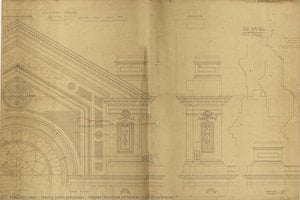
The true brilliance of Johnson’s oeuvre lies in his ability to freeze a moment of architectural triumph in time. His drawings serve as historical windows, offering us a glimpse into the splendor of structures that defined the Victorian landscape. One cannot discuss his contributions without reflecting on his celebrated works from 1874, a period where his technical mastery reached its zenith. His elevations of the South Facade Architectural Details and the South Elevation of the Refreshment Wing at Alexandra Palace stand as testament to his ability to render the monumental with an intimate touch. In these pieces, every cornice, column, and ornamental flourish is rendered with such fidelity that one can almost feel the weight of the stone and the grandeur of the palace's design.
Beyond the grand palaces, Johnson possessed a remarkable talent for capturing the delicate intersection of nature and engineering. His Elevations of Front of Conservatory showcases his ability to document the intricate glasswork and iron frameworks that were becoming hallmarks of Victorian leisure architecture. This work highlights a significant aspect of his development: the transition from purely structural documentation to an art form that celebrates the aesthetic harmony of the built environment. His legacy is defined by these specific achievements:
- Technical Mastery: The use of fine pen and ink to achieve high-contrast shadows and intricate textures in classical masonry.
- Historical Documentation: Providing irreplaceable visual records of iconic British landmarks like Alexandra Palace during their period of greatest significance.
- Architectural Sensitivity: A unique ability to balance the rigid requirements of engineering accuracy with the fluid beauty of artistic composition.
Ultimately, Harry John Johnson remains a vital figure for those who appreciate the intersection of art and industry. While his name may not occupy the same spotlight as the great landscape painters of his age, his contribution to the visual history of Britain is profound. He captured the structural heartbeat of a nation in transition, leaving behind a collection of works that continue to inspire awe through their meticulous detail and their enduring celebration of Victorian architectural elegance.