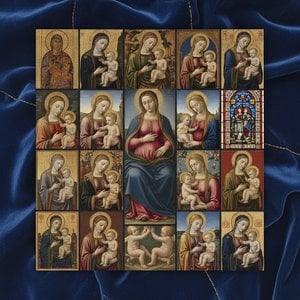
The Ethereal Legacy of Angelo Puccinelli
In the twilight of the fourteenth century, amidst the burgeoning artistic renaissance of Tuscany, there emerged a painter whose work would serve as a bridge between medieval devotion and the dawn of humanism. Angelo Puccinelli, a figure often shrouded in the soft mists of history, remains one of the most captivating, albeit enigmatic, voices of his era. Hailing from the storied city of Lucca, Puccinelli’s life was deeply intertwined with the spiritual and aesthetic currents of Italy. While precise biographical details remain elusive, archival traces place him in Siena around 1380, a pivotal moment when the artistic traditions of the past were beginning to harmonize with a new, more naturalistic vision of the world.
The artistry of Puccinelli was not born in isolation but was instead a profound dialogue with the masters of his time. His presence in Siena allowed him to absorb the pioneering spirit of Lippo Memmi, whose explorations into perspective and delicate naturalism provided a foundation for Puccinelli’s own development. Furthermore, traces of the powerful influence of Spinello Aretino can be seen in his more structured compositions. This synthesis of Sienese grace and Florentine-inspired realism allowed him to create works that were simultaneously grounded in physical reality and elevated by divine mystery.
A Mastery of Light and Devotion
To behold a Puccinelli painting is to enter a space of quiet, luminous contemplation. He was a master of the tempera on panel technique, utilizing meticulous layering to achieve an ethereal glow that seems to emanate from within the wood itself. His palette, characterized by subtle gradations and soft, luminous tones, was perfectly suited for his most celebrated subject matter: the Virgin and Child. In these depictions, the Madonna is not merely a figure of historical piety but a vessel of divine grace, her features softened by a light that feels both celestial and intimately human.
His technical prowess extended beyond mere color application; he possessed an uncanny ability to imbue sacred figures with a palpable sense of presence. Whether through the delicate rendering of a saint's drapery or the tender interaction between mother and infant, Puccinelli’s work captures the profound emotional weight of religious narrative. His compositions often feature a serene stillness, inviting the viewer into a state of meditative prayer, where the boundaries between the earthly and the divine begin to blur.
Enduring Significance in the Italian Canon
Though his name may not carry the same immediate recognition as the giants of the High Renaissance, the historical significance of Angelo Puccinelli is undeniable. He represents a crucial evolutionary step in the transition from the stylized iconography of the Middle Ages to the more human-centric art of the later centuries. His ability to weave together the disparate threads of Sienese elegance and Florentine naturalism helped pave the way for the stylistic revolutions that would soon transform the Italian peninsula.
Today, his surviving works—scattered across prestigious collections such as the Pinacoteca Nazionale di Siena, the Getty Museum, and the Musée du Petit Palais—stand as silent witnesses to a period of immense cultural transformation. His legacy is preserved in:
- The Marriage of St. Catherine: A rare signed work that showcases his ability to handle complex narrative structures.
- Madonna and Bambino (1393): A poignant example of his tender approach to the maternal bond, currently housed in Lucca.
- The Transit of the Virgin (1386): A masterpiece of spiritual movement and light, found in the church of Santa Maria Forisportam.
Through these works, Puccinelli continues to offer a window into the soul of the fourteenth century, reminding us that even in the shadows of history, there are artists whose light refuses to fade.