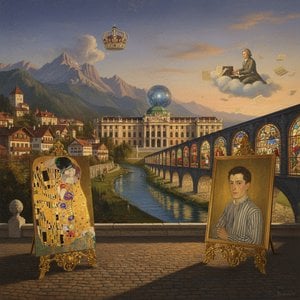
Alexander Clarot: A Viennese Romantic Portraitist
Alexander Clarot (1796 – 1842) stands as a pivotal figure in the landscape of Austrian art during the first half of the nineteenth century. Born in Vienna, Austria, he embarked on an artistic journey that would solidify his reputation as a masterful miniaturist and portrait painter—a testament to the enduring allure of Romanticism’s meticulous observation and emotive expression. His formative years were spent honing his skills at the Vienna Academy of Fine Arts, where he absorbed the stylistic conventions of his time and established himself as a respected member by 1829.- Early Influences: Clarot's artistic sensibilities were profoundly shaped by the prevailing Romantic movement, which championed emotion, imagination, and an idealized depiction of nature. Artists like Eugène Delacroix and Caspar David Friedrich served as significant inspirations, encouraging him to prioritize expressive color palettes and dramatic compositions.
- Technique & Style: Clarot’s distinctive style was characterized by painstaking detail—a hallmark of Viennese miniature painting—combined with a Romantic sensibility. He meticulously rendered textures and nuances in his portraits, capturing subtle expressions and conveying psychological depth. His brushstrokes were deliberate and controlled, prioritizing accuracy alongside artistic vision.
- Notable Works: Clarot’s oeuvre comprises numerous captivating pieces that exemplify the Romantic spirit. Among his most celebrated works are “Karl Artaria, Viennese Art Dealer” (1835), a portrait of a prominent art dealer reflecting Vienna's cultural vibrancy; "A portrait of a woman in a bonnet with a pink ribbon" (1837), showcasing exquisite craftsmanship and capturing the gracefulness of Victorian femininity; and “Self-portrait” (1825), offering an intimate glimpse into Clarot’s artistic identity.
Vienna Academy & Artistic Recognition
His enrollment at the Vienna Academy of Fine Arts proved instrumental in furthering his artistic development and securing recognition within the Viennese art community. The academy fostered a competitive environment that encouraged experimentation and refinement, allowing Clarot to hone his technique and broaden his stylistic horizons. Furthermore, membership signaled acceptance into the established artistic hierarchy—a crucial step toward establishing himself as a respected artist of his era.Legacy & Historical Significance
Alexander Clarot’s contribution to Austrian art extends beyond his individual masterpieces; he embodies the spirit of Romantic Vienna – a period marked by intellectual ferment and artistic innovation. His meticulous portraits not only documented the faces of prominent figures but also served as conduits for conveying psychological complexity and capturing the essence of Victorian ideals. Today, Clarot's works continue to resonate with audiences worldwide, representing an enduring legacy of Romantic artistry and demonstrating the power of observation combined with emotional resonance.Resources
- Further Research:ULAN Full Record Display (Getty Research)
Spørsmål og svar
Hvordan er Alexander Clarot sin karriere delt inn i perioder?
En kronologisk oversikt over Alexander Clarot sitt arbeid er tilgjengelig på kunstnerens Karriereløp-side, hvor verkene presenteres i rekkefølge etter når de ble skapt, kapittel for kapittel.
Finnes det en virtuell 3D-omvisning av Alexander Clarot sine verk?
Et virtuelt besøk er mulig: Virtuelt 3D-galleri-siden til Alexander Clarot presenterer kunstnerens verk i et tredimensjonalt galleri.
Kan jeg bla gjennom Alexander Clarot sine verk etter fargepalett?
Siden Etter fargepalett grupperer Alexander Clarot sine kunstverk etter fargepalett.