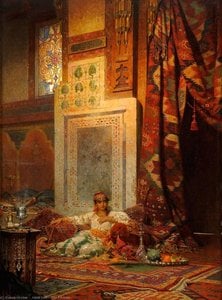
Adolf Seel (1829 - 1907): Master of Moorish Landscapes
Adolf Seel (1 March 1829–14 February 1907) was a German painter. He trained at the Düsseldorf Academy of Arts and is associated with the Düsseldorf school of painting. His artistic vision centered on capturing the grandeur and intricate beauty of architectural landscapes, particularly those imbued with Moorish and Arab influences—a fascination that would define his oeuvre and solidify his place within the broader context of Orientalist art.- Early Life & Training: Born in Wiesbaden, Seel’s formative years were spent honing his artistic skills at Düsseldorf Academy of Arts under Wilhelm Sohn (1830-1899). Sohn instilled in him a meticulous approach to observation and representation, emphasizing realism alongside expressive color. This foundational training proved crucial for developing Seel's distinctive style.
- Parisian Influences & Italian Exploration: Recognizing the importance of broadening his artistic horizons, Seel embarked on a journey to Paris in 1851, immersing himself in the vibrant intellectual and artistic atmosphere of the Belle Époque. Exposure to Impressionist techniques subtly shaped his palette and compositional sensibilities. Subsequently, he traveled extensively throughout Italy (1864-1865), absorbing the stylistic nuances of Venetian painting and studying classical sculpture—elements that would inform his later works.
- Orientalist Vision: Seel’s true passion lay in depicting the exotic landscapes of the Orient, specifically Egypt and Palestine. Unlike many contemporaries who focused on portraits or genre scenes, he dedicated himself to meticulously rendering architectural structures – mosques, palaces, caravanserais – alongside expansive vistas. This approach wasn't merely decorative; it served as a vehicle for conveying profound emotional resonance and capturing the spirit of Islamic culture.
- Technique & Style: Seel’s mastery lay in his ability to fuse meticulous detail with atmospheric perspective. He employed glazing techniques—applying thin layers of translucent paint over underlying colors—to achieve luminous effects that conveyed depth and realism. His landscapes weren't simply scenic representations; they were carefully constructed narratives designed to evoke a sense of wonder and contemplation.
- Notable Achievements & Legacy: Seel’s artistic reputation soared throughout his lifetime, culminating in prestigious awards from Vienna (1876) and Berlin (1878). His paintings—particularly those depicting Alhambra palaces and Cairo mosques—remain celebrated for their breathtaking beauty and technical virtuosity. Today, Seel's work continues to inspire admiration for its evocative portrayal of the Orient and its contribution to the Düsseldorf school’s legacy as a bastion of Romantic idealism.
Key Works
- Inside of a Byzantine church (1862): Demonstrates Seel's early exploration of architectural grandeur, capturing the solemn beauty of religious spaces with masterful lighting and color.
- Motive from San Marco in Venice: Reflects his Impressionist influences, showcasing vibrant hues and dynamic brushstrokes within a celebrated Venetian landmark.
- The cloister of the cathedral to half in the winter (Main Picture): Considered Seel’s magnum opus, this monumental canvas exemplifies his signature style—a panoramic vista infused with atmospheric perspective and luminous color—establishing him as one of Düsseldorf's foremost landscape painters.
Influence & Artistic Context
Seel’s work stands firmly within the Düsseldorf school of painting, a movement characterized by its commitment to realism and emotional intensity. He absorbed the stylistic precepts of Romanticism while simultaneously embracing innovations from Impressionism and Japonisme—influences that broadened his artistic vocabulary and enriched his visual language. His dedication to architectural landscapes—particularly Moorish buildings—established him as a pioneer in Orientalist painting, anticipating later developments in genre and contributing significantly to the aesthetic sensibilities of his era.Spørsmål og svar
I hvilken historisk periode arbeidet Adolf Seel?
Adolf Seel var virksom i perioden 19th Century. Denne perioden plasserer kunstnerens virke i en historisk kontekst.
Hvordan finner jeg alle verk av Adolf Seel innenfor et bestemt medium?
Siden Alle medier grupperer Adolf Seel sine kunstverk etter teknikk.
Hvilke farger brukte Adolf Seel oftest?
Fargeprofilen til Adolf Seel sine verk vises på kunstnerens Fargepalettens sjel-side.
Hvor finner man Adolf Seel sine kunstverk kategorisert etter motiv?
Utforsk Adolf Seel sine verk etter motiv på kunstnerens Motivatlas-side.