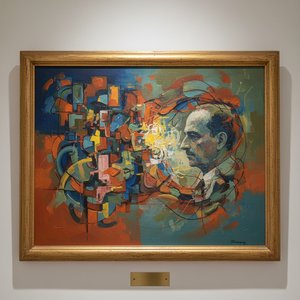
A Life Immersed in Light: The Evocative World of Rafael Estrany
Rafael Estrany, born in Barcelona in 1884 and passing away in 1958, was a Spanish artist whose work embodies a captivating blend of Impressionistic sensibilities and a deeply personal connection to the Mediterranean landscape. While not as widely celebrated internationally as some of his contemporaries, Estrany carved out a significant niche for himself within the Spanish art scene, particularly known for his vibrant paintings and sculptures that capture the warmth, light, and everyday life of Catalonia. His artistic journey was one of dedicated study, exploration, and a consistent pursuit of expressing emotional resonance through color and form. He initially honed his skills at the School of Arts and Crafts in Mataró, followed by studies at the Baixas Academy in Barcelona – foundational experiences that instilled within him a strong technical base. A pivotal moment came with his time at the Julien Academy in Paris, where he encountered new artistic currents and broadened his perspective. This exposure to the Parisian avant-garde, coupled with a meeting with James Ensor in Belgium, subtly influenced his developing style, though Estrany remained firmly rooted in his own unique vision.Early Influences and Artistic Development
Estrany’s early work demonstrates a clear fascination with capturing fleeting moments of light and atmosphere – hallmarks of the Impressionist movement. However, he wasn't simply replicating what he saw; rather, he was using these techniques to convey a deeper emotional response to his surroundings. His palette began to bloom with rich, warm tones, reflecting the sun-drenched coasts and bustling cityscapes of Catalonia. He exhibited remarkable versatility early on, working comfortably in both painting and sculpture. This dual focus allowed him to explore different dimensions of form and texture, enriching his overall artistic expression. The influence of Post-Impressionism is also discernible in his work, particularly in the way he employed bold brushstrokes and a heightened sense of color saturation. He wasn’t interested in photographic realism; instead, he sought to distill the essence of a scene, capturing its emotional core through expressive mark-making. His early exhibitions – over sixty solo shows throughout his career – were met with considerable acclaim, establishing him as a rising talent within the Spanish art world.Themes and Techniques: A Celebration of Catalan Life
Estrany’s subject matter often revolved around scenes of everyday life in Catalonia. He depicted lively coastal towns teeming with activity, families enjoying moments together, and intimate portraits that reveal the character and spirit of his subjects. Children frequently appear in his paintings, embodying innocence, joy, and a sense of carefree abandon. His landscapes are not merely representations of places; they are imbued with a palpable atmosphere – the warmth of the sun on skin, the scent of salt air, the sounds of laughter echoing through narrow streets. Technically, Estrany was known for his masterful use of impasto, applying thick layers of paint to create textured surfaces that capture the play of light and shadow. This technique adds a tactile quality to his work, inviting viewers to engage with the paintings on a visceral level. His sculptures, while less numerous than his paintings, share a similar emphasis on form, texture, and emotional expression. He often worked in bronze, creating figures that are both dynamic and deeply human.Recognition and Legacy
Throughout his career, Rafael Estrany received numerous accolades for his artistic achievements, winning prizes at national and international exhibitions. He served as the director of the School of Arts and Crafts in Mataró, dedicating himself to nurturing the next generation of artists. While he participated in group exhibitions across Spain, Mexico, Panama, and Rome, his work remained largely focused on capturing the essence of Catalan life. Today, Estrany’s paintings and sculptures are held in various public and private collections throughout Spain, offering a glimpse into a vibrant artistic world that celebrated beauty, emotion, and the simple joys of everyday existence. His legacy lies not in groundbreaking innovation but in his consistent dedication to expressing his unique vision with skill, passion, and a profound love for his homeland. He stands as a testament to the power of art to capture the spirit of a place and the enduring human experience.Exploring Estrany’s Work Today
- Discover his evocative coastal scenes brimming with warmth and light.
- Appreciate the textured impasto and playful brushwork that define his style.
- Explore his sculptures, which share a similar emphasis on form and emotional depth.
- Consider how his work reflects the cultural landscape of Catalonia in the early 20th century.