


Kunstverket som vises på denne siden er beskyttet av opphavsretten, noe som betyr at vi ikke har juridisk tillatelse til å lage eller selge identiske reproduksjoner. Denne beskyttelsen håndheves i henhold til internasjonale avtaler som for eksempel Bernerkonvensjonen og av nasjonale lover, inkludert de som er fastsatt i Amerikansk lov om opphavsrett – Tittel 17.
Denne metoden er i fullt samsvar med opphavsrettslige regler, da den ikke innebærer kopiering eller duplisering av det beskyttede kunstverket. I stedet er det snakk om en kreativ nytolkning – et nytt maleri som er inspirert av originalen, men ikke identisk med den.
Giclée- eller lerretsprint av museumskvalitet med rask produksjon og fleksible valgmuligheter for etterbehandling. ( Kjøp håndmalt maleri Bytt til digitalt bilde)
Velg mellom våre forhåndsdefinerte størrelser som bevarer kunstverkets opprinnelige proporsjoner.

Skriv inn ønsket bredde og høyde for å tilpasse trykket til din ramme eller vegg. Et trykk kan kun beskjæres, aldri skaleres opp utover motivets opprinnelige størrelse, noe som betyr at et format med andre proporsjoner vil føre til tap av deler av bildet. Vi sender deg en digital mockup for godkjenning før vi starter trykkeprosessen. Bildet som vises på denne siden viser ikke den faktiske beskjæringen — det er kun mockuppen som viser dette.
Verdensomspennende levering () på 2 uker i stedet for standard 4/5 uker. (17 November)
Work
Størrelse på reproduksjon
In the realm of mid-century abstraction, few voices resonate with as much structural purity and rhythmic vitality as that of Yoo Youngkuk. His 1968 masterpiece, Work, serves as a profound testament to his lifelong pursuit of distilling the natural world into its most fundamental geometric essences. At first glance, the viewer is met with a striking, crimson-hued triangle, a central void that commands the eye and anchors the composition. Yet, upon closer inspection, this is not merely a static shape; it is an intricate mosaic of smaller, interlocking triangles that create a mesmerizing sense of texture and movement. The painting breathes with a life of its own, as if the very fabric of the canvas is composed of light and energy captured in a moment of perfect equilibrium.
The technique employed in this piece reflects Yoo’s mastery over color and form, utilizing a layered approach that builds an incredible sense of depth. The vibrant red background does not simply sit behind the central figure; it interacts with the surrounding smaller triangles to create a pulsating, multidimensional space. This layering suggests a portal—a gateway into another dimension where geometry replaces gravity. For the discerning collector or interior designer, this work offers more than just visual interest; it provides a focal point of intense intellectual and emotional depth. The way the light seems to dance across the fractured surfaces of the red planes invites the viewer to linger, lost in the rhythmic repetition of shape that mimics the organic complexity found in mountain ranges and geological formations.
Historically, this work emerges from a period when Yoo Youngkuk was refining his unique visual language, bridging the gap between the rugged landscapes of his South Korean heritage and the rigorous demands of international abstraction. While his motifs often drew inspiration from the majestic mountains of Uljin, Work transcends mere representation. It is an exploration of the sublime—the feeling of standing before something vast, structured, yet infinitely mysterious. The central hole in the triangle acts as a symbolic eye, a vacuum that pulls the observer into the heart of the painting, evoking feelings of both introspection and wonder.
Integrating such a powerful piece into a contemporary space requires an appreciation for its bold, architectural presence. Whether placed in a minimalist gallery setting or used to add a sophisticated burst of color to a modern living space, this reproduction captures the soul of Korean abstractionism. It is a piece designed for those who seek art that challenges the intellect while soothing the spirit through its perfect, mathematical harmony. To own a piece of Yoo Youngkuk’s legacy is to invite a sense of structured peace and avant-garde elegance into one's environment, turning any room into a sanctuary of modern thought.
Håndmalte kopier av "Work" av Yoo Youngkuk kan kjøpes på denne nettsiden: en håndmalt oljereproduksjon på linlerret, via siden for Håndmalt oljereproduksjon.
Alt i alt er "Work" registrert som balanced. Oppfattet lysstyrke beskriver hvor lyst eller mørkt verket fremstår.
Yoo Youngkuk er også kjent under navnene Liu Yongguo.


1916 - 2002 , Korea

Step into the haunting dreamscapes of Giorgio de Chirico. Explore 25 iconic Metaphysical paintings, from eerie shadows to surrealist enigmas. Find museum-quality art reproductions and timeless decor inspiration. Discover all masterpieces on WahooArt.com.
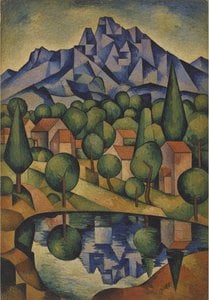
Explore the profound legacy of Paul Cézanne. Discover how his mastery of geometric forms and vibrant color bridged Impressionism and Cubism, offering timeless inspiration for fine art collectors and enthusiasts seeking to understand the foundations of modern art.
Explore the profound influence of geometry and line in fine art. Discover how structural composition creates visual impact, from Cubist mastery to Op Art precision, and learn to curate sophisticated, mathematically balanced collections for discerning art connoisseurs.
 Forhåndsvisning
 Send
Send Del
Del
 Vis detaljer
 Utskriftsvennlig guide

 Last ned bilde
 Liknende objekter
 Røntgenundersøkelse
 Lysbildefremvisning
 Spørsmål og svar
 Statistikk

 Vis hele teksten






































 Glassalternativet er kun tilgjengelig i størrelser under 110 cm


