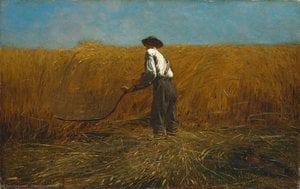
A Brush with the American Spirit: The Life and Art of Winslow Homer
Winslow Homer, born in Boston in 1836, wasn’t sculpted by the traditional European art academies that shaped so many of his contemporaries. Instead, he emerged from a distinctly American experience, one rooted in practicality and observation. His journey began not with grand historical canvases, but as a commercial illustrator at the tender age of twelve for Harper's Weekly. This early apprenticeship was formative, honing an exceptional ability to capture scenes with clarity and detail – skills that would become hallmarks of his mature work. He wasn’t learning perspective in Paris; he was learning to *see* America, its people, and its unfolding story. The bustling streets of Boston, the quiet dignity of rural New England life, these were his first subjects, rendered with a precision born of necessity for the demands of print media. This foundation allowed him to transition into painting, initially in watercolor, before fully embracing the expressive potential of oil paints.
From Pastoral Scenes to the Raw Power of Nature
Homer’s early paintings often depicted idyllic scenes – children playing, farmers tending their fields, quiet moments of domesticity. These works, while charming, hinted at a deeper artistic sensibility waiting to be unleashed. The catalyst for this transformation was undoubtedly the Civil War. As a war correspondent for Harper's Weekly, Homer witnessed firsthand the brutal realities of conflict. He didn’t focus on heroic battles or grand strategies; instead, he documented the everyday lives of soldiers and civilians, the quiet moments of grief and resilience amidst chaos. This experience profoundly altered his artistic vision. The pastoral scenes gave way to more challenging subjects: veterans grappling with trauma, freed slaves navigating a new world, and the stark beauty of landscapes touched by hardship. He began to explore themes of struggle, isolation, and humanity’s precar
He wasn't interested in imitating European styles; he wanted to create an art that was uniquely American, reflecting its landscapes, its people, and its challenges. His style also evolved, becoming bolder and more direct, reflecting the raw emotional impact of what he had witnessed.
Breezing Up (A Fair Wind), painted in 1876, exemplifies this skill – a quintessential depiction of American maritime life, brimming with energy and movement.
The Gulf Stream, created decades later, is perhaps his most iconic work, a powerful and symbolic portrayal of a lone man battling the forces of nature, a metaphor for human struggle against overwhelming odds. He wasn’t simply painting what he saw; he was conveying a feeling, an emotional truth about the human condition.
Mastering Light, Texture, and the American Landscape
Winslow Homer's artistic technique is immediately recognizable for its solidity and texture. He wasn’t interested in fleeting impressions; he wanted to build up a sense of tangible reality on the canvas. His oil paintings are characterized by a direct painting approach – layers of paint applied with confidence, creating depth and luminosity. He possessed an extraordinary ability to capture light, whether it was the dazzling glare of the sun on the ocean or the soft glow of twilight over a rural landscape. This mastery extended to his watercolors, where he achieved remarkable atmospheric effects through vibrant colors and delicate washes. He admired European artists like those of the Barbizon school – known for their realistic depictions of rural life – and acknowledged influences from Courbet and Millet, but he ultimately forged his own distinctly American path.
A Legacy Forged in American Realism
Winslow Homer's art offers a profound window into 19th-century America, providing invaluable insights into the social, political, and cultural landscape of his time. His paintings are not merely beautiful representations; they are powerful statements about human resilience, the beauty and power of nature, and the complexities of the American experience. He died in 1910, leaving behind a prolific body of work that continues to resonate with audiences today. His ability to depict America with honesty and authenticity – without romanticizing or idealizing it – ensures his place as one of America’s most important and enduring artists. His influence can be seen in the work of later American painters who sought to depict their own country with similar directness and emotional depth.
- His work continues to inspire contemporary artists.
- Homer remains a pivotal figure in the development of American Realism.



 Forhåndsvisning
 Kjøp håndmalt maleri
 Send
Send Del
Del
 Vis detaljer
 Utskriftsvennlig guide

 Last ned bilde
 Liknende objekter
 Røntgenundersøkelse
 Lysbildefremvisning
 Q&A
Q&A Statistikk


 Vis hele teksten






































 Glassalternativet er kun tilgjengelig i størrelser under 110 cm


![Indian Tobacco Shop Sign [reverse, Indian Facing Right] — Winslow Homer, Contemporary Realism](/media/artworks/images-thumb/74/22/7422432cafc295265ef3b7f7fa62d35d.jpg)