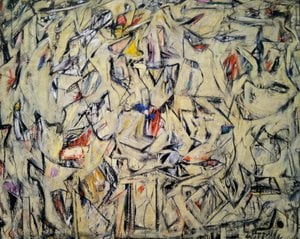
A Symphony of Discord: De Kooning’s ‘Untitled XII’
Willem de Kooning's ‘Untitled XII,’ painted in 1983, is not merely a painting; it’s an excavation of raw emotion rendered with the visceral intensity that defined his entire career. This vibrant canvas, dominated by a tumultuous interplay of red and blue, immediately confronts the viewer with a sense of unrestrained energy – a hallmark of De Kooning's Abstract Expressionist approach. The composition is deliberately fractured, a deliberate rejection of traditional representational forms, reflecting the artist’s lifelong struggle to articulate the complexities of the human psyche through color and form. It’s a painting that demands attention, inviting contemplation on themes of conflict, passion, and ultimately, the very nature of perception.
The Legacy of Rotterdam and the Outsider
Born in Rotterdam in 1904, Willem de Kooning's artistic journey was profoundly shaped by his early life. The dissolution of his parents’ marriage at a young age instilled within him a persistent sense of displacement – a feeling that would become a recurring motif in his work. This restlessness fueled an unconventional path; he eschewed formal academic training, apprenticing with commercial artists before pursuing evening classes at the Academie van Beeldende Kunsten en Technische Wetenschappen. His infamous stowaway voyage to America in 1926, a bold act of defiance and self-discovery, cemented his status as an outsider – a crucial element in understanding his artistic vision. This biographical context informs ‘Untitled XII,’ suggesting a deeply personal struggle for identity and expression.
Technique and the Language of Color
De Kooning’s technique is characterized by a dynamic layering of paint, built up through vigorous brushstrokes and impasto – thick applications of pigment that create a tactile surface. The painting's color palette isn't harmonious; rather, it’s deliberately discordant, utilizing jarring juxtapositions of red and blue to generate tension and visual excitement. Notice the way he manipulates these colors, sometimes blending them seamlessly, other times leaving them starkly separate, creating areas of intense saturation alongside muted tones. This controlled chaos is a key element in conveying the emotional weight of the piece. The inclusion of white and orange accents further amplifies this effect, adding to the overall sense of movement and dynamism.
Abstract Expressionism: A Reflection of the Soul
'Untitled XII' stands as a quintessential example of Abstract Expressionism, an artistic movement that emerged in post-World War II America. Rejecting representational art, these artists sought to express universal human emotions and experiences directly on canvas. De Kooning’s work aligns perfectly with this ethos – it doesn’t depict a recognizable scene or object; instead, it offers a raw, unfiltered glimpse into the artist's inner world. The painting’s power lies in its ability to evoke a visceral response from the viewer, prompting questions about the nature of feeling and the role of art in communicating these intangible experiences. It is a testament to De Kooning's mastery in translating subjective emotion into a powerfully visual form.



 Forhåndsvisning
 Kjøp håndlaget maleri
 Send
Send Del med andre
 Vis detaljer

 Last ned bildet
 Liknende objekter
 Røntgenundersøkelse
 Lysbildefremvisning
 Statistikk

 Vis hele teksten






































 Glassalternativet er kun tilgjengelig i størrelser under 110 cm