


Kunstverket som vises på denne siden er beskyttet av opphavsretten, noe som betyr at vi ikke har juridisk tillatelse til å lage eller selge identiske reproduksjoner. Denne beskyttelsen håndheves i henhold til internasjonale avtaler som for eksempel Bernerkonvensjonen og av nasjonale lover, inkludert de som er fastsatt i Amerikansk lov om opphavsrett – Tittel 17.
Denne metoden er i fullt samsvar med opphavsrettslige regler, da den ikke innebærer kopiering eller duplisering av det beskyttede kunstverket. I stedet er det snakk om en kreativ nytolkning – et nytt maleri som er inspirert av originalen, men ikke identisk med den.
Giclée- eller lerretsprint av museumskvalitet med rask produksjon og fleksible valgmuligheter for etterbehandling. ( Kjøp håndmalt maleri Bytt til digitalt bilde)





























Velg mellom våre forhåndsdefinerte størrelser som bevarer kunstverkets opprinnelige proporsjoner.

Skriv inn ønsket bredde og høyde for å tilpasse trykket til din ramme eller vegg. Et trykk kan kun beskjæres, aldri skaleres opp utover motivets opprinnelige størrelse, noe som betyr at et format med andre proporsjoner vil føre til tap av deler av bildet. Vi sender deg en digital mockup for godkjenning før vi starter trykkeprosessen. Bildet som vises på denne siden viser ikke den faktiske beskjæringen — det er kun mockuppen som viser dette.
Verdensomspennende levering () på 2 uker i stedet for standard 4/5 uker. (10 November)
Bull Fight
Størrelse på reproduksjon
Sunil Kumar Das's "Bull Fight," completed in 1952, is more than just a depiction of an animal; it’s a visceral embodiment of energy, movement, and the enduring spirit of Spanish tradition. Created by this pivotal figure in Indian Expressionism, the artwork captures a fleeting moment during a corrida – a bullfight – with remarkable intensity. Das, deeply influenced by Persian artistic techniques and his profound connection to Indian heritage, masterfully translated these influences into a style characterized by dynamic compositions and an unwavering focus on capturing the essence of his subjects.
“Bull Fight” carries significant symbolic weight, rooted in Spanish culture and tradition. The bull itself represents courage, strength, and defiance – qualities admired within the context of the corrida. Das’s portrayal transcends a simple observation; it's an engagement with a complex ritual, inviting contemplation on themes of bravery, skill, and the relationship between man and beast. The warm brown background further enhances this sense of tradition and rustic authenticity.
Created in 1952, “Bull Fight” reflects a period of burgeoning artistic experimentation in India. Das’s work aligns with the broader movement towards figurative painting while simultaneously forging a unique path rooted in his personal vision. The artwork's expressive realism – reminiscent of preparatory drawings – speaks to a desire to capture not just appearances but also the emotional and psychological impact of the subject. This piece, now available as a hand-painted reproduction, offers a window into the artistic sensibilities of a master and a powerful reminder of the enduring allure of animal portraiture.
"Bull Fight" av Sunil Kumar Das viser en Serene kontrast mellom de lyse og mørke partiene.
Dateringen fra 1952 plasserer "Bull Fight" i Mature Period av Sunil Kumar Das sin kunstneriske utvikling.
"Bull Fight" anbefales til Statement, og det anbefalte rommet er et Living Room.

Sunil Kumar Das (1939–2015) stands as a monumental figure in the pantheon of Indian contemporary art, a painter whose brushstrokes bridged the gap between ancient tradition and modern expressionism. Born in the culturally rich landscape of Bhubaneswar, Odisha, Das developed an artistic language that was both deeply personal and profoundly universal. His work does not merely observe the world; it interprets it through a lens of emotional intensity and symbolic depth. By weaving together the intricate aesthetics of Persian techniques with the soulful essence of Indian heritage, he created a visual narrative that resonates with the strength, resilience, and grace of the human condition.
The foundation of his mastery was laid during his formative years at Kala Bhavan, Calcutta, now known as Rabindra Bharati University. Under the mentorship of legendary figures such as Nirode Shankar Ray, Das underwent a rigorous artistic evolution. This period of formal training allowed him to master classical painting methods while simultaneously exploring the boundaries of contemporary figurative art. His education provided him with a sophisticated understanding of perspective and composition, often drawing inspiration from the architectural grandeur of Persian art to lend a sense of structured elegance to his more fluid, expressive compositions.
Perhaps the most enduring legacy of Sunil Kumar Das is his celebrated "Bull Series." In these works, the artist moved beyond simple animal portraiture to explore themes of raw power, endurance, and unyielding determination. Utilizing masterful charcoal sketches and meticulous tonal gradations, he captured the muscular tension and heavy presence of the bull. These pieces serve as metaphors for the strength found within Indian mythology and folklore, representing a spirit that remains unbroken by time or hardship. The texture of his work in this series is particularly noteworthy, as he used layering techniques to create a sense of palpable energy that seems to breathe from the canvas.
Beyond the primal energy of his animal studies, Das possessed a remarkable ability to depict the human form, particularly through his evocative portrayals of women. In these paintings, the artist transitioned from the monumental to the intimate. His depictions are characterized by:
The historical significance of Sunil Kumar Das lies in his ability to synthesize disparate influences into a cohesive, modern identity. He was not merely a follower of trends but a creator of a unique stylistic niche within Indian Expressionism. His work serves as a vital link between the classical traditions of the East and the experimental spirit of the modern era. Through his dedication to detail and his profound respect for symbolic storytelling, he ensured that his art would remain a significant chapter in the history of 20th-century Indian art.
Today, the works of Das continue to inspire collectors and scholars alike, offering a window into a period of intense artistic growth in India. His ability to capture the essence of resilience through the Bull Series and the delicate beauty of human emotion through his figurative works ensures that his name remains synonymous with the profound depth of the Indian contemporary spirit.

1939 - 2015 , India
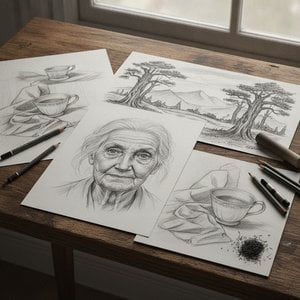
Explore the profound elegance of pencil and charcoal sketching. Discover how masters use line, shadow, and chiaroscuro to capture light and texture, bridging the gap between preparatory studies and timeless fine art masterpieces.

Explore the profound artistry of graphite drawing. Discover professional techniques for mastering depth, texture, and detail through a lens of art history, from classical sketches to modern masterpieces. Elevate your understanding of the pencil medium with our expert guide.

Explore the profound beauty of the sketch. Discover how masters use charcoal and graphite to capture raw emotion, anatomical precision, and fluid movement, bridging the gap between ephemeral marks and eternal oil masterpieces.

Elevate your artistic practice with this expert guide to mastering the line. Discover advanced techniques in graphite, charcoal, and contour drawing designed for art students seeking technical precision and expressive depth in their fine art studies.

Elevate your artistry with this definitive expert guide to mastering charcoal. Designed for art students, learn professional techniques for capturing profound depth, intricate textures, and dramatic shadows through advanced blending and chiaroscuro methods.
 Forhåndsvisning
 Send
Send Del
Del
 Vis detaljer
 Utskriftsvennlig guide

 Last ned bilde
 Liknende objekter
 Røntgenundersøkelse
 Lysbildefremvisning
 Spørsmål og svar
 Statistikk


 Vis hele teksten









 Glassalternativet er kun tilgjengelig i størrelser under 110 cm


