A Dramatic Encounter: Exploring ‘The Knight Errant’ by Sir John Everett Millais
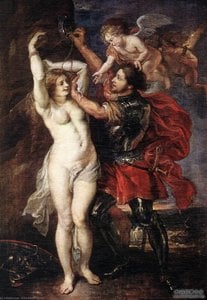
Sir John Everett Millais's “The Knight Errant,” completed in 1870, is a profoundly evocative work that immediately transports the viewer to the heart of Romanticism. Measuring 136 x 184 cm, this oil on canvas isn’t merely a depiction of a knight and a woman; it’s an intensely felt exploration of vulnerability, protection, and the enduring power of nature – themes central to the Pre-Raphaelite movement.
The scene depicts a knight, clad in gleaming armor, standing beside a naked woman. This juxtaposition is deliberately unsettling, radiating both chivalric duty and profound exposure. The woman’s expression, often interpreted as one of distress or discomfort, adds another layer to the painting's complex narrative. Millais masterfully utilizes light and shadow, creating a palpable sense of tension that draws the eye across the canvas, focusing on the stark contrast between the knight’s rigid form and the woman’s delicate vulnerability.
The Pre-Raphaelite Vision: Detail and Emotion
Millais was a pivotal figure in the Pre-Raphaelite movement, a group fiercely dedicated to rejecting the idealized forms and artificiality that had come to dominate academic art. Inspired by the clarity, detail, and emotional honesty of early Italian masters – notably Giotto and Duccio – Millais sought to return to a more direct engagement with reality. “The Knight Errant” exemplifies this approach perfectly. The artist’s meticulous technique is immediately apparent in the rendering of the knight's armor—each plate painstakingly detailed, reflecting light with a remarkable realism that suggests a sculptor’s eye. Similarly, the woman’s skin tones are rendered with an almost photographic precision, capturing subtle variations and textures that contribute to her palpable vulnerability.
- Technique: Millais employed a layering technique, building up color through numerous thin glazes – a hallmark of Pre-Raphaelite painting. This allowed for incredible luminosity and depth.
- Color Palette: The muted tones of the armor contrast dramatically with the vibrant greens and browns of the natural setting, further emphasizing the thematic conflict.
Subject Matter and Symbolism
The central figures—the knight and the woman—represent opposing forces, embodying themes of protection versus vulnerability, strength against weakness. The setting – a tree-lined area – serves to heighten the drama, contrasting the human conflict with the enduring power of nature. Some scholars interpret the scene as an allegory for the loss of innocence or the corruption of ideals. The knight’s armor, while representing order and defense, also suggests confinement and restriction, mirroring the woman's state of vulnerability.
Historical Context and Artistic Significance
Painted in 1870, “The Knight Errant” reflects a period of significant social and artistic change. The Victorian era was marked by both rapid industrialization and a renewed interest in medieval chivalry and romantic ideals. Millais’s work aligns with this cultural fascination while simultaneously challenging conventional representations of heroism and beauty. His dedication to meticulous detail and emotional honesty cemented his legacy as one of the most important artists of the Pre-Raphaelite movement, influencing generations of painters who followed.
Spørsmål og svar
Kan jeg se "The Knight Errant" som en lysbildefremvisning i fullskjerm?
Du kan se diaporamabildet av "The Knight Errant" på verkets Bildekarusell-side.
Når ble "The Knight Errant" av John Everett Millais laget, og hvilken stilart tilhører den?
"The Knight Errant" av John Everett Millais er datert 1870 og tilhører Pre-Raphaelite Brotherhood.
Kan jeg se en forhåndsvisning av "The Knight Errant" av John Everett Millais før jeg bestiller?
På Se kunstverket i et rom-siden for "The Knight Errant" kan du forhåndsvise kunstverket før du bestiller.



 Forhåndsvisning
 Bytt til trykk
 Send
Send Del
Del
 Vis detaljer
 Utskriftsvennlig guide

 Last ned bilde
 Liknende objekter
 Røntgenundersøkelse
 Lysbildefremvisning
 Q&A
Q&A Statistikk


 Vis hele teksten






































 Glassalternativet er kun tilgjengelig i størrelser under 110 cm