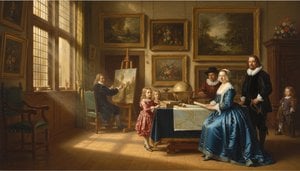
Johannes Vermeer’s Intimate Symphony: The Guitar Player
Johannes Vermeer’s “The Guitar Player,” painted in Delft around 1672, isn't merely a depiction of a man playing an instrument; it’s a carefully constructed window into the quiet heart of Dutch domestic life during the Golden Age. This remarkable painting transcends its simple subject matter to become a profound meditation on light, stillness, and the subtle beauty found in everyday moments. Vermeer, a master of capturing fleeting impressions and imbued with a deep understanding of human psychology, presents us with an image that invites prolonged contemplation – a testament to his extraordinary skill.
The scene unfolds within a modestly furnished room, bathed in the soft glow of what appears to be a window emanating light from the right. The composition is deliberately asymmetrical; the guitar player occupies only a quarter of the canvas, drawing our attention entirely to him and his instrument. This imbalance isn’t haphazard; it creates a dynamic tension, suggesting movement and an unspoken narrative. A partially visible landscape painting on the wall behind the musician adds another layer of intrigue, hinting at Vermeer's fascination with layered realities and the interplay between interior and exterior worlds. The inclusion of books scattered around the room speaks to a life dedicated to learning and contemplation – a subtle detail that elevates the scene beyond a simple portrait.
A Masterclass in Light and Shadow
Vermeer’s genius lies not just in his subject matter, but in his unparalleled command of light. He employs a technique known as *chiaroscuro*, skillfully manipulating shadows to sculpt form and create an atmosphere of intimacy and warmth. The light isn't harsh or dramatic; it’s diffused and gentle, illuminating the guitar player’s face and hands with a luminous quality. Notice how Vermeer uses subtle gradations of tone – from the darkest shadows enveloping the lower portion of the canvas to the bright highlights on the guitar strings – to draw our eye and create a sense of depth. The meticulous detail in rendering these light effects is a hallmark of Vermeer's style, demonstrating his painstaking attention to every brushstroke.
The choice of the guitar itself is significant. While instruments were frequently depicted in Dutch genre paintings, the guitar – a relatively new arrival in Europe at this time – carries connotations of romance and leisure. The young woman’s posture suggests an invitation to share in her musical enjoyment, creating a sense of warmth and connection. Her attire, though modest, hints at a certain social standing, reflecting the burgeoning prosperity of the Dutch Republic.
Historical Context and Artistic Influences
“The Guitar Player” is firmly rooted in the artistic landscape of the Dutch Golden Age, a period characterized by an unprecedented flourishing of art and culture. Vermeer’s work shares similarities with those of his contemporaries, such as Rembrandt van Rijn and Aert van der Neer, who also explored themes of domestic life and everyday activities. However, Vermeer's unique approach – his focus on capturing fleeting moments of beauty and his masterful use of light – set him apart from his peers. The painting’s influence can be seen in the works of later artists, particularly Impressionists who sought to capture the effects of light and atmosphere.
The painting’s creation coincided with a time of political and economic upheaval in the Netherlands, marked by war with France. Vermeer's life was not one of great wealth or fame; he struggled financially throughout his career. Yet, despite these challenges, he continued to paint, driven by an unwavering passion for his art. “The Guitar Player” stands as a testament to his resilience and artistic vision.
A Timeless Masterpiece – Reimagined
As a meticulously hand-painted oil reproduction, this artwork offers a unique opportunity to experience the beauty and intimacy of Vermeer’s original masterpiece in a new light. It allows us to appreciate the subtle nuances of his technique and the profound emotional impact of his work. Whether displayed as a focal point in your home or office, “The Guitar Player” will undoubtedly serve as a source of inspiration and contemplation for years to come. Explore the full artwork at WahooArt.com and delve deeper into the world of Johannes Vermeer.



 Forhåndsvisning
 Bytt til trykk
 Send
Send Del med andre
 Vis detaljer
 Veiledning

 Last ned bildet
 Liknende objekter
 Røntgenundersøkelse
 Lysbildefremvisning
 Statistikk


 Vis hele teksten






































 Glassalternativet er kun tilgjengelig i størrelser under 110 cm