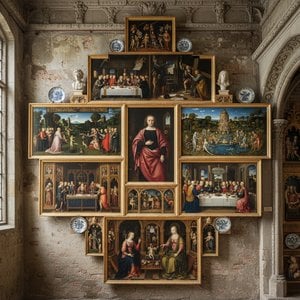
St Columba Altarpiece (central panel) by Rogier van der Weyden
The St Columba Altarpiece, created in 1455 by the Flemish master Rogier van der Weyden, stands as a cornerstone of Early Netherlandish painting and embodies the artistic ideals of its time. Housed at the Alte Pinakothek in Munich, Germany, this monumental panel offers an unparalleled glimpse into the devotional fervor and sophisticated visual language that characterized the Burgundian Renaissance.
Composition and Style: Van der Weyden’s genius lies in his masterful orchestration of form and color. The central panel depicts a serene tableau featuring Mary holding the infant Jesus, surrounded by twelve figures representing saints—primarily St Columba himself—and attendants. Unlike many contemporary altarpieces that prioritized grandeur and ostentation, van der Weyden opted for a restrained elegance, prioritizing clarity of line and luminous pigment to convey profound spiritual emotion.
Technique: Executed in oil on oak wood, the painting demonstrates Van der Weyden’s meticulous attention to detail. He employed glazing techniques—layers of translucent paint—to achieve remarkable depth and luminosity, capturing the subtle nuances of light and shadow with breathtaking accuracy. The artist's masterful rendering of drapery is particularly noteworthy; folds cascade gracefully across the figures, creating a sense of movement and conveying an impression of sumptuousness.
Historical Context: Commissioned for St Columba’s Church in Cologne during Philip the Good’s reign, the altarpiece reflects the prevailing religious piety of the era. It aligns with broader artistic trends—particularly the influence of Hans Memling's Annunciation—that championed naturalism and psychological realism. The depiction of St Columba underscores the importance of Celtic Christianity within the Holy Roman Empire.
Symbolism: The altarpiece is replete with symbolic imagery. The Virgin Mary’s posture exudes serenity and compassion, embodying maternal tenderness. Jesus Christ—represented as a radiant infant—symbolizes divine grace and redemption. The saints surrounding Mary represent various facets of Christian faith and virtue. Furthermore, the architectural setting—a stylized courtyard reminiscent of Romanesque churches—evokes a sense of timelessness and spiritual grandeur.
Legacy: Rogier van der Weyden’s St Columba Altarpiece profoundly impacted subsequent generations of artists. His innovative approach to composition and his unwavering commitment to naturalistic representation established him as a pivotal figure in the development of Northern Renaissance art. Stefan Lochner, influenced by Van der Weyden's stylistic innovations—particularly his elongated figures and vibrant colors—became one of the most celebrated painters of his time.
Relevance to Modern Art Appreciation: The St Columba Altarpiece continues to inspire artists today with its masterful execution and emotive power. Its meticulous detail, luminous color palette, and psychologically astute portrayal of human emotion resonate across centuries, reminding us of the enduring beauty and spiritual significance of art.
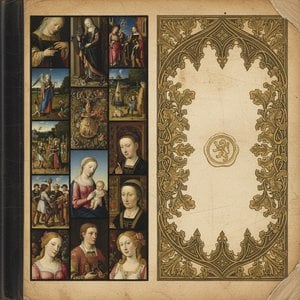
Further Exploration: For those interested in delving deeper into Rogier van der Weyden’s oeuvre, St Columba Altarpiece (central panel) and St Columba Altarpiece (detail) are available for viewing on WahooArt.
Key Points:
- Rogier van der Weyden was a pivotal figure in Early Netherlandish painting.
- The St Columba Altarpiece is housed at the Alte Pinakothek in Munich, Germany.
- It exemplifies restrained elegance and luminous pigment to convey profound spiritual emotion.
- Van der Weyden’s technique—glazing and drapery rendering—established him as a stylistic innovator.
- His influence extended to Stefan Lochner and continues to inspire modern artists.



 Forhåndsvisning
 Bytt til trykk
 Send
Send Del med andre
 Vis detaljer

 Last ned bildet
 Liknende objekter
 Røntgenundersøkelse
 Lysbildefremvisning
 Statistikk


 Vis hele teksten






































 Glassalternativet er kun tilgjengelig i størrelser under 110 cm