Om kunstneren
A Dream Weaver: The Life and Art of Paul Delvaux
Paul Delvaux, født i den lille belgiske landsby Wanze i 1897, var en kunstner hvis verk ofte ble beskrevet som drømmeaktige og urovekkende. Hans liv og kunst er et fascinerende møte mellom streng akademisk utdannelse og en dyp fascinasjon for det surrealistiske, selv om han aldri offisielt identifiserte seg med bevegelsen. Fra sin barndom i Flandern ble han formet av motstridende innflytelser: den disiplinerte verdenen av klassisk språkstudier og latin, sammenblandet med fantasifulle historier fra Jules Verne og Homers *Odysseen*. Denne dualiteten – mellom orden og fantasi – ville bli et sentralt tema i hans kunstneriske visjon. I utgangspunktet ble han veiledet mot en praktisk karriere innen arkitektur av sine foreldre, men Delvaux fant uunngåelig sin vei til maleri, og meldte seg inn på den kongelige kunstakademiet i Brussel. Selv om han kjempet med de matematiske kravene ved arkitektur, la utdannelsen en grunnleggende ferdighet i perspektiv og form som senere ville danne grunnlaget for hans urovekkende realistiske drømmescapes. Hans tidlige verk reflekterte denne akademiske bakgrunnen, primært landskapsmalerier i en post-impressionistisk stil, men selv da begynte antydninger av den særegne atmosfære som skulle definere hans modne arbeid å dukke opp.
The Seeds of a Surreal Vision
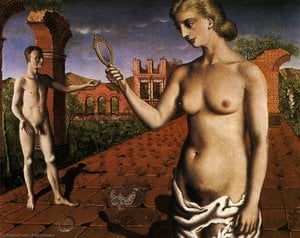
Det avgjørende øyeblikket i Delvaux’ kunstneriske utvikling kom med hans møte med verkene til Giorgio de Chirico. De Chiricos metafysiske malerier – skarpe, gåtefulle scener befolket av skygger og klassisk arkitektur – resonerte dypt med Delvaux, og åpnet en ny verden av muligheter. Han begynte å populisere sine lerret med nakne figurer, ofte plassert mot imponerende arkitektoniske strukturer eller i enorme, øde landskap. Disse var ikke bare representasjoner av det menneskelige formen; de var utforskninger av begjær, ensomhet og det underbevisste sinn. Påvirkningen fra flamske ekspresjonister som Constant Permeke og Gustave De Smet er også synlig i denne perioden, og bidrar til en viss melankolsk intensitet i hans palett og penselstrøk. Likevel utviklet Delvaux raskt sin egen unike stil – en blanding av klassisk presisjon og drømmende irrasjonalitet. Hans malerier begynte å skape en følelse av uro, en følelse at noe skjult lå under overflaten av virkeligheten. Gjenkjennelige motiver dukket opp: tog, beinholdne figurer og kvinner med vevede ansikter, alt bidrar til den urovekkende atmosfæren som definerer hans arbeid.
Recurring Motifs and Symbolic Language
Delvaux’ kunstnerspråk er rikt på symbolikk, selv om han konsekvent motsto forsøk på å tolke det på en direkte psykoanalytisk måte. Den nakne kvinnen, et sentralt element i mange av hans malerier, fremstår ofte som passiv eller melankolsk, og representerer både begjær og sårbarhet. Tog og jernbanestasjoner dukker ofte opp som symboler på overgang, forflyttelse og modernitetens angst. Beinholdne figurer er ikke bare makabre symboler på død, men representerer en hjemsøkende tilstedeværelse, en påminnelse om dødelighet som gjennomsyrer selv de mest idylliske scenene. Klassisk arkitektur gir et bakteppe av orden og varighet, men blir ofte fremstilt på en merkelig forvrengt eller ufullstendig måte, noe som antyder sårbarhet under overflaten. Disse elementene er ikke bare dekorative; de er integrert i den emosjonelle og psykologiske effekten av hans arbeid. For eksempel skaper maleriet *Night Train* en kraftig og uforglemmelig bilde – anonyme figurer, truende arkitektur og en følelse av forestående fare. Kunstneren selv forklarte at motivene hans stammet fra personlige minner og inntrykk, spesielt fra barndommen, snarere enn bevisste forsøk på å dechiffrere det underbevisste.
Key Works and Artistic Development
Delvaux’ kunst utviklet seg over et langt liv, og han eksperimenterte med ulike teknikker og motiver. I 1930-årene begynte han å bli mer interessert i en samling kuriositeter i Spitzner Museum i Brussel, inkludert skjeletter og Venus-figurer mot røde fløyelsbakgrunner – motiver som senere dukket opp i hans malerier. Etter andre verdenskrig ble han sterkt påvirket av italiensk kunst, spesielt den manieristiske tradisjonen, noe som førte til at han begynte å eksperimentere med forvrengte perspektiver og uvanlige komposisjoner. I 1943 malte han *Sleeping Venus*, et ikonisk verk som ble en definerende del av hans stil. Senere i karrieren skapte han serier av bilder der unge jenter står i natten og betrakter tog, noe som gjenspeiler en tidlig fascinasjon for togets bevegelser. I 1959 malte han et stort veggmaleri i Palais du Congrès i Brussel, et av flere store utsmykningsprosjekter han gjennomførte i sine senere år. Han ble direktør for det kongelige kunstakademiet i 1965 og mottok en pris for sin bidrag til kunst. Paul Delvaux Museum åpnet i Saint-Idesbald, Belgia, i 1987, og huser verdens største samling av hans verk.
Legacy and Lasting Influence
Paul Delvaux døde i 1994 i Veurne, Belgia, men hans kunst fortsetter å fascinere og inspirere. Hans malerier er utstilt i museer over hele verden, inkludert Tate Gallery i London og Musée de Toyama i Japan. Han demonstrerte at surrealismen kunne eksistere utenfor de strenge grensene for automatisk skriving og drømmeanalyse, og omfavnet i stedet en nøye teknikk og en dypt personlig visjon. Hans arv lever videre ikke bare gjennom hans malerier, men også gjennom den vedvarende kraften i hans unike kunstnerspråk – et språk som fortsetter å tale til våre dypeste frykter og ønsker.



 Forhåndsvisning
 Bytt til trykk
 Send
Send Del med andre
 Vis detaljer

 Last ned bildet
 Liknende objekter
 Røntgenundersøkelse
 Lysbildefremvisning
 Statistikk


 Vis hele teksten