The Noble Deed Of Scipio (Poussin) - A Symphony of Virtue and Baroque Mastery
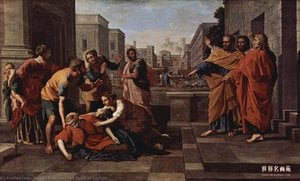
Nicolas Poussin’s “The Noble Deed Of Scipio,” painted around 1640, isn’t merely a depiction of an ancient Roman legend; it's a profound meditation on honor, restraint, and the enduring values championed by Stoicism. This captivating work, now residing within the esteemed Pushkin State Museum in Moscow, offers a glimpse into the Baroque era’s masterful command of light, composition, and emotional resonance – qualities that continue to enthrall viewers centuries later. Poussin, already establishing himself as a leading figure in French art, meticulously crafted this scene based on a tale recounted by Plutarch: Scipio Africanus’s selfless act of returning a captive woman—taken during the siege of Syracuse—to her awaiting fiancé after he had been briefly held by Scipio's soldiers. More than simply recounting an event, Poussin elevates it into a potent allegory for human virtue.
The painting immediately draws the eye with its carefully orchestrated arrangement. The central figures – Scipio himself and the young woman—are positioned within a shallow space, creating a sense of intimacy and immediacy. Notice how Poussin employs a subtle pyramidal composition, guiding the viewer’s gaze upward towards Scipio, who stands in a commanding red robe, a color traditionally associated with nobility and leadership. This vibrant hue contrasts beautifully with the pristine white of the woman's dress, symbolizing her innocence and purity—a visual shorthand for virtue itself. The surrounding figures – soldiers, attendants, and other Roman nobles – are rendered with remarkable detail, each contributing to the scene’s overall sense of dignity and importance. Poussin’s skill in depicting textures – the folds of the robes, the sheen of armor, the delicate fabric of the woman's dress – is truly astonishing.
A Symphony of Light and Shadow: Poussin’s Baroque Technique
Poussin was a master of *chiaroscuro*, the dramatic use of light and shadow, a hallmark of the Baroque style. He doesn’t simply illuminate the scene; he sculpts it with light, creating depth and emphasizing key elements. Observe how the light falls across Scipio's face, highlighting his noble expression and conveying a sense of solemn resolve. The shadows deepen the background, receding into an atmospheric haze that suggests distance and adds to the painting’s overall mood. This masterful manipulation of light isn’t just aesthetic; it serves to heighten the emotional impact of the scene, reinforcing Scipio's virtuous act.
Furthermore, Poussin’s meticulous attention to detail is evident in every aspect of the composition. The swords and military equipment scattered throughout the painting serve as a poignant reminder of the context – a world of war and conquest. However, they are presented not as symbols of aggression but rather as elements that underscore Scipio's restraint and self-control. Poussin’s use of linear perspective – creating an illusion of depth through converging lines – is exceptionally precise, contributing to the painting’s realism and sense of spatial coherence. The subtle variations in color and tone further enhance this effect, drawing the viewer into the scene.
Symbolism Woven Into the Narrative
Beyond its technical brilliance, “The Noble Deed Of Scipio” is rich in symbolism. The red robe worn by Scipio isn’t simply a signifier of his status; it represents his commitment to honor and justice. The woman's white dress symbolizes her vulnerability and innocence – a virtue that Scipio protects with unwavering restraint. Even the background landscape, rendered with atmospheric perspective, contributes to the painting’s symbolic meaning, evoking a sense of timelessness and moral grandeur. The presence of the attendants, some gesturing towards the scene, subtly reinforces the importance of this particular act.
The painting's narrative speaks powerfully to themes of duty, compassion, and the triumph of virtue over adversity—values that resonated deeply with audiences during Poussin’s time and continue to inspire contemplation today. It exemplifies the Baroque ideal of portraying human experience as elevated by spiritual insight, capturing not just what is seen but also what is felt.
A Legacy Enduring Through Centuries
Nicolas Poussin's influence extends far beyond his own era, shaping the artistic sensibilities of subsequent generations. Artists like Jacques-Louis David and Jean-Auguste-Dominique Ingres drew inspiration from Poussin’s masterful technique and compositional principles, demonstrating the enduring power of classical ideals in Western art history. “The Noble Deed Of Scipio” stands as a testament to this legacy—a timeless masterpiece that invites viewers to consider the profound significance of moral conduct and the beauty of understated elegance.
For those seeking a stunning reproduction or a deeper appreciation of this iconic artwork, WahooArt offers meticulously crafted hand-painted reproductions that faithfully capture the essence of Poussin’s vision. Experience the grandeur of Baroque art and bring home a piece of history—a visual embodiment of virtue and enduring artistic excellence.
Spørsmål og svar
Hvor plasseres "Nicolas Poussin" av Nicolas Poussin i kunsthistorien?
Den kunsthistoriske klassifiseringen av "Nicolas Poussin" av Nicolas Poussin er Baroque, fra Renessansen-perioden.
Hva er anbefalt trykkstørrelse for "Nicolas Poussin" av Nicolas Poussin?
"Nicolas Poussin" anbefales i en trykkstørrelse på Stor. Andre størrelser er tilgjengelige med de samme proporsjonene.
Hvilket rom passer til fargene i "Nicolas Poussin" av Nicolas Poussin?
Med sine Jordnær farger, anbefales "Nicolas Poussin" for et Stue og oppholdsrom.



 Se i rommet
 Bestill håndmalt reproduksjon
 Del som digitalt kort
 Del
Del
 Detaljer
 Studentguide

 Last ned
 Liknende objekter
 Røntgen
 Lysbildefremvisning
 Besøksstatistikk


 Les mer






































 Glassalternativet er kun tilgjengelig i størrelser under 110 cm