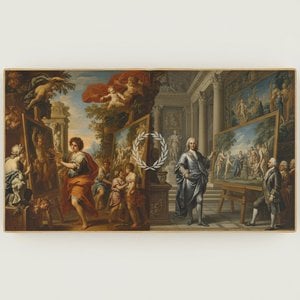
The Shadowed Genius of Avignon
Nicolas Mignard, often remembered by the evocative moniker Mignard d’Avignon, remains one of the most compelling yet understated figures of the French Baroque era. Born in 1606 in the historic city of Troyes, he emerged from a lineage of skilled artisans, a background that provided him with a foundational discipline essential for his later triumphs. While history often casts a long shadow over his more famous brother, Pierre Mignard, Nicolas carved out a distinct identity through a career that bridged the provincial elegance of Avignon with the opulent splendor of the Parisian court. His life was a journey of stylistic evolution, moving from the structured Mannerism of his youth to a profound engagement with the classical grandeur of Italy.
The early years of Mignard’s development were marked by a rigorous pursuit of mastery. After initial training under a local master in Troyes, he sought inspiration within the halls of Fontainebleau, where he spent formative periods meticulously copying Mannerist works. This practice was not merely an academic exercise but a deep immersion into the complex rhythms and elongated forms that defined the era. It is believed that his time in Paris also brought him into contact with the influential Simon Vouet, whose fluid brushwork and vibrant palettes likely left an indelible mark on Mignard’s burgeoning aesthetic. This period of intense study prepared him for the transformative voyage to Rome in 1635, a journey undertaken under the patronage of the Cardinal Archbishop of Lyon.
A Roman Revelation and the Avignon Years
Rome served as the crucible in which Mignard’s artistic soul was truly forged. Immersed in the papal city's atmosphere of classical revival, he found himself profoundly moved by the legacy of Annibale Carracci. The robust compositions and balanced naturalism of the Carracci school became a cornerstone of his technique, influencing his ability to execute both delicate etchings and monumental canvases. During this Roman sojourn, Mign.ard developed a sophisticated command over light and shadow, learning to weave narrative complexity into religious and mythological themes. This period of intense classical study allowed him to return to France not merely as a student, but as a master capable of commanding the grandest of scales.
Upon settling in Avignon around 1633, Mignard entered his most prolific period of regional influence. The city, with its unique blend of French and papal culture, provided an ideal stage for his religious and decorative works. He became a sought-after painter for both ecclesiastical institutions and the private residences of the nobility, decorating opulent interiors with scenes that breathed life into myth and scripture alike. His work during these years was characterized by:
- Masterful Composition: A seamless integration of figures within architectural and landscape settings.
- Illusionistic Perspective: The use of trompe l'oeil techniques to expand the perceived space of religious panels.
- Narrative Depth: An ability to imbue mythological subjects with a sense of human emotion and dramatic tension.
Ascension to the Royal Court
The trajectory of Mignard’s career reached its zenith when the gaze of the Sun King, Louis XIV, turned toward him. The occasion was the royal visit to Avignon, where Mignard’s skill in portraiture caught the attention of the court. Tasked with capturing the likenesses of prominent figures, including the powerful Cardinal Mazarin, Mignard demonstrated a psychological acuity that transcended mere likeness. This recognition led to a pivotal moment in 1660 when he was summoned to Paris by a lettre de cachet, an order that effectively transitioned him from a regional master to a central figure in the French artistic establishment.
His arrival in Paris marked his integration into the highest echelons of the Académie Royale de Peinture et de Sculpture. Achieving the status of Professor and Assistant Rector, Mignard stood at the heart of the era's most significant artistic debates. Though often overshadowed by the political dominance of Charles Le Brun, Mignard’s presence in the Academy ensured that his refined, classically-inflected style remained a vital component of the French Baroque identity. He passed away in 1668, leaving behind a legacy of works that continue to reflect the grandeur, the devotion, and the sophisticated elegance of a bygone golden age.


 Forhåndsvisning

 Send
 Del
 Vis detaljer
 Utskriftsvennlig guide


 Last ned bilde
 Liknende objekter
 Røntgenundersøkelse
 Lysbildefremvisning
 Spørsmål og svar

 Statistikk

 Vis hele teksten
 Bytt til trykk






































 Glassalternativet er kun tilgjengelig i størrelser under 110 cm