

Giclée- eller lerretsprint av museumskvalitet med rask produksjon og fleksible valgmuligheter for etterbehandling. ( Kjøp håndmalt maleri Bytt til digitalt bilde)





























Velg mellom våre forhåndsdefinerte størrelser som bevarer kunstverkets opprinnelige proporsjoner.

Skriv inn ønsket bredde og høyde for å tilpasse trykket til din ramme eller vegg. Et trykk kan kun beskjæres, aldri skaleres opp utover motivets opprinnelige størrelse, noe som betyr at et format med andre proporsjoner vil føre til tap av deler av bildet. Vi sender deg en digital mockup for godkjenning før vi starter trykkeprosessen. Bildet som vises på denne siden viser ikke den faktiske beskjæringen — det er kun mockuppen som viser dette.
Verdensomspennende levering () på 2 uker i stedet for standard 4/5 uker. (10 November)
Tarbagatai
Størrelse på reproduksjon
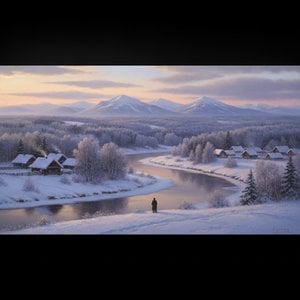
Nicholas Roemerich's “Tarbagatai” is more than just a landscape painting; it’s a profound meditation on the intersection of human aspiration and the enduring power of nature. Executed with his signature meticulous detail and imbued with a deeply spiritual sensibility, this artwork transports the viewer to the rugged beauty of Central Asia, specifically the Tarbagatai Mountains region of Kazakhstan – a place that held immense personal significance for Roerich.
The scene unfolds with a captivating serenity. A formidable stone fortress dominates the background, its yellow-tiled roof blazing against the expansive sky. The architectural details are rendered with painstaking accuracy, reflecting Roerich’s dedication to historical research and his belief that art should be rooted in tangible reality. Two gentle hills frame the composition, adding depth and a sense of vastness, while a solitary figure stands before them, seemingly lost in contemplation of this majestic vista. This central figure isn't merely a compositional element; it represents humanity’s inherent desire for connection with something greater than itself – a theme recurrent throughout Roerich’s oeuvre.
Roerich’s artistic style is immediately recognizable. He developed a highly detailed, almost photographic realism, but never without injecting it with an ethereal quality. His technique involved layering thin glazes of oil paint, building up color and luminosity gradually – a process that allowed him to achieve the rich, vibrant tones characteristic of his work. This meticulous approach, combined with his extensive knowledge of archaeology and ancient cultures, resulted in paintings that possess both scientific precision and profound spiritual resonance.
Roerich’s work was deeply influenced by his belief in the interconnectedness of all things – a concept he termed “Pantheism.” In "Tarbagatai," the fortress itself can be interpreted as a symbol of human civilization, standing against the forces of nature. The solitary figure represents the individual soul seeking spiritual enlightenment. Roerich frequently incorporated alchemical and esoteric symbolism into his paintings, reflecting his interest in ancient wisdom traditions and his desire to promote peace through artistic expression. The Tarbagatai region held particular significance for Roerich as a site of archaeological discovery and a place he believed was imbued with powerful spiritual energy.
"Tarbagatai" evokes a profound sense of wonder and tranquility. It’s a painting that invites the viewer to pause, reflect, and contemplate the relationship between humanity and the natural world. Roerich's work continues to resonate with audiences today, not only for its technical brilliance but also for its timeless themes of spirituality, exploration, and the enduring beauty of the landscape. WahooArt’s hand-painted reproductions capture the essence of this masterpiece, allowing you to experience Roerich’s vision in stunning detail.
"Tarbagatai" har en Serene atmosfære.
"Tarbagatai" av Nikolai Roerich kombinerer Acrylic On Canvas-teknikken med Roerich Romanticism-stilen. Teknikk og stilretning beskriver verkets utførelse og estetiske uttrykk.
Se lysbildefremvisningen her: Bildekarusell for "Tarbagatai" av Nikolai Roerich.


1874 - 1947 , Russland

Opplev impressionismens magi! Utforsk 10 ikoniske landskapsmalerier av Monet, Renoir og Van Gogh. Lær om kunsthistorien bak mesterverkene & finn din perfekte veggkunst på WahooArt.com – museumskvalitet for ditt hjem.
Embark on a soulful journey through Russia's breathtaking landscapes. Discover exquisite, hand-painted oil reproductions of Peredvizhniki masterpieces, meticulously crafted to bring the emotional depth and timeless beauty of Russian fine art into your personal sanctuary.

Opplev John Constables 25 mest ikoniske malerier! Fordyp deg i engelsk romantikk, landskapskunst og atmosfæriske scener. Finn museumskvalitets reproduksjoner & interiørinspirasjon på WahooArt.com. Utforsk samlingen online!

Level up your space with high-voltage landscapes from WahooArt.com. Discover bold, vibrant nature scenes—from hand-painted oils to premium prints. Shop high-impact, designer-grade art designed for modern interiors and maximum visual impact. Recharge your decor today.

Oppdag de 10 mest ikoniske romantiske landskapsmaleriene! Fra Caspar David Friedrich til Turner – utforsk kunsthistorien, stemningen og fargepalettene. Finn museumskvalitets reproduksjoner på WahooArt.com.
 Forhåndsvisning
 Send
Send Del
Del
 Vis detaljer
 Utskriftsvennlig guide

 Last ned bilde
 Liknende objekter
 Røntgenundersøkelse
 Lysbildefremvisning
 Spørsmål og svar
 Statistikk

 Vis hele teksten









 Glassalternativet er kun tilgjengelig i størrelser under 110 cm


