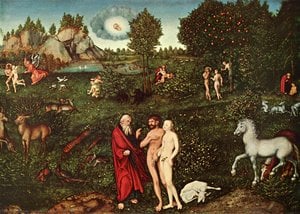
The Echoes of Paradise: Lucas Cranach’s “The Golden Age”
Lucas Cranach the Elder's "The Golden Age," painted in 1530, isn’t merely a depiction of nude figures frolicking in a garden; it’s a vibrant distillation of Renaissance ideals, a carefully constructed allegory steeped in classical mythology and humanist thought. This oil-on-panel masterpiece, now housed within the Alte Pinakothek in Munich, offers a glimpse into a world where earthly pleasure and divine harmony intertwine – a vision both alluring and subtly complex.
Cranach, a pivotal figure of the German Renaissance, served as court painter to the Electors of Saxony for much of his career. His work reflects this patronage, blending meticulous realism with an expressive understanding of human psychology. “The Golden Age” exemplifies this skill, showcasing not just anatomical accuracy but also a remarkable ability to convey mood and narrative through gesture and composition. The painting’s genesis lies in the ancient Greek concept of the *Ages of Man*, as articulated by Hesiod – a cyclical progression from an idyllic, pre-civilized “Golden Age” to one defined by strife and decay. Cranach cleverly translates this philosophical framework into a visual experience, inviting the viewer to contemplate humanity's relationship with nature, pleasure, and ultimately, mortality.
A Symphony of Nudity and Movement
The scene unfolds within a lush, enclosed garden, its boundaries delineated by a sturdy stone wall. Within this idyllic space, a group of young couples engage in a variety of activities: dancing, bathing, eating grapes, and simply enjoying each other’s company. Cranach masterfully employs the technique of *contrapposto*, subtly shifting the weight of the figures to create dynamic poses that ripple through the composition. The musculature is rendered with remarkable precision, yet the overall effect is one of effortless grace and naturalism. Note the subtle variations in skin tone – a deliberate choice that adds depth and realism to the scene, while simultaneously reinforcing the painting’s classical inspiration.
The figures themselves are arranged in carefully considered groupings, suggesting relationships and interactions. The use of light and shadow is particularly effective, highlighting certain bodies and creating a sense of intimacy within the larger composition. Cranach's attention to detail extends beyond the human forms; observe the meticulously rendered foliage, the delicate details of the fruit, and the subtle textures of the stone wall – all contributing to the painting’s immersive quality.
Symbolism Woven into the Landscape
Beyond its immediate visual appeal, “The Golden Age” is rich in symbolic meaning. The garden itself represents an idealized paradise, a realm free from the constraints and anxieties of civilized life. The abundance of fruit symbolizes fertility and prosperity, while the presence of animals suggests a harmonious relationship between humanity and nature. The fortress visible in the upper left corner, likely representing Hartenfels Castle, subtly anchors the scene to the contemporary world, reminding us that this idyllic vision is not entirely detached from reality.
Furthermore, the painting’s title directly references Hesiod's concept of the Golden Age – a time when humanity lived in perfect harmony with itself and with the natural world. Cranach’s depiction of nude figures engaged in playful activities can be interpreted as an allegory for this lost state of innocence, inviting viewers to reflect on the potential for human happiness and fulfillment.
A Timeless Appeal
"The Golden Age" remains a powerfully evocative work of art, captivating audiences with its beauty, grace, and subtle complexity. It’s a testament to Lucas Cranach's artistic skill and his deep understanding of classical mythology and humanist thought. Whether admired for its technical brilliance or appreciated for its profound symbolic meaning, this painting continues to resonate with viewers centuries after its creation – a timeless reminder of the enduring allure of paradise and the human desire for a life of beauty, pleasure, and harmony.



 Forhåndsvisning
 Kjøp håndlaget maleri
 Send
Send Del med andre
 Vis detaljer

 Last ned bildet
 Liknende objekter
 Røntgenundersøkelse
 Lysbildefremvisning
 Statistikk


 Vis hele teksten






































 Glassalternativet er kun tilgjengelig i størrelser under 110 cm