x
Kjøp håndlaget maleri Kjøp håndlaget maleriKjøp bilde Kjøp bilde SendSend
Vis detaljerVis detaljer Legg til i favoritter Legg til i favoritter Last ned bildetLast ned bildet Liknende objekterLiknende objekter LysbildefremvisningLysbildefremvisning

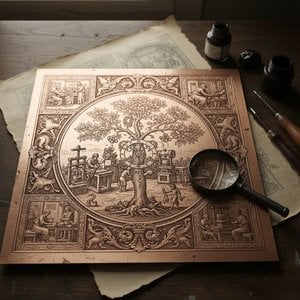
Circular Plate for Ben Uri

Intricate carvings of symbolic figures adorn this 1915 wooden plate by Lazar Berson, a masterpiece of Jewish decorative art that invites you to explore the profound craftsmanship of a historical era.

Explore the unique Jewish art of Lazar Berson (1882-1954), founder of Ben Uri Arts Society. Discover symbolic designs & motifs reflecting his Lithuanian heritage.

Giclée / Kunsttrykk

Giclée- eller lerretsprint av museumskvalitet med rask produksjon og fleksible valgmuligheter for etterbehandling. (Kjøp håndlaget maleri Kjøp håndlaget maleriKjøp bilde Kjøp bilde)

Standardformat
skreddersydd
CM
INCH

Velg mellom våre forhåndsdefinerte størrelser som bevarer kunstverkets opprinnelige proporsjoner.

bredde
høyde

Du kan oppgi egne mål for å tilpasse en spesifikk ramme eller et bestemt område. Dersom den valgte størrelsen ikke samsvarer med det originale bildets proporsjoner, vil vi enten beskjære kunstverket eller utvide bildet med en speilet eller ensfarget kant. En digital mockup vil bli sendt til din godkjenning før produksjonen starter.
Vennligst merk at forhåndsvisningen på skjermen ikke gjenspeiler den faktiske beskjæringen eller utvidelsen. Kun mockuppen vil vise den endelige komposisjonen nøyaktig.
Selv om tilpassede størrelser er tilgjengelige, anbefaler vi å velge et mål fra den forhåndsdefinerte listen for å bevare de originale proporsjonene.

Verdensomspennende levering () på 2 uker i stedet for standard 4/5 uker. (30 August)

why_choose_icon
Gratis ekspressfrakt over hele verden
why_choose_icon
Lerretsduk av høykvalitets lin
why_choose_icon
Full forsikring under transport
why_choose_icon
Garanti for refusjon av toll og importavgifter
why_choose_icon
Garantert korrekt fargegjengivelse
why_choose_icon
60 dagers returrett (kun ved feil)
why_choose_icon
100% pengene tilbake-garanti
why_choose_icon
Rabatt ved flere kjøp

Totalpris for bestilling

$ 68

reproduction

Circular Plate for Ben Uri

Giclée / Kunsttrykk

Størrelse på reproduksjon

-

Endelig pris

$ 68

Kort om verket

  • Subject or theme: Figures and symbols
  • Year: 1915
  • Notable elements or techniques: Intricate carvings, etched figures
  • Medium: Wood
  • Artistic style: Decorative art

A Tapestry of Wood and Tradition

In the delicate interplay of light and shadow upon its carved surface, the Circular Plate for Ben Uri stands as a profound testament to the enduring spirit of Jewish cultural identity. Created in 1915 by the visionary Lazar Berson, this piece is far more than a mere decorative object; it is a narrative vessel, etched into wood with an intimacy that speaks to the soul. As one gazes upon the intricate circular design, the eye is immediately drawn into a rhythmic dance of figures and symbols, each meticulously rendered to tell a fragment of a larger, sacred story. The craftsmanship reveals a mastery of woodworking, where every notch and groove serves to elevate the medium from simple timber to a complex stage for historical and spiritual drama.

The artistry of Berson is deeply rooted in his unique synthesis of Lithuanian heritage and the mystical depths of Kabbalistic thought. Within this circular composition, at least thirteen distinct figures emerge, creating a celestial or communal assembly that feels both ancient and immediate. The technique employed here relies on the depth of the carving to create natural highlights and shadows, giving the wooden surface a sculptural quality that changes as the viewer moves around it. This tactile dimension makes the piece an extraordinary choice for collectors who appreciate art that possesses a physical presence—a work that demands attention not just through its imagery, but through its very texture.

Historical Resonance and Symbolic Depth

To understand this plate is to understand the turbulent era of its birth. Created during the height of the First World War, the piece embodies the resilience of a community seeking to preserve its essence amidst global upheaval. Berson, having moved to London, sought to establish a permanent visual language for Jewish art through the founding of the Ben Uri association. This plate serves as an early manifestation of that ambition, acting as a bridge between the traditional shtetl life of his youth and the burgeoning modern Jewish art movement in London. The symbols etched into the wood are not merely ornamental; they are coded messages of continuity, faith, and the preservation of memory.

For the discerning interior designer or art enthusiast, this reproduction offers a unique opportunity to introduce a sense of historical gravity and warmth into a contemporary space. The organic nature of the wood provides a grounding element, while the complexity of the carvings invites long periods of contemplation. Whether placed as a focal point in a curated gallery wall or used to add a layer of sophisticated storytelling to a study, the Circular Plate for Ben Uri brings with it an emotional weight that is rare in modern decor. It is an invitation to connect with a legacy of artistry that refuses to be forgotten, making it a timeless acquisition for any collection dedicated to the beauty of human heritage.


Om kunstneren

A Visionary of the Diaspora: The Life and Legacy of Lazar Berson

The life of Lazar Berson remains a captivating tapestry of light and shadow, much like the mystical traditions that fueled his creative spirit. Born in 1882 in the village of Škupiškyi, within the heart of a Lithuanian shtetl, Berson’s early years were steeped in the rich, rhythmic textures of Jewish life. While precise biographical details from his formative era are often obscured by the passage of time, the essence of his upbringing is etched into every line of his work. He carried with him the profound spiritual weight of the shtetl and a deep-seated connection to Jewish tradition, which would later serve as the foundation for a revolutionary artistic mission in the bustling urban centers of Europe.

Berson’s artistic journey was one of grand movement and intellectual expansion. His pursuit of mastery led him from the cultural renaissance of St. Petersburg to the prestigious halls of the École des Beaux-Arts in Paris. In the vibrant, bohemian atmosphere of Paris, Berson found himself immersed in a "prayer quorum" of Jewish émigré artists, living amidst the legendary La Ruche. It was here, surrounded by the energy of modernism and peers such as Marc Chagall and Léon Bakst, that his unique visual language began to coalesce. He sought to bridge the gap between the ancient and the avant-garde, blending the formal training of Western academic painting with the soulful, symbolic depth of Jewish folk art and the esoteric mysteries of Kabbalah.

Symbolism and the Sacred Geometry of Design

To encounter a work by Lazar Berson is to enter a world where geometry meets divinity. His aesthetic was not merely decorative; it was a deliberate attempt to manifest spiritual truths through visual form. Berson’s compositions are often characterized by an intricate dance of patterns, where the mathematical precision of geometric shapes provides a vessel for profound religious symbolism. He frequently utilized motifs that resonated with the cosmic order, such as:

  • The Menorah: The seven-branched candelabrum, serving as a luminous symbol of divine presence and continuity.
  • The Star of David: An iconic emblem woven into the very fabric of his designs to assert Jewish identity.
  • Zodiac Symbols: Celestial imagery that connected the earthly experience to the movements of the heavens.
  • Hebrew Lettering: The sacred script used as both a structural and a spiritual element within his compositions.

This fusion of Kabbalistic mysticism and decorative design allowed Berson to create art that functioned as a bridge between worlds. His work often featured circular, mandala-like structures—such as his notable 1915 designs—that invited the viewer into a state of contemplation, mirroring the cyclical nature of life and faith.

The Ben Uri Legacy and Historical Significance

Perhaps Berson’s most enduring achievement was not found solely on canvas or wood, but in the community he built. In 1915, amidst the upheaval of the First World War, Berson moved to London and founded The Jewish-National Decorative Art Association, known today as the Ben Uri Arts Society. This institution was born from a visionary desire to cultivate a thriving ecosystem for Jewish artistry within the East End community. Through this society, Berson championed the importance of decorative arts and design, aiming to elevate Jewish culture and identity through aesthetically compelling and culturally resonant creations.

Though his personal history contains moments of sudden and mysterious disappearance from the London capital in 1916, his impact remained indelible. He successfully fostered a spirit of collaboration between artists and craftsmen, ensuring that the beauty of the diaspora would be preserved through tangible, exquisite objects. Today, Berson is remembered not just as a painter or a designer, but as a pioneer who provided a voice for a culture in transition, leaving behind a legacy of resilience, identity, and profound spiritual beauty.

Lazar Berson

Lazar Berson

1882 - 1954 , Lithuania

Kort om kunstneren

  • Artistic Movement Or Style: Decorative Art
  • Date Of Birth: October 16, 1882
  • Date Of Death: 1954
  • Full Name: Lazar Berson
  • Nationality: Lithuanian
  • Notable Artworks: ['Circular Design for Ben Uri']
  • Place Of Birth: Škupiškyi, Lithuania