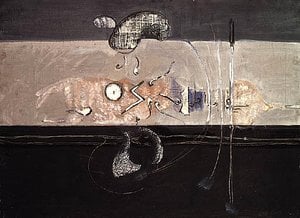
Kunstverket som vises på denne siden er beskyttet av opphavsretten, noe som betyr at vi ikke har juridisk tillatelse til å lage eller selge identiske reproduksjoner. Denne beskyttelsen håndheves i henhold til internasjonale avtaler som for eksempel Bernerkonvensjonen og av nasjonale lover, inkludert de som er fastsatt i Amerikansk lov om opphavsrett – Tittel 17.
Denne metoden er i fullt samsvar med opphavsrettslige regler, da den ikke innebærer kopiering eller duplisering av det beskyttede kunstverket. I stedet er det snakk om en kreativ nytolkning – et nytt maleri som er inspirert av originalen, men ikke identisk med den.
Giclée- eller lerretsprint av museumskvalitet med rask produksjon og fleksible valgmuligheter for etterbehandling. ( Kjøp håndmalt maleri Bytt til digitalt bilde)
Velg mellom våre forhåndsdefinerte størrelser som bevarer kunstverkets opprinnelige proporsjoner.

Skriv inn ønsket bredde og høyde for å tilpasse trykket til din ramme eller vegg. Et trykk kan kun beskjæres, aldri skaleres opp utover motivets opprinnelige størrelse, noe som betyr at et format med andre proporsjoner vil føre til tap av deler av bildet. Vi sender deg en digital mockup for godkjenning før vi starter trykkeprosessen. Bildet som vises på denne siden viser ikke den faktiske beskjæringen — det er kun mockuppen som viser dette.
Verdensomspennende levering () på 2 uker i stedet for standard 4/5 uker. (14 November)
Bathroom Composition
Størrelse på reproduksjon

John Keates, born March 30th, 1773, in Wells, Somerset, was a British schoolmaster whose artistic legacy extends far beyond his modest academic pursuits. He stands as a pivotal figure within the Pre-Raphaelite Brotherhood—a movement that championed idealized beauty and meticulous observation—and his paintings offer a unique glimpse into the aesthetic sensibilities of Victorian England.
Early Life & Education: Keates’s upbringing in a stable-keeper’s family instilled in him an appreciation for craftsmanship and detail, shaping his artistic approach. He excelled at Eton College, demonstrating exceptional talent in Latin and Greek—subjects considered crucial for cultivating intellectual rigor.
Cambridge Years & Literary Influences: Keates pursued his studies at Cambridge University, earning prestigious accolades including the Browne Medal and Craven Scholarship. His exposure to Romantic poets like Wordsworth and Coleridge profoundly impacted his worldview and artistic vision, fostering a fascination with nature’s sublime grandeur.
Career as Schoolmaster & Artistic Development: Following graduation, Keates embarked on a career as a schoolteacher—a profession he embraced wholeheartedly—and honed his artistic skills through meticulous observation of the natural world. His landscapes, characterized by serene compositions and subtle tonal gradations, exemplify the Pre-Raphaelite commitment to capturing fleeting moments of beauty.
The Pre-Raphaelite Brotherhood & Artistic Style: Keates joined the Pre-Raphaelite Brotherhood in 1848—a collective dedicated to reviving artistic ideals considered lost under the influence of Michelangelo and Raphael. His paintings reflect this movement’s stylistic hallmarks: luminous color palettes, precise draughtsmanship, and a preoccupation with mythological subjects—particularly those rooted in classical antiquity.
Notable Works & Legacy: Keates produced approximately 150 paintings during his lifetime, showcasing an impressive range of subject matter—from Venetian interiors to Tuscan landscapes—and demonstrating remarkable technical proficiency. His work continues to inspire admiration for its understated elegance and profound sensitivity to the visual arts, securing his place as one of the Pre-Raphaelite Brotherhood’s most distinguished practitioners.
Keates’ fascination with Italy—particularly Venice—fueled his artistic endeavors. He traveled extensively throughout Europe during his formative years, immersing himself in the cultural milieu of the Renaissance and Baroque periods. This experience profoundly shaped his aesthetic sensibilities, informing his compositional choices and color palettes.
Keates’s artistic sensibilities were undeniably shaped by his admiration for Raphael—the Renaissance painter whose frescoes in the Vatican adorned with mythological subjects served as a model for Pre-Raphaelite artists. He sought to emulate Raphael’s mastery of color and form, striving to achieve an aesthetic ideal rooted in classical antiquity.
“SI RO MA MAU” stands as Keates’s most celebrated painting—a monumental landscape that embodies the Pre-Raphaelite commitment to capturing atmospheric perspective and conveying profound emotional resonance. The artwork is notable for its masterful depiction of a Tuscan hillside bathed in golden sunlight.
John Keates' artistic legacy endures as a testament to his unwavering dedication to craftsmanship, observation, and imaginative exploration. His paintings—characterized by understated elegance and profound emotional depth—continue to captivate audiences worldwide—affirming his place as one of the Pre-Raphaelite Brotherhood’s most distinguished practitioners.

Transform your bathroom with icons from Van Eyck to Warhol. Find curated museum-quality art on WahooArt.com. Explore the full collection online.

Discover how curated masterworks transform hotel interiors into immersive brand journeys. Explore the neuroaesthetics of hospitality, from bespoke oil reproductions to large-scale murals, designed to elevate guest experience and drive luxury brand loyalty through intentional art curation.
 Forhåndsvisning
 Send
Send Del
Del
 Vis detaljer
 Utskriftsvennlig guide

 Last ned bilde
 Liknende objekter
 Røntgenundersøkelse
 Lysbildefremvisning
 Spørsmål og svar
 Statistikk
 Vis hele teksten






































 Glassalternativet er kun tilgjengelig i størrelser under 110 cm