


Håndmalt olje på lerret i din valgte størrelse og ramme, laget på bestilling av våre kunstnere. ( Kjøp trykk Kjøp bilde)





























Velg mellom våre forhåndsdefinerte størrelser som bevarer kunstverkets opprinnelige proporsjoner.

Du kan angi egne mål for å tilpasse en spesifikk ramme eller plass. Dersom den valgte størrelsen ikke samsvarer med originalbildets proporsjoner, vil vi enten beskjære kunstverket eller utvide maleriet med ytterligere håndmalte elementer. En digital mockup vil bli sendt til din godkjenning før produksjonen starter.
Vennligst merk at forhåndsvisningen på skjermen ikke gjenspeiler den faktiske beskjæringen eller utvidelsen. Kun mockuppen vil vise den endelige komposisjonen nøyaktig.
Selv om tilpassede størrelser er tilgjengelige, anbefaler vi å velge et mål fra den forhåndsdefinerte listen for å bevare de originale proporsjonene.
Verdensomspennende levering () på 3–4 uker i stedet for standard 5 uker. (7 September). Ingen kompromisser med kvaliteten.


A Head Keeper, Windsor Castle
Størrelse på reproduksjon
John Frederick Lewis's 1826 pencil sketch, "A Head Keeper, Windsor Castle," is more than just a depiction of a man in formal attire; it’s a meticulously rendered study of power, duty, and the quiet dignity of service. Captured with loose, expressive lines characteristic of a sketching style rather than a finished painting, this work offers a rare glimpse into the daily life of one of England's most iconic institutions – Windsor Castle. The composition immediately draws the eye to the subject’s face, framed by a top hat and a richly textured coat, conveying an air of both authority and thoughtful contemplation. The background, deliberately understated, serves primarily to anchor the figure within the vastness of the castle grounds, suggesting a world of protocol and responsibility.
Lewis's technique is immediately engaging. The artist skillfully employs shading – not with heavy, dramatic contrasts but rather through subtle gradations of grey and black – to sculpt volume and define the man’s features. The lines themselves are dynamic, conveying movement and a sense of immediacy as if Lewis were capturing the subject in real-time. Notice how the loose, almost gestural strokes contribute to the sketch's overall feeling of intimacy; it’s not a formal portrait intended for grand display, but rather an observation made with keen interest and a subtle appreciation for the individual before him. The rough texture of the paper itself adds another layer of authenticity, hinting at the immediacy of the drawing process.
Understanding the subject’s role is crucial to appreciating the artwork fully. “Head Keeper” refers to an individual responsible for overseeing a specific section or area within Windsor Castle – in this case, likely managing staff and maintaining order during visits. This position demanded not only administrative skills but also a strong sense of decorum and a deep understanding of the castle’s traditions. Lewis's sketch captures this essence perfectly; the man embodies both competence and restraint, projecting an image of steadfastness and reliability. The attire – the top hat, coat, and waistcoat – speaks to the formality expected within the royal household, while his posture suggests a quiet confidence.
Windsor Castle itself is a living testament to centuries of British history, evolving from a medieval fortress into a sprawling palace complex. The castle’s function has shifted over time, serving as a residence for monarchs, a military headquarters, and now primarily a tourist attraction. Lewis's sketch reflects this layered history; it’s not simply a portrait of an individual but also a subtle commentary on the enduring power and legacy of the institution he represents. The castle's architecture, with its imposing walls and grand halls, provides a silent backdrop to the keeper's quiet vigilance.
Beyond its literal depiction, “A Head Keeper” is rich in symbolic meaning. The man’s stern expression – a hint of seriousness or perhaps even melancholy – invites speculation about his thoughts and experiences. Is he weary from the demands of his role? Does he harbor secret anxieties about the castle's future? Lewis masterfully uses facial expression to convey an emotional depth that transcends the purely visual.
The sketch’s overall mood is one of quiet contemplation, a moment captured in time before the bustle of royal life resumes. It evokes a sense of stability and tradition, reminding us of the continuity between past and present within the walls of Windsor Castle. There's an understated dignity to the scene – a recognition of the importance of those who maintain order and uphold the institution’s values. The sketch is not celebratory or grandiose; it’s a quietly powerful portrait of duty and responsibility, offering a poignant glimpse into the life of a largely unseen figure within one of England’s most iconic landmarks.
John Frederick Lewis was a pivotal figure in 19th-century British art, particularly renowned for his Orientalist paintings. His travels to Spain and Morocco profoundly influenced his style, leading him to develop a distinctive approach characterized by meticulous detail, vibrant colors, and an acute awareness of local customs and traditions. “A Head Keeper” exemplifies this talent, showcasing Lewis’s ability to capture not just the outward appearance of his subjects but also their inner character and the atmosphere of the places they inhabit. This sketch stands as a testament to his skill and offers a valuable insight into the world of royal service within the heart of Windsor Castle.

John Frederick Lewis, en fremtredende engelsk orientalistmaler, ble født den 14. juli 1804 i London. Han var sønn av Frederick Christian Lewis, en graver og landskapsmaler. Denne familiære kunstneriske bakgrunnen påvirket utvilsomt hans tidlige utvikling. Hans formelle opplæring begynte under veiledningen av Sir Thomas Lawrence, hvor han finpusset sine ferdigheter sammen med andre kunstnere som Edwin Landseer. Dette grunnleggende tidsrom la en solid forståelse av teknikk og komposisjon til grunn for ham.
Lewis’s kunstneriske karriere utfoldet seg gjennom flere distinkte faser, hver preget av utviklende stiler og tematiske fokusområder:
Lewis’s kunst var sterkt påvirket av den romantiske ideen om Orient, men han forsøkte å skildre det med en nøyaktighet som var unik for sin tid. Han studerte grundig arkitektur, tekstiler og kostymer, og fanget ofte atmosfæren i de stedene han besøkte.
Lewis skapte et betydelig antall verk som ble feiret for sin metoderte detalj og suggestive atmosfære. Noen av hans mest anerkjente stykker inkluderer:
Lewis var kjent for sin evne til å fange lys og skygge, og for sine rike fargepaletter. Hans malerier er ofte preget av en følelse av ro og mystikk, og gir et innblikk i livet i det fjerne Østen.
Lewis’s stil ble formet av flere innflytelser, først og fremst Sir Thomas Lawrences vekt på portrettkunst og komposisjon. Imidlertid ga hans direkte observasjon av middelhavskulturer ham muligheten til å utvikle en unik estetikk preget av:
Lewis’s bidrag til kunstverdenen ligger i hans betydelige rolle i å utvikle orientalistmaleri. Hans metoderte fremstillinger av islamsk arkitektur, møbler og kostymer satte nye standarder for realisme innen sjangeren. Han populariserte en romantisk, men detaljert visjon av Midtøsten blant vestlige publikum. Etter sin tilbakekomst til England i 1851 fortsatte han å male til sin død den 15. august 1876 i Walton-on-Thames.
Hans arbeid fortsetter å bli studert og beundret for sitt kunstneriske talent og historiske innsikt i 1900-tallets oppfatninger av Østen.

1804 - 1876 , Storbritannia
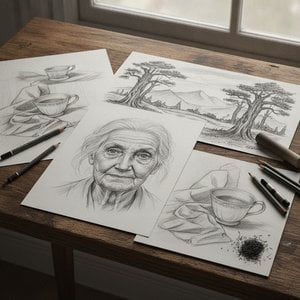
Explore the profound elegance of pencil and charcoal sketching. Discover how masters use line, shadow, and chiaroscuro to capture light and texture, bridging the gap between preparatory studies and timeless fine art masterpieces.

Explore the profound beauty of the sketch. Discover how masters use charcoal and graphite to capture raw emotion, anatomical precision, and fluid movement, bridging the gap between ephemeral marks and eternal oil masterpieces.

 Forhåndsvisning
 Send
Send Del med andre
 Vis detaljer

 Last ned bildet
 Liknende objekter
 Røntgenundersøkelse
 Lysbildefremvisning


 Vis hele teksten







 Glassalternativet er kun tilgjengelig i størrelser under 110 cm


