Få en utskriftsklar fil som går langt utover forhåndsvisningen på nett. Hvert digitale bilde vi selger er hentet fra en høyoppløselig master i vår database – vanligvis mellom 5 000 og 15 000 piksler bred – slik at du kan trykke stort, beskjære tett eller gjenskape fine detaljer med full trygghet.
Ingen filer forlater studioet vårt uten å bli bearbeidet. En digital ekspert kontrollerer fargene mot det originale maleriet og korrigerer dem ved behov, for deretter å forbedre klarhet og detaljrikdom med profesjonelle retusjeringsverktøy — alltid tro mot kunstnerens penselstrøk og stil. Resultatet er et bilde som fremstår som selve maleriet, ikke som en skann med filter.
Du godkjenner før ferdigstilling: vår ekspert sender bildet på e-post til din vurdering innen 72 timer. Ikke fornøyd? Be om forbedringer eller korrigeringer, eller be om refusjon dersom kvaliteten ikke svarer til forventningene.
Dette er kvaliteten forlag, designstudioer, gallerier og trykkerier stoler på.
Last ned en høyoppløselig fil til personlig bruk, utskrift og kreative prosjekter. ( Bytt til trykk Kjøp håndmalt maleri)
Når du velger WahooArt.com, får du ikke bare et bilde – du mottar et profesjonelt etterbehandlet digitalt kunstverk, skapt med presisjon og med en garantert tilfredshetsgaranti. Her er alt som automatisk følger med din bestilling:
Din høyoppløselige digitale bildefil sendes til din e-post innen 72 timer etter bestilling – klar til umiddelbar bruk.
Ditt kunstverk blir profesjonelt optimalisert ved hjelp av avanserte AI-verktøy og manuell redigering, noe som sikrer maksimal detaljrikdom, klarhet og fargegjengivelse.
Har du ved et uhell slettet eller mistet filen din? Ingen bekymring – vi sender den på nytt når som helst, helt gratis.
Nyt ditt kunstverk umiddelbart uten toll, avgifter eller leveringskostnader – digitale nedlastinger er alltid avgiftsfrie.
Vi sikrer at det digitale bildet gjenspeiler de originale fargene så nøyaktig som mulig ved hjelp av profesjonelle verktøy og fargehåndtering.
Hvis du ikke er fornøyd med ditt digitale bilde, vil vi revidere det eller refundere 100% innen 100 dager – uten spørsmål.
Ikke fornøyd? Få full refusjon innen 100 dager etter at du har mottatt din digitale fil – uten spørsmål.
Kjøp 3 bilder, spar 10% - Kjøp 5, spar 15% - Kjøp 10+, spar 20%. Ideelt for kreative prosjekter, gallerier og byråer.

In the misty, windswept landscapes of late Victorian and Edwardian Scotland, few artists captured the ephemeral beauty of the wilder terrains as poignantly as John Campbell Mitchell. Born on December 1, 1861, in the coastal town of Campbeltown, Argyllshire, Mitchell’s early life was a tapestry of contrasting paths. While he was initially apprenticed to a local law firm, his heart remained tethered to the rugged scenery of his youth. This duality between the structured world of legal study and the untamed spirit of the Scottish coast would later manifest in his art as a masterful balance between technical precision and atmospheric freedom. Under the pivotal mentorship of the renowned William McTaggart, Mitchell’s latent talent was nurtured, leading him away from the courtroom and toward the prestigious Edinburgh College of Art.
The evolution of Mitchell's brushwork was profoundly shaped by his journey to the heart of the art world in Paris. Studying under Jean-Joseph Benjamin-Constant, he absorbed the vibrant, light-drenched techniques of French Impressionism, which breathed a new vitality into his approach to landscape. Upon returning to Scotland, he did not merely replicate foreign styles but instead synthesized them with the unique, somber, and dramatic character of his homeland. Settling in Corstermine, Edinburgh, Mitchell dedicated himself to documenting the shifting moods of the Scottish weather, finding profound inspiration in the expansive views of Kintyre, Galloway, and the coastal stretches of Aberlady.
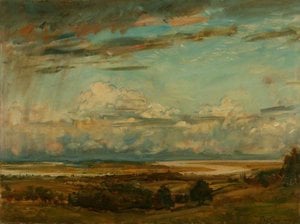
To gaze upon a Mitchell canvas is to experience the very breath of the moorland. His style was defined by broad, open views that utilized a sophisticated command of tonalism and color. He possessed a rare ability to render the heavy, moisture-laden skies of Scotland, using thick impasto to give texture to clouds and the shimmering surface of coastal waters. His works often feature:
In celebrated works such as "Cattle on the Solway" and "Sunset, Argyllshire," one can observe his transition from a student of form to a master of atmosphere. His paintings are not merely static depictions of geography; they are emotional responses to the grandeur and intimacy of nature, where a single grazing animal or a distant curlew serves as a focal point within an overwhelming expanse of sky and earth.
Mitchell’s ascent within the prestigious Royal Scottish Academy (RSA)—achieving Associate status in 1904 and full membership in 1919—marked his arrival as a cornerstone of the Scottish art community. His dedication to portraying the natural splendor of Scotland with unwavering precision ensured that his work resonated with both contemporary critics and future generations of collectors. Beyond his technical skill, Mitchell’s significance lies in his role as a bridge between the traditional landscape traditions of the 19th century and the more fluid, expressive sensibilities of the early 20th century.
Though he passed away in 1922 at the age of sixty, his influence persists through the enduring evocative power of his landscapes. He left behind a visual legacy that continues to serve as a window into a vanished era of Scottish pastoral life, reminding us of the profound connection between the artist's eye and the untamed soul of the land. His works remain cherished in significant collections, including the Manchester Art Gallery and various esteemed museums across Scotland, standing as eternal echoes of the moorland’s quiet majesty.

1861 - 1922
 Forhåndsvisning
 Send
Send Del
Del
 Vis detaljer
 Utskriftsvennlig guide

 Last ned bilde
 Liknende objekter
 Røntgenundersøkelse
 Lysbildefremvisning
 Spørsmål og svar
 Statistikk
 Vis hele teksten