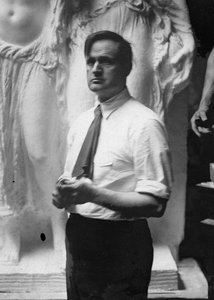
The Weight of Remembrance: James Earle Fraser’s “For Humanity Obverse”
James Earle Fraser's "For Humanity Obverse," a bronze medal commemorating the efforts during World War I, transcends mere commemorative function. It stands as a poignant testament to sacrifice, resilience, and the enduring human spirit in the face of conflict. Crafted by one of America’s most celebrated sculptors, Fraser masterfully captures a pivotal moment – a line of soldiers advancing with resolute determination – within a meticulously detailed bronze surface that speaks volumes about both the era and the artist's profound understanding of form and emotion.
The medal’s design immediately draws the eye to the central figure: a soldier, rendered in profile, carrying his rifle over his shoulder. His posture is one of unwavering commitment, yet there’s an underlying tension, a suggestion of the immense burden he carries. To his left, crossed swords – a potent symbol of battle and conflict – are subtly integrated, reminding us of the brutal realities that fueled this humanitarian effort. Below him, a landscape of rolling hills or mountains provides a grounding element, anchoring the scene in a tangible reality while simultaneously hinting at the vastness of the war’s impact. The weathered patina of the bronze itself contributes significantly to the piece's narrative; it whispers tales of time and exposure, lending an air of authenticity and historical weight.
A Sculptor Forged by the West
James Earle Fraser’s artistic journey was deeply intertwined with the American West. Born in Minnesota and raised amidst frontier life, he developed a unique perspective shaped by his family's history – his father an engineer involved in recovering remains from Little Bighorn, and his mother tracing her lineage back to the Pilgrims. This formative experience instilled within him a profound appreciation for both the rugged beauty of the landscape and the complexities of American identity. Fraser’s early exposure to Native American culture further enriched his artistic sensibilities, informing his approach to depicting human figures with sensitivity and respect.
His training in Paris provided him with invaluable exposure to European artistic traditions, particularly classical sculpture, which he skillfully integrated into his own distinctive style. Fraser's work is characterized by a remarkable realism, achieved through painstaking attention to detail – the folds of the soldier’s uniform, the texture of the landscape, and the subtle nuances of expression on the figure’s face. This commitment to accuracy, combined with an intuitive understanding of human psychology, elevates “For Humanity Obverse” beyond a simple commemorative medal; it becomes a powerful visual narrative.
Symbolism and Historical Context
The inscription "FOR HUMANITY" boldly declares the medal’s purpose – a recognition of those who dedicated themselves to humanitarian efforts during World War I. However, the image itself carries deeper symbolic weight. The advancing soldiers represent not just military strength but also courage, sacrifice, and unwavering resolve. The crossed swords serve as a reminder of the conflict that necessitated these actions, while the landscape symbolizes the world being shaped by war’s consequences.
Created in 1918, during the height of the Great War, “For Humanity Obverse” reflects the nation's collective response to a global crisis. It was commissioned as part of a series of medals recognizing individuals and organizations involved in humanitarian work – efforts ranging from medical care to refugee assistance. The medal’s design embodies the spirit of patriotism and service that defined America’s wartime experience, capturing both the solemnity of loss and the unwavering hope for a better future.
A Legacy in Bronze
James Earle Fraser's "For Humanity Obverse" remains a significant work of American art. Beyond its historical context, it stands as a testament to the artist’s skill, vision, and profound understanding of human nature. The medal’s enduring appeal lies not only in its technical brilliance but also in its ability to evoke powerful emotions – empathy, respect, and a sense of shared humanity. Reproductions of this remarkable bronze piece offer a tangible connection to a pivotal moment in history, allowing us to contemplate the sacrifices made by those who fought for peace and justice.



 Bytt til trykk
 Send
Send Del med andre
 Vis detaljer

 Last ned bildet
 Liknende objekter
 Lysbildefremvisning
 Statistikk


 Vis hele teksten