The Sculptural Poetics of Hugh Gerard Byars
Born in Dublin in 1957, Hugh Gerard Byars has emerged as a profound voice in contemporary Irish sculpture, crafting a visual language that speaks to the very essence of human connection. His journey into the heart of form and space began at Trinity College Dublin, where he earned his BA in Fine Art in 1980. It was during these formative years that Byars encountered the influential sculptor William Tucker, a mentor whose teachings on materiality and process-based experimentation would leave an indelible mark on Byars’ artistic DNA. Under Tucker’s guidance, Byars began to look beyond traditional bronze and stone, finding a new frontier in unconventional materials like resin and fiberglass—substances capable of capturing both the permanence of sculpture and the ephemeral nature of a single, fleeting moment.
The true hallmark of Byars’ career arrived in 1987 with the inception of his celebrated embrace sculptures. At a time when much of the sculptural world was gravitating toward the monumental and the imposing, Byars chose a path of intimacy and vulnerability. These works, often featuring pairs of figures intertwined in delicate, complex poses, serve as a poignant meditation on the duality of human relationships: the simultaneous experience of profound connection and inevitable separation. By encasing these intertwined forms within translucent resin, he creates a sense of suspended animation, as if the viewer is witnessing a private, sacred ritual frozen in time. His ability to manipulate light through these semi-transparent mediums allows the sculptures to breathe, inviting the eye to wander through the layers of form and shadow.
A Tapestry of Form and Emotion
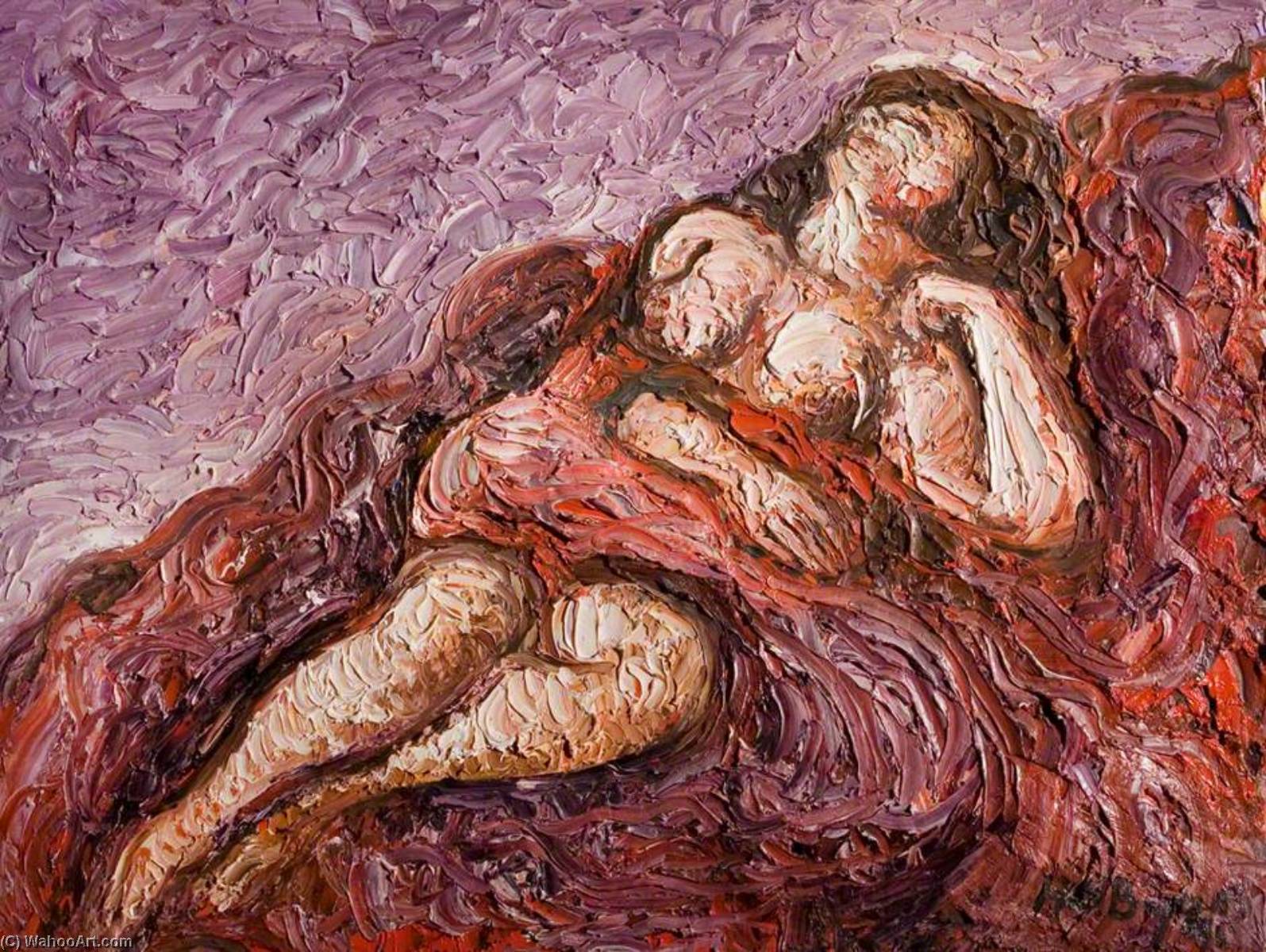
While his sculptural work often dominates his legacy, Byars’ artistic exploration extends into the realm of painting, where he employs a diverse range of styles to explore the human condition. In works such as Untitled and Embrace (1991), he utilizes oil on canvas to translate the tactile intimacy of his sculptures into a two-dimensional plane, using muted, earthy tones to evoke warmth and closeness. Conversely, his painting Man of Merkland Street reveals a much more visceral side of his talent; here, he embraces an Expressionist fervor, utilizing thick impasto and a fiery palette of reds and oranges to create an unsettling, haunting portrait that vibrates with raw energy.
This versatility highlights the central tension in Byars’ oeuvre: the balance between the structured and the spontaneous. Whether he is working with the rigid precision required for fiberglass casting or the loose, symbolic lines of a contemporary portrait, his focus remains steadfastly on the emotional resonance of his subjects. His later works, such as Figure by a River (2000), demonstrate an ability to blend elements of Naive Art and Primitivism, using simplified forms and moonlit cityscapes to reflect upon the quiet, often overlooked interactions within modern urban life.
Legacy and Artistic Significance
The significance of Hugh Gerard Byars lies in his refusal to let sculpture remain a static medium. Through his meticulous attention to detail and his commitment to conceptual rigor, he has transformed the physical boundaries of his materials to reflect the intangible boundaries of the human spirit. His contributions to Irish contemporary art are marked by several key achievements:
- Innovation in Materiality: The pioneering use of resin and fiberglass to capture light, translucency, and the sensation of touch.
- The Language of Intimacy: The creation of a unique symbolic vocabulary through his "embrace" series, redefining how sculpture communicates human vulnerability.
- Conceptual Depth: A career-long exploration of the relationship between the human form and the surrounding space, bridging the gap between physical presence and psychological absence.
Today, Byars stands as a master of the evocative, an artist whose work continues to challenge viewers to contemplate the complexities of love, loss, and the enduring beauty found in the most delicate of human encounters.


 Forhåndsvisning
 Switch to Print
 Send
Send Del med andre
 Vis detaljer

 Last ned bildet
 Liknende objekter
 Røntgenundersøkelse
 Lysbildefremvisning
 Stats
Stats


 Vis hele teksten


