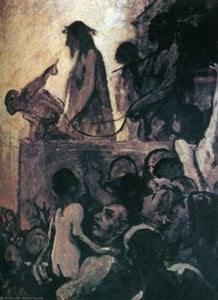
Giclée- eller lerretsprint av museumskvalitet med rask produksjon og fleksible valgmuligheter for etterbehandling. ( Kjøp håndmalt maleri Bytt til digitalt bilde)





























Velg mellom våre forhåndsdefinerte størrelser som bevarer kunstverkets opprinnelige proporsjoner.

Skriv inn ønsket bredde og høyde for å tilpasse trykket til din ramme eller vegg. Et trykk kan kun beskjæres, aldri skaleres opp utover motivets opprinnelige størrelse, noe som betyr at et format med andre proporsjoner vil føre til tap av deler av bildet. Vi sender deg en digital mockup for godkjenning før vi starter trykkeprosessen. Bildet som vises på denne siden viser ikke den faktiske beskjæringen — det er kun mockuppen som viser dette.
Verdensomspennende levering () på 2 uker i stedet for standard 4/5 uker. (8 November)
The Republic
Størrelse på reproduksjon
Honoré Daumier’s “The Republic” (1848) isn't merely a painting; it’s a potent distillation of the anxieties and aspirations swirling within post-revolutionary France. Captured with his signature blend of realism and biting satire, this oil on canvas presents a scene both familiar and profoundly unsettling – a woman, presumably a mother, holding her children close while simultaneously embodying the ideals of republican virtue. The composition immediately draws the eye to her central position; she’s not a regal figure or an idealized Madonna, but a common woman, weathered yet resolute, clutching a flag and a bottle—symbols that speak volumes about the precarious balance between nourishment and civic duty in a nation grappling with its new identity.
Daumier was deeply invested in documenting the social realities of his time. Born in Marseille in 1808, he witnessed firsthand the upheavals of the French Revolution and the subsequent political instability. His art became a relentless critique of the established order – the monarchy, the aristocracy, the Church, and the burgeoning bourgeoisie—all perceived as obstacles to genuine republicanism. “The Republic” is no exception; it’s a pointed commentary on the challenges faced by women in particular during this period of transition. The flag she holds isn't simply a symbol of national pride, but a visual representation of the ideals – liberty, equality, fraternity – that were supposed to underpin the new republic. The bottle, often interpreted as representing sustenance and motherhood, subtly suggests the vital role of family in sustaining these values.
Daumier’s technique is characterized by a remarkable directness and emotional intensity. He eschewed the polished surfaces and idealized forms favored by many of his contemporaries, opting instead for a rougher, more immediate style. The brushstrokes are visible, conveying a sense of urgency and immediacy. The palette is muted—earthy browns, ochres, and greys—reflecting the somber mood of the scene and emphasizing the weight of responsibility borne by the central figure. Notice how he uses light and shadow to sculpt her face, highlighting the lines etched by hardship yet radiating an undeniable strength. The background, featuring a simple chair and hinting at a boat, grounds the scene in a domestic setting, further emphasizing the woman’s role as the heart of the family and the embodiment of republican values.
He was heavily influenced by artists like Rubens, particularly in his use of dramatic chiaroscuro – the stark contrast between light and dark—to create a sense of theatricality. This technique amplifies the emotional impact of the painting, drawing attention to the woman’s face and gestures while simultaneously suggesting the turbulent political landscape surrounding her. Daumier's skill lay not just in his technical proficiency but also in his ability to imbue ordinary subjects with extraordinary significance.
Beyond its immediate depiction, “The Republic” is laden with symbolism. The flag, as mentioned earlier, represents the ideals of the republic, while the bottle speaks to the fundamental needs of family and community. However, the scene isn’t entirely optimistic. The woman's posture suggests a quiet determination rather than triumphant celebration. She’s not basking in victory; she’s enduring—a testament to the ongoing struggle for republican values. Some scholars have suggested that the children represent the future of France, entrusted to this woman’s care as she navigates the complexities of the new political order.
Daumier's work was often controversial during his lifetime, and “The Republic” is no exception. His unflinching critique of social injustice earned him both admirers and enemies. Yet, it remains a powerful and enduring image—a poignant reminder of the challenges inherent in establishing a truly democratic society and the vital role played by ordinary citizens in upholding its ideals.
Reproductions of “The Republic” capture the essence of Daumier’s artistic vision. Available in various sizes, this iconic artwork offers a unique opportunity to bring a touch of historical significance and social commentary into any space. The rich textures and dramatic lighting are faithfully reproduced, allowing you to appreciate the depth and complexity of Daumier's masterful technique. Whether displayed as a statement piece or incorporated into a more subtle interior design scheme, “The Republic” is sure to spark conversation and inspire reflection on the enduring values of liberty, equality, and fraternity.
De registrerte målene for "The Republic" av Honoré Daumier er 73 x 60 cm. Reproduksjoner kan bestilles i andre størrelser med de samme proporsjonene.
Når det gjelder oppfattet lysstyrke, er "The Republic" av Honoré Daumier deep_shadow.
Opphavsrettslig status for "The Republic" av Honoré Daumier: verket er fritt tilgjengelig – opphavsretten har utløpt. Dette avgjør om det er tillatt å lage frie reproduksjoner av bildet.


1808 - 1879 , Frankrike

Explore the powerful history of social commentary in art! Discover key artists like Hogarth & Daumier, movements from Realism to American Social Realism, and how art reflects—and challenges—society. Expert insights at WahooArt.
Explore the history of satire in art! From Hogarth's London to contemporary critique, discover how artists use wit & visual power to reflect and challenge society. Expert insights at WahooArt.

Explore the history of satire in art! From ancient masters like Aristophanes to Goya & Grosz, discover how artists use wit and critique to reflect—and challenge—society. Expert insights at WahooArt.

Explore the satirical world of John Leech, Victorian England's master caricaturist! Discover his iconic work for Punch magazine, illustrations with Dickens, and lasting impact on social commentary & art history. A comprehensive analysis.

Explore the life & work of Honoré Daumier, a master of 19th-century French realism and satire. Discover his powerful lithographs, paintings, and sculptures critiquing society – and his lasting influence on modern art.
 Forhåndsvisning
 Send
Send Del
Del
 Vis detaljer
 Utskriftsvennlig guide

 Last ned bilde
 Liknende objekter
 Røntgenundersøkelse
 Lysbildefremvisning
 Spørsmål og svar
 Statistikk


 Vis hele teksten









 Glassalternativet er kun tilgjengelig i størrelser under 110 cm