x
ForhåndsvisningForhåndsvisning Se i ARSe i AR Kjøp håndlaget maleri Kjøp håndlaget maleriKjøp bilde Kjøp bilde SendSend
Vis detaljerVis detaljer Legg til i favoritter Legg til i favoritter Last ned bildetLast ned bildet Liknende objekterLiknende objekter RøntgenundersøkelseRøntgenundersøkelse LysbildefremvisningLysbildefremvisning

The Defender

Experience the dramatic realism of Daumier's The Defender (c. 1865), capturing courtroom tension with expressive lines and muted tones; discover this masterpiece today.

Oppdag Honoré Daumier (1808-1879), den franske mesteren av realisme & satire. Utforsk hans kraftfulle litografier, malerier og skulpturer som kritiserer 1900-tallets samfunn og påvirker moderne kunst.

Giclée / Kunsttrykk

Giclée- eller lerretsprint av museumskvalitet med rask produksjon og fleksible valgmuligheter for etterbehandling. (Kjøp håndlaget maleri Kjøp håndlaget maleriKjøp bilde Kjøp bilde)

P118B $10
P118H $10
P118W $10
P438Z $10
P508JH $12
P508YH $12
P805H $10
P805Z $10
P919BZ $10
P919G $10
P919XJ $10
P959ZH $10
P968JZ $12
W106C $8
W218G $10
W218JH $8
W218Y $10
W307PJ $10
W316G $10
W316PJ $8
W316Y $10
W398PJ $8
W4111J $10
W500HY $15
W500JH $15
W692G $12
W849H $8
W940BG $15
W953PJ $8

Standardformat
skreddersydd
CM
INCH

Velg mellom våre forhåndsdefinerte størrelser som bevarer kunstverkets opprinnelige proporsjoner.

bredde
høyde

Du kan oppgi egne mål for å tilpasse en spesifikk ramme eller et bestemt område. Dersom den valgte størrelsen ikke samsvarer med det originale bildets proporsjoner, vil vi enten beskjære kunstverket eller utvide bildet med en speilet eller ensfarget kant. En digital mockup vil bli sendt til din godkjenning før produksjonen starter.
Vennligst merk at forhåndsvisningen på skjermen ikke gjenspeiler den faktiske beskjæringen eller utvidelsen. Kun mockuppen vil vise den endelige komposisjonen nøyaktig.
Selv om tilpassede størrelser er tilgjengelige, anbefaler vi å velge et mål fra den forhåndsdefinerte listen for å bevare de originale proporsjonene.

Verdensomspennende levering () på 2 uker i stedet for standard 4/5 uker. (1 September)

why_choose_icon
Gratis ekspressfrakt over hele verden
why_choose_icon
Lerretsduk av høykvalitets lin
why_choose_icon
Full forsikring under transport
why_choose_icon
Garanti for refusjon av toll og importavgifter
why_choose_icon
Garantert korrekt fargegjengivelse
why_choose_icon
60 dagers returrett (kun ved feil)
why_choose_icon
100% pengene tilbake-garanti
why_choose_icon
Rabatt ved flere kjøp

Totalpris for bestilling

$ 68

reproduction

The Defender

Giclée / Kunsttrykk

Størrelse på reproduksjon

-

Endelig pris

$ 68

Kort om verket

  • Notable elements or techniques: Expressive lines; Hatching & Crosshatching
  • Title: The Defender
  • Artist: Honoré Daumier
  • Artistic style: Social Commentary
  • Influences: Rubens
  • Movement: Realism
  • Medium: Lithograph

Kunstighetsquiz

Det er kun ett riktig svar på hvert spørsmål.

Spørsmål 1:
What artistic style is Honoré Daumier’s "The Defender" primarily characterized by?
Spørsmål 2:
Describe the predominant color palette used in "The Defender".
Spørsmål 3:
What technique is Daumier primarily employing to create texture in the lithograph?
Spørsmål 4:
The blurred background of "The Defender" serves what purpose?
Spørsmål 5:
What is Daumier’s reputation for in terms of artistic expression?

Honoré Daumier’s “The Defender”: A Study in Dramatic Realism

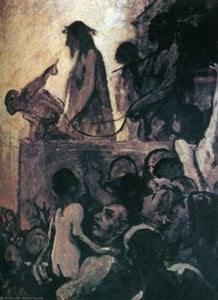
Honoré Daumier's "The Defender," created around 1865, stands as a cornerstone of Realist art—a genre dedicated to portraying life truthfully without romantic embellishment. More than just a depiction of a courtroom scene, this watercolor captures the palpable tension and psychological complexity inherent in legal proceedings, cementing Daumier’s reputation as a keen observer of human behavior and a fearless critic of societal injustices.

Composition and Technique: Mastering Line and Tone

The artwork's horizontal orientation emphasizes stability while simultaneously drawing the viewer’s eye into the central figures—a lawyer passionately gesturing with his arm and a woman radiating apprehension. Daumier skillfully employs expressive lines to sculpt form, particularly in the lawyer’s hand and forearm, conveying urgency and conviction. Hatching and cross-hatching techniques are meticulously applied throughout the composition, generating texture and shading that imbue the scene with depth and atmosphere. The muted color palette—primarily browns, grays, beige, and black—serves to heighten the drama, mirroring the solemnity of the courtroom setting.

Historical Context: Satirical Commentary on Justice

Daumier’s work emerged during a period of significant social upheaval in France – the Second Empire. He was deeply invested in documenting the realities of everyday life and exposing hypocrisy within the political elite. “The Defender” isn't merely a visual record; it’s a deliberate commentary on the legal system, questioning its impartiality and highlighting the vulnerability of those facing judgment. Daumier’s artistic choices reflect his commitment to portraying human emotion with unflinching honesty.

Symbolism: Anxiety, Advocacy, and Representation

The woman's posture—hunched shoulders, averted gaze—symbolizes anxiety and fear – emotions powerfully conveyed by Daumier through subtle shading and expressive lines. Conversely, the lawyer’s forceful gesture embodies advocacy and determination. The blurred background crowd represents the impersonal nature of justice, emphasizing the individual’s confrontation with a larger societal force. These symbolic elements elevate “The Defender” beyond a simple courtroom sketch, transforming it into an exploration of human psychology and social critique.

Emotional Impact: Capturing Human Vulnerability

"The Defender" resonates profoundly with viewers due to Daumier's masterful ability to capture the emotional core of his subject matter. The subdued color palette and meticulous linework contribute to a sense of melancholy and contemplation, prompting reflection on themes of vulnerability, courage, and the pursuit of truth. It’s a testament to Daumier’s enduring legacy as an artist who dared to confront uncomfortable realities with unwavering artistic integrity.


Om kunstneren

A Life Etched in Satire: The World of Honoré Daumier

Honoré-Victorin Daumier’s life unfolded against the backdrop of a rapidly changing France, a nation grappling with revolution and social upheaval. Born in Marseille in 1808, his early years were shaped by a lineage steeped in artistic tradition—his father, a poet and glazier, and his grandfather, a sculptor—instilling within him an appreciation for both visual and literary expression. However, Daumier’s path diverged from the expected, driven not by a desire for poetic acclaim but by a profound empathy for the plight of ordinary people and a burning need to expose societal injustices. His father's relocation to Paris in 1814 exposed young Honoré to the vibrant artistic atmosphere of the capital, a crucible where classical influences mingled with nascent Romantic ideals. Despite initial plans for a legal career, Daumier’s heart belonged to art, an inclination nurtured through apprenticeships under Alexandre Lenoir, absorbing the techniques and sensibilities of the old masters, particularly Rubens and Titian. His training at the Académie Suisse provided a formal foundation, but it was his innate sensitivity—a keen awareness of human suffering and political corruption—that truly defined his artistic vision.

The Sharpened Pen: Caricature and Social Commentary

Daumier’s career ignited with explosive force in the wake of the 1830 Revolution, a watershed moment that unleashed a torrent of social and political change. He quickly established himself as a master lithographer, initially working anonymously for various publications before gaining recognition through his provocative work with *Le Charivari*, a fiercely independent comic journal founded by Charles Philipon. It was within this radical publication that Daumier’s genius truly blossomed. His caricatures weren't mere humorous illustrations; they were biting critiques of the bourgeoisie, the legal system, and the political establishment—a relentless assault on hypocrisy and corruption. He fearlessly lampooned King Louis-Philippe, a figure he viewed as detached from the realities of his people, earning himself a six-month imprisonment in 1832 for a particularly stinging caricature. This act of defiance, far from silencing him, solidified his commitment to using art as a weapon against oppression. His lithographs became visual manifestos, capturing the spirit of dissent and offering a stark portrayal of the social ills plaguing France. The sheer volume of his output during this period is staggering—thousands of images that served as both popular entertainment and potent political statements. Daumier’s work was not simply satirical; it possessed a raw emotional honesty, reflecting the hardships faced by the working class and the inequalities inherent in French society.

Beyond Caricature: Painting and Sculptural Visions

While Daumier is most celebrated for his lithographs, to reduce him solely to caricature would be a profound oversight. He was also a dedicated painter and sculptor, though recognition for these works came later in his life. His paintings, often depicting scenes of everyday Parisian life—the cramped third-class carriages, the weary laundresses, the pompous lawyers—are imbued with a remarkable sense of realism and empathy. Unlike idealized depictions of nobility or heroism, Daumier’s subjects were ordinary people, struggling to survive in a world dominated by wealth and privilege. He masterfully employed loose brushwork and dramatic lighting to convey emotion and atmosphere, foreshadowing some of the techniques later embraced by the Impressionists—a subtle shift towards capturing fleeting moments and subjective impressions. His sculptural work, largely created in clay during his lifetime (many pieces remaining unbaked), reveals a similar commitment to capturing the human form with honesty and emotional depth. These sculptures, rediscovered after his death, demonstrate a remarkable talent for modeling and an ability to convey psychological complexity through physical gesture—a testament to his profound understanding of the human condition.

A Lasting Legacy: Influence and Historical Significance

Honoré Daumier’s impact on art history is undeniable. He bridged the gap between Romanticism and Realism, laying the groundwork for future generations of artists who sought to depict the world as it truly was—warts and all. His unflinching social commentary influenced artists like Gustave Courbet and Édouard Manet, both of whom embraced a more direct approach to portraying social realities. Daumier’s innovative use of lithography revolutionized printmaking, transforming it from a primarily decorative medium into a powerful tool for political expression and social critique. His work continues to resonate today, reminding us of the enduring power of art to challenge authority, expose injustice, and bear witness to the human condition. The Musée d'Orsay in Paris houses a significant collection of his paintings and sculptures, offering visitors a poignant glimpse into the world he so vividly portrayed. Furthermore, his lithographs are widely accessible through collections like those found on WahooArt, ensuring that his satirical genius continues to provoke thought and inspire dialogue across generations. Daumier wasn’t merely an artist; he was a chronicler of his time—a visual poet who used his talent to give voice to the voiceless and hold power accountable. His legacy endures as a testament to the enduring relevance of art as a force for social change, a reminder that even a single image can spark revolution.

Honoré Daumier

Honoré Daumier

1808 - 1879 , Frankrike

Kort om kunstneren

  • Artistic Movement Or Style: Realisme, Satire
  • Artists Or Movements Influenced By This Artist:
    • Impressionisme
    • Moderne kunst
  • Artists Who Influenced This Artist:
    • Alexandre Lenoir
    • David
  • Date Of Birth: 26. februar 1808
  • Date Of Death: 10. februar 1879
  • Full Name: Honoré-Victorin Daumier
  • Nationality: Fransk
  • Notable Artworks:
    • Rue Transnonain
    • Les gens de justice
  • Place Of Birth: Marseille, Frankrike
Utforsk kunstverk organisert etter temaer, stiler og kjennetegn.