Giclée- eller lerretsprint av museumskvalitet med rask produksjon og fleksible valgmuligheter for etterbehandling. ( Kjøp håndmalt maleri Bytt til digitalt bilde)





























Velg mellom våre forhåndsdefinerte størrelser som bevarer kunstverkets opprinnelige proporsjoner.

Skriv inn ønsket bredde og høyde for å tilpasse trykket til din ramme eller vegg. Et trykk kan kun beskjæres, aldri skaleres opp utover motivets opprinnelige størrelse, noe som betyr at et format med andre proporsjoner vil føre til tap av deler av bildet. Vi sender deg en digital mockup for godkjenning før vi starter trykkeprosessen. Bildet som vises på denne siden viser ikke den faktiske beskjæringen — det er kun mockuppen som viser dette.
Verdensomspennende levering () på 2 uker i stedet for standard 4/5 uker. (8 November)
Ecce Homo
Størrelse på reproduksjon
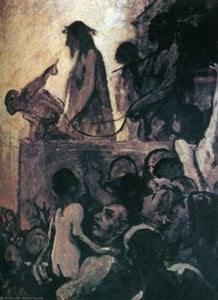
In the mid-19th century, as the world began to shift under the weight of industrialization and political upheaval, Honoré Daumier captured a moment of profound spiritual and social tension. His 1850 masterpiece, Ecce Homo, is far more than a mere biblical illustration; it is a visceral encounter with the essence of human suffering. The painting captures the harrowing instant when Pontius Pilate presents a battered Jesus Christ to a judgmental crowd, uttering the fateful words, "Behold the Man." Through his unflinching lens, Daumier strips away the gilded, idealized layers often found in religious iconography, replacing them with a stark, heavy realism that forces the viewer to confront the uncomfortable truth of injustice and the weight of collective condemnation.
The composition is a masterclass in psychological depth and dramatic tension. Daumier utilizes a technique deeply rooted in the tradition of chiaroscuro, a method he refined by studying the dramatic light and shadow of masters like Rubens. This interplay of light and dark does not merely illuminate the scene; it sculpts the very emotions of the figures. A luminous, almost ethereal glow surrounds the central figure of Christ, yet this light does not offer comfort—instead, it serves to highlight his isolation against a backdrop of grim, shadowed faces. The crowd is not a monolithic entity but a collection of individual gazes: some are filled with mockery, others with a haunting, silent observation, creating a sense that the viewer is standing right there in the dust and heat of the Roman trial.
Technically, Ecce Homo showcases Daumier’s extraordinary command over oil on canvas. His brushwork avoids the superficial prettiness of the era, opting instead for a textured, robust application that mirrors the grit of the subject matter. The palette is dominated by earthy, somber tones—deep browns, muted ochres, and heavy shadows—which ground the divine event in a tangible, earthly reality. This commitment to Realism allows the painting to transcend its historical period; it becomes a universal symbol of compassion amidst cruelty. For the collector or the lover of fine art, this piece offers a profound sense of gravity, making it an anchor for any sophisticated interior.
For those looking to integrate such a powerful work into a curated space, Ecce Homo serves as a magnificent focal point. Its ability to command attention through tonal complexity and emotional weight makes it ideal for galleries or study rooms where art is intended to provoke thought and conversation. A high-quality reproduction of this work preserves the subtle gradations of Daumier’s shadows and the raw, expressive lines of his draftsmanship, allowing the haunting beauty of this 19th-century triumph to breathe within a modern setting. It is an invitation to look closer, to feel the weight of history, and to find beauty in the most honest depictions of the human condition.
Honoré Daumier brukte Oil On Canvas-teknikken i "Ecce Homo". Teknikken definerer det materielle uttrykket til det originale verket.
"Ecce Homo" av Honoré Daumier beskrives med en Dramatic stemning. Denne klassifiseringen kan bidra til å matche verket med et passende miljø.
"Ecce Homo" av Honoré Daumier kombinerer Oil On Canvas-teknikken med Contemporary Realism-stilen. Teknikk og stilretning beskriver verkets utførelse og estetiske uttrykk.


1808 - 1879 , Frankrike

Discover the timeless art of fresco painting. Explore the profound history, technical mastery of buon fresco, and the enduring legacy of Renaissance masters like Michelangelo in this expert guide to painting on wet plaster.

Explore the profound mastery of fresco painting, from the technical alchemy of buon fresco to the legendary narratives of Renaissance masters like Ghirlandaio. Discover how this timeless medium shaped art history and continues to inspire architectural grandeur today.

Explore the profound power of religious symbolism in art history. From Renaissance masterpieces to sacred iconography, uncover the hidden meanings behind divine details in a deep dive into classical art excellence.
 Forhåndsvisning
 Send
Send Del
Del
 Vis detaljer
 Utskriftsvennlig guide

 Last ned bilde
 Liknende objekter
 Røntgenundersøkelse
 Lysbildefremvisning
 Spørsmål og svar
 Statistikk


 Vis hele teksten









 Glassalternativet er kun tilgjengelig i størrelser under 110 cm