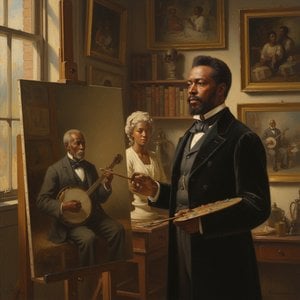
A Legacy of Character and Heritage: The Life of Henry Inman
In the burgeoning landscape of nineteenth-century American art, few figures captured the evolving identity of a young nation as intimately as Henry Inman. Born in 1801 in Utica, New York, to English immigrant parents, Inman was a product of both old-world tradition and new-world ambition. His early years in the settlement of Utica provided a foundation of industriousness, but it was his move to the vibrant, growing metropolis of New York City in 1812 that truly ignited his artistic destiny. Under the mentorship of established masters such as John Wesley Jarvis and John Quidor, Inman refined a technical precision that would become his hallmark, learning to navigate the delicate balance between realistic representation and the soulful expression required for high-society portraiture.
Inman’s artistic journey was never confined to a single genre; rather, it was a multifaceted exploration of the American experience. While he possessed a remarkable talent for capturing the quiet, everyday moments of life through his genre scenes—notably his evocative depictions of “Rip Van Winkle” and “The News Boy”—his heart belonged to the study of human character. His portraits were more than mere likenesses; they were psychological studies that sought to reveal the inner dignity and intellect of his subjects. Through a meticulous application of light and shadow, he breathed life into the faces of the era's most influential figures, creating a visual record of leadership and intellect that remains vital to our understanding of American history.
The Documentation of a Vanishing World
Perhaps the most profound chapter of Inman’s career lies in his monumental contribution to the preservation of Native American heritage. Collaborating with the celebrated lithographer Thomas L. McKenney, Inman undertook the Herculean task of producing "The History of the Indian Tribes of North America." This endeavor required him to meticulously copy over one hundred oil paintings originally executed by Charles Bird King. This was not merely a technical exercise in reproduction; it was an act of historical preservation. Through his diligent work, Inman helped ensure that the likenesses and cultural dignity of Native American leaders were etched into the permanent annals of American art history.
This period of his life demonstrated a deep-seated empathy and an alignment with the intellectual currents of his time, which sought to document the complexities of a changing continent. His ability to translate the grandeur of these original works into a format accessible to a wider audience cemented his reputation as an artist of significant social and historical responsibility. In doing so, he bridged the gap between fine art and ethnographic record, making him a pivotal figure in the early American movement toward cultural documentation.
Artistic Mastery and Historical Significance
The breadth of Inman’s portraiture serves as a Who's Who of nineteenth-century American prominence. His canvases featured an extraordinary array of notable figures, including:
- Political Titans: Such as Martin Van Buren, William H. Seward, and DeWitt Clinton.
- Legal Luminaries: Including Chief Justices Marshall and Nelson.
- Intellectuals and Explorers: Most notably the naturalist John James Audubon and the writer Fitz-Greene Halleck.
Beyond his individual canvases, Inman’s influence extended to the very institutions that shaped American art. His role in the founding of the National Academy of Design underscores his commitment to establishing a formal structure for artistic excellence in the United States. Though his life was tragically short, ending in 1846, the impact of his work remains indelible. He left behind a legacy defined by a rare combination of technical virtuosity and a profound respect for the subjects he portrayed, ensuring that the faces of the past continue to speak to the generations of the present.



 Forhåndsvisning
 Bytt til trykk
 Send
Send Del med andre
 Vis detaljer

 Last ned bildet
 Liknende objekter
 Røntgenundersøkelse
 Lysbildefremvisning
 Statistikk


 Vis hele teksten






































 Glassalternativet er kun tilgjengelig i størrelser under 110 cm