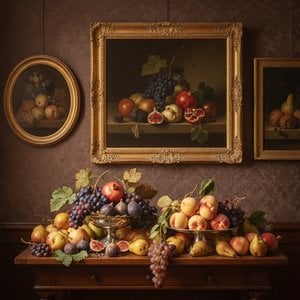
Gustave Courbet’s Still Life of Red Apples: A Revolutionary Moment in Art
In 1871, at a pivotal moment in the history of art, Gustave Courbet presented the world with “Three Red Apples,” a deceptively simple composition that belies its profound significance. More than just a depiction of fruit on a table, this painting represents a radical shift in artistic practice – a deliberate rejection of academic conventions and a passionate embrace of Realism’s commitment to portraying everyday life with unflinching honesty. Housed within the esteemed Musée d'Orsay in Paris, this work stands as a testament to Courbet’s revolutionary vision and his enduring influence on subsequent generations of artists.
The Essence of Realism: Observation and Truth
Courbet’s Realism wasn’t merely about painting what one saw; it was about capturing the *truth* of that observation. He deliberately eschewed romantic idealization, historical grandiosity, or mythological narratives – subjects typically favored by the established art academies. Instead, he focused on the ordinary: a table, three apples, and the play of light upon their surfaces. This seemingly modest subject matter became a powerful statement in itself, asserting the validity of depicting the world as it truly was, without embellishment or judgment. The painting’s power lies precisely in its simplicity – a deliberate choice to strip away artifice and confront the viewer with the raw reality of the scene.
Symbolism Within Simplicity: Apples, Temptation, and Mortality
The apple itself is laden with symbolic weight, drawing upon centuries of artistic and cultural associations. In the biblical story of Adam and Eve, the forbidden fruit represents temptation, knowledge, and ultimately, humanity’s fall from grace. Throughout Western art history, apples have served as potent symbols – in Renaissance paintings they often signify beauty, love, and even mortality. Courbet masterfully utilizes this pre-existing symbolism, inviting viewers to contemplate the deeper meanings embedded within the seemingly straightforward arrangement of fruit. The vibrant red color further intensifies these associations, evoking both pleasure and a subtle sense of foreboding.
Technique and Composition: A Masterclass in Observation
Courbet’s technique is characterized by bold, expressive brushstrokes that capture the texture and form of the apples with remarkable accuracy. He employed a loose, painterly style – avoiding meticulous detail and instead focusing on conveying the essence of the subject matter. The composition is remarkably balanced, with the three apples arranged in a triangular formation that draws the eye across the canvas. The dark background serves to accentuate the brilliance of the fruit, creating a dramatic contrast of light and shadow. The subtle variations in color and tone – from the deep crimson of the apples to the muted browns and grays of the table – demonstrate Courbet’s keen observational skills and his ability to capture the nuances of everyday life.
Legacy and Influence: A Bridge to Modern Art
“Three Red Apples” is considered a pivotal work in the development of modern art. It paved the way for Impressionism, Cubism, and other movements that challenged traditional artistic conventions. Courbet’s commitment to depicting reality without idealization profoundly influenced artists like Paul Cézanne, who sought to capture the underlying structure of objects rather than their superficial appearance. The painting's directness and its focus on ordinary subjects resonated with a growing desire for art to reflect the experiences of everyday people – a sentiment that continues to inform artistic practice today. It remains a powerful reminder of Courbet’s revolutionary vision and his enduring legacy as one of the most important artists of the 19th century.



 Forhåndsvisning
 Kjøp håndlaget maleri
 Send
Send Del med andre
 Vis detaljer

 Last ned bildet
 Liknende objekter
 Røntgenundersøkelse
 Lysbildefremvisning
 Statistikk


 Vis hele teksten






































 Glassalternativet er kun tilgjengelig i størrelser under 110 cm