Grace Gardner: A Life Painted in Bold Color and Evocative Abstraction
Grace Gardner (1920-2013) wasn’t merely an artist; she was a force of nature within the abstract art world, a vibrant spirit who relentlessly pursued her vision of color and form. Born in Yugoslavia – though later adopting the name “Gardner” – her early life laid the foundation for a career defined by bold experimentation and a deep connection to the natural world. From humble beginnings, she embarked on a journey that took her across continents and culminated in a body of work celebrated for its dynamic energy, intricate layering, and profound exploration of fertility and nature’s rhythms.
Gardner's formative years were shaped by a confluence of influences. Initially trained in traditional methods, she quickly gravitated towards abstraction, finding inspiration in the works of artists like Rudolf Laban and Frances Richardson. These early teachers instilled within her a disciplined approach to technique while simultaneously encouraging her to break free from conventional boundaries. Crucially, she also found resonance with the work of Kwok Wai Lau, whose explorations of color and texture proved pivotal in shaping her distinctive style. Her relocation to Cornwall in 1984 marked a significant turning point, providing her with a new environment and a renewed sense of creative purpose. The rugged beauty of the Cornish coastline, with its dramatic cliffs and abundant flora, became a constant source of inspiration, permeating her canvases with a palpable sense of place.
The Evolution of a Distinctive Style
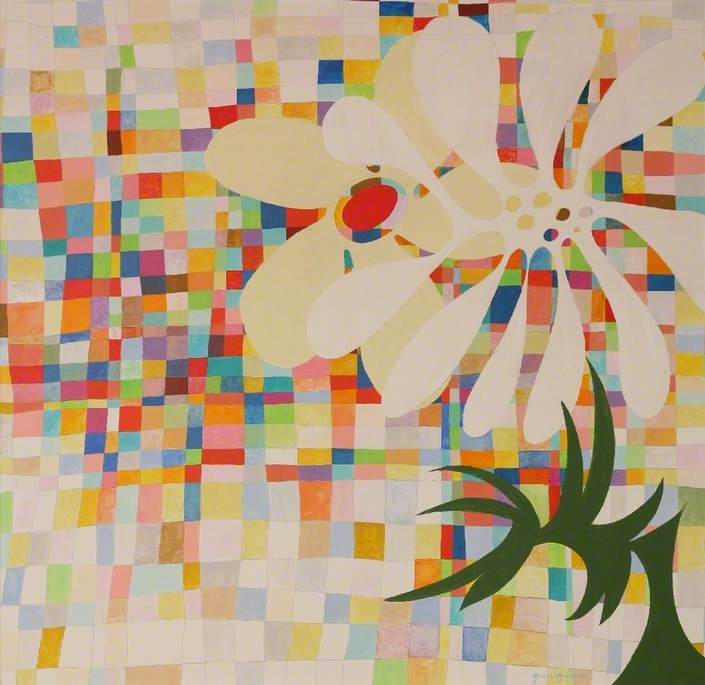
Gardner’s artistic evolution is characterized by a remarkable progression from early explorations of color to increasingly complex and layered compositions. Her initial works often featured vibrant fields of color – reds, blues, yellows – applied with a loose, expressive brushstroke. However, as her career unfolded, she developed a sophisticated technique involving multiple layers of paint, creating textured surfaces that seemed to shimmer and vibrate with energy. The “grid” series, born during a period of illness, stands as a testament to this evolution. These intricate compositions, built upon a repeating grid pattern, explored themes of growth, renewal, and the cyclical nature of life – mirroring her own experience of recovery.
A key element of Gardner’s style was her masterful use of ribbons—a recurring motif in her work that she described as representing “the flow of energy” and “the interconnectedness of all things.” These ribbons, often rendered in bold strokes of color, weave through her paintings, creating a sense of movement and dynamism. Her later works became increasingly abstract, with the ribbons dissolving into swirling patterns of color, evoking the feeling of a vibrant, living landscape.
Major Works and Exhibitions
Throughout her prolific career, Gardner exhibited extensively both in Europe and North America. Her work has been featured in prestigious galleries such as the Drian Galleries in London, the American Embassy Gallery in Rome, and the Polish National Museum in Warsaw. Notably, she participated in “American Artists in Britain” at Universities of Hull and Leeds in 1976, showcasing her distinctive style to a wider audience. Her painting "Formerly Yugoslavia II," a dynamic abstract expressionist piece dominated by blues and reds, exemplifies her ability to convey powerful emotions through color and texture – a work now housed in the WahooArt database.
The Falmouth Art Gallery holds a significant collection of Gardner’s works, including a substantial donation from the artist herself. This collection offers invaluable insight into the development of her style and provides a comprehensive overview of her artistic output. Her 2004 gift to the gallery solidified her legacy as a major figure in British abstract art.
Legacy and Historical Significance
Grace Gardner’s impact on the art world extends far beyond the individual canvases she created. She was a tireless advocate for abstraction, consistently pushing the boundaries of color and form. Her work reflects a deep engagement with both the natural world and the human experience – themes that resonate powerfully today. Her unwavering dedication to her craft, coupled with her distinctive style and prolific output, has cemented her place as one of the most important abstract artists of the 20th century. She left behind a body of work that continues to inspire and challenge viewers, reminding us of the transformative power of color and the enduring beauty of abstraction.



 Forhåndsvisning
 Kjøp håndlaget maleri
 Send
Send Del med andre
 Vis detaljer

 Last ned bildet
 Liknende objekter
 Røntgenundersøkelse
 Lysbildefremvisning

 Vis hele teksten






































 Glassalternativet er kun tilgjengelig i størrelser under 110 cm





