Giclée- eller lerretsprint av museumskvalitet med rask produksjon og fleksible valgmuligheter for etterbehandling. ( Kjøp håndmalt maleri Bytt til digitalt bilde)





























Velg mellom våre forhåndsdefinerte størrelser som bevarer kunstverkets opprinnelige proporsjoner.

Skriv inn ønsket bredde og høyde for å tilpasse trykket til din ramme eller vegg. Et trykk kan kun beskjæres, aldri skaleres opp utover motivets opprinnelige størrelse, noe som betyr at et format med andre proporsjoner vil føre til tap av deler av bildet. Vi sender deg en digital mockup for godkjenning før vi starter trykkeprosessen. Bildet som vises på denne siden viser ikke den faktiske beskjæringen — det er kun mockuppen som viser dette.
Verdensomspennende levering () på 2 uker i stedet for standard 4/5 uker. (8 November)
The Hunter's Gift
Størrelse på reproduksjon
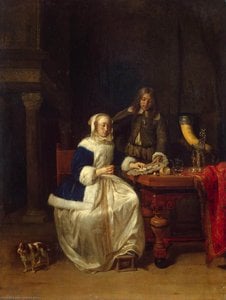
To gaze upon Gabriel Metsu’s The Hunter's Gift is to step across the threshold and into a moment suspended in time—a tableau vivant steeped in the quiet richness of Dutch Golden Age domesticity. This painting, executed in 1658, transcends a mere portrait; it is an intimate narrative woven from light, texture, and carefully placed objects. The scene unfolds within a richly appointed room, suggesting the comfortable elegance of prosperous burgher life. At its heart are two figures: a woman seated gracefully at a table, engrossed in the contemplation of a book, accompanied by a gentleman whose presence anchors the left side of the composition. The arrangement is one of studied ease, inviting the viewer to lean closer and decipher the unspoken dialogue passing between them.
Metsu, known for his eclectic artistic spirit, demonstrates here a profound command over genre scenes interwoven with meticulous still life elements. Observe the objects scattered across the table: the gleam on the wine glasses, the quiet curve of the vase near the center, and the scholarly weight of the open book. These items are not mere props; they are carefully curated components contributing to the overall atmosphere. The inclusion of several dogs, positioned with naturalistic grace—one near the edge, another closer to the group—lends a palpable sense of life and companionship to the setting. Even the small details, such as the clock ticking silently above the fireplace mantle or the bird perched delicately upon the tabletop, draw the eye into an almost obsessive appreciation for texture and form.
The symbolism within The Hunter's Gift invites deeper contemplation. The presence of hunting paraphernalia, hinted at by the title, juxtaposed with the domestic setting, suggests a harmonious balance between worldly pursuits and intellectual repose. The book itself speaks to learning and virtue, while the wine glasses hint at conviviality and shared experience. Metsu masterfully employs these everyday objects—the bowl, the bottles, the literature—to elevate the scene from simple depiction to profound meditation on life's pleasures: companionship, knowledge, and material comfort. It is a celebration of cultivated taste.
The technical brilliance evident in this work lies in Metsu’s handling of light. The illumination seems to emanate from an unseen source, catching highlights on polished wood, the sheen of dog fur, and the creamy pages of the book, lending the entire scene a luminous, almost palpable quality. For those who appreciate the depth of Dutch Baroque painting, this piece offers unparalleled emotional resonance. It speaks not of grand historical events, but of the quiet dignity found in shared moments—a feeling that continues to captivate collectors and interior designers alike. Owning a reproduction allows one to bring this sophisticated atmosphere of tranquil elegance into your own space, transforming a room into a sanctuary reminiscent of 17th-century Dutch refinement.
De Earthy fargene i "The Hunter's Gift" av Gabriel Metsu harmonerer med det anbefalte rommet: et Living Room.
"The Hunter's Gift" er et WallArt-verk.
Square-formatet til "The Hunter's Gift" av Gabriel Metsu anbefales for et Living Room. Format og romfølelse fungerer sammen som en veiledning for plassering av en reproduksjon.


1629 - 1667 , Nederland

Embark on a sophisticated journey through the Dutch Golden Age. Unveil the dramatic brilliance of Rembrandt’s chiaroscuro and the expressive landscapes of 17th-century masters in this authoritative exploration of light, shadow, and enduring artistic legacy.

Explore the dramatic mastery of Dutch Baroque art. Discover how chiaroscuro and light define the Golden Age, from Rembrandt's shadows to maritime grandeur. Perfect for classic art enthusiasts seeking deep historical insight and inspiration.
 Forhåndsvisning
 Send
Send Del
Del
 Vis detaljer
 Utskriftsvennlig guide

 Last ned bilde
 Liknende objekter
 Røntgenundersøkelse
 Lysbildefremvisning
 Spørsmål og svar
 Statistikk


 Vis hele teksten









 Glassalternativet er kun tilgjengelig i størrelser under 110 cm