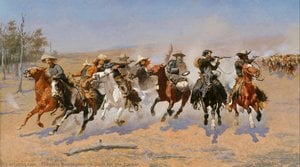
A Cavalryman’s Breakfast – A Moment of Quiet Strength on the Frontier
Frederic Remington's “A Cavalryman’s Breakfast on the Plains,” painted in 1892, isn’t merely a depiction of soldiers enjoying a meal; it’s a carefully constructed tableau brimming with the spirit and complexities of the American West. This oil-on-canvas masterpiece, now residing within the Amon Carter Museum of American Art in Fort Worth, offers a poignant glimpse into the daily lives of the U.S. Cavalry during the late 19th century – a time of expansion, conflict, and profound cultural shifts.
Remington, already establishing himself as a leading chronicler of this rapidly changing landscape, masterfully captures a seemingly simple scene. The composition is remarkably balanced, drawing the eye to the central group of cavalrymen gathered around a crackling campfire. Their faces, etched with weariness and camaraderie, tell stories of long days patrolling vast territories, facing unpredictable weather, and navigating the challenges of frontier life. Notice how Remington subtly contrasts the ruggedness of their uniforms – the heavy boots, thick coats, and weathered leather – with the warmth emanating from the fire and the shared intimacy of their meal.
The Brushstrokes of a Pioneer
Remington’s artistic style is immediately recognizable: bold, dynamic brushwork that conveys movement and energy. He doesn't shy away from depicting the textures of the scene – the rough bark of the trees, the worn fabric of the uniforms, the flickering flames of the campfire. The artist employs a technique known as *chiaroscuro*, skillfully manipulating light and shadow to create depth and drama. The warm glow of the fire illuminates the faces of the soldiers, while the surrounding darkness hints at the vastness and potential dangers of the plains. This masterful use of light not only adds visual interest but also subtly underscores the scene’s emotional core – a sense of vulnerability amidst an expansive, sometimes unforgiving, environment.
Beyond simple realism, Remington imbues his work with a strong narrative voice. The inclusion of the figures in the background—a small group observing the cavalrymen—suggests a broader community, perhaps a Native American tribe or settlers, adding another layer to the story. The painting isn’t just about breakfast; it's about connection, resilience, and the shared experience of life on the frontier.
A Window into the West – Remington’s Legacy
Frederic Remington (1861-1909) was more than just an artist; he was a cultural interpreter. Born in Canton, New York, far from the landscapes he would later immortalize, Remington developed a deep fascination with the American West through his family’s connections to the Remington Arms Company and his own relentless curiosity. His paintings, often depicting cowboys, Native Americans, and the U.S. Cavalry, played a significant role in shaping public perception of this era – though it's important to acknowledge that his portrayals sometimes reflected prevailing stereotypes of the time.
“A Cavalryman’s Breakfast on the Plains” stands as one of Remington’s most celebrated works, exemplifying his ability to capture both the grandeur and the quiet dignity of frontier life. It remains a powerful testament to the spirit of those who shaped the American West, inviting viewers to contemplate themes of community, survival, and the enduring allure of the open range. Reproductions of this iconic painting offer a beautiful way to bring a piece of this captivating era into your home or office – a reminder of a time when courage, resilience, and a shared meal could define an entire culture.



 Forhåndsvisning
 Kjøp håndlaget maleri
 Send
Send Del med andre
 Vis detaljer
 Veiledning

 Last ned bildet
 Liknende objekter
 Røntgenundersøkelse
 Lysbildefremvisning
 Statistikk


 Vis hele teksten






































 Glassalternativet er kun tilgjengelig i størrelser under 110 cm