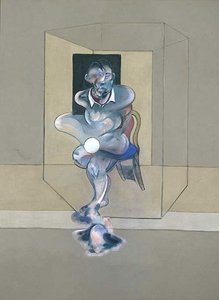
Et liv fordypet i det viscerale
Francis Bacon, et navn synonymt med den mest råe emosjonaliteten i det 20. århundres kunst, ble født i Dublin, Irland, i 1909. Men hans kunstneriske ånd fant sitt sanne uttrykk i landskapet etterkrigstidens Storbritannia. Hans tidlige liv var langt fra stabilt; hyppige flyttinger på grunn av morens helse skapte en følelse av fremmedgjøring som dypt formet hans verdensbilde og til slutt gjennomsyret hans lerret. Et komplekst forhold til sin strenge far og et nært bånd med barnevakten Jessie Lightfoot farget ytterligere det emosjonelle terrenget i hans formative år. I utgangspunktet tiltrukket av hesteløp og et liv med gambling, drev Bacon rundt i forskjellige yrker før han endelig viet seg til maling i slutten av tjueårene – en forsinket start som kanskje intensiverte hastverket og intensiteten i hans senere arbeid. Han ble ikke formelt utdannet, men smidde sin egen vei, absorberte påvirkninger fra ulike kilder og utviklet et unikt urovekkende visuelt språk.
Krybepunktet av tidlige påvirkninger
Bacons kunstneriske oppvåkning var ikke umiddelbar, men snarere en gradvis akkumulering av inntrykk. Arbeidene til Pablo Picasso, spesielt de forvrengte figurene fra hans tidlige kubistiske periode, viste seg å være avgjørende for å frigjøre ham fra tradisjonell representasjon. Han fant ytterligere inspirasjon i Egon Schieles hjemsøkende fotografi, hvis uttrykksfulle forvrengninger av menneskeskikk resonerte med Bacons egen spirende fascinasjon for eksistensens skjørhet og sårbarhet. Men det var et tilfeldig møte med Sergei Eisensteins film *Panserkrysseren Potemkin* som ga en avgjørende katalysator. Filmens viscerale bilder, spesielt et nærbilde av et skrikende ansikt, ble et vedvarende motiv i Bacons arbeid, og representerte primal terror og dybden av menneskelig lidelse. Han beundret også de gamle mestrene, fremfor alt Diego Velázquez, hvis *Portrett av pave Innocent X* han berømt ville tolke på nytt gjennom hele sin karriere, og forvandle den autoritative pavelige figuren til et torturert spøkelse. Disse påvirkningene var ikke bare stilistiske appropriasjoner; de ble absorbert og omformet gjennom Bacons egen unike følsomhet, noe som resulterte i en kunstnerisk visjon som både var dypt personlig og universelt gjenkjennelig.
Smiing av en signaturstil: Forvrengning og isolasjon
Bacons gjennombrudd kom med *Tre studier for figurer ved korsfestelsens fot* (1944), et verk som sjokkerte og fengslet publikum i etterkrigstidens London. Dette triptykonet etablerte hans signaturstil – forvrengte, fragmenterte figurer isolert innen klaustrofobiske rom. Dette var ikke fremstillinger av religiøs martyrdom, men snarere viscerale utforskninger av menneskelig angst, strippet for enhver trøstende fortelling eller åndelig trøst. Hans malerier har ofte uklare eller oppløsende former, som formidler en følelse av psykologisk uro og fysisk sårbarhet. Han brukte hyppig geometriske strukturer – bur, bokser – for å begrense sine motiver, og understreke deres isolasjon og maktesløshet. Bacons palett var typisk dempet og dyster, som gjenspeiler de mørke temaene han utforsket, selv om den ble punktert av utbrudd av intens farge som forsterket den emosjonelle virkningen. Bruken av disse burene var ikke bare et komposisjonsgrep; det symboliserte de iboende begrensningene og restriksjonene som pålegges menneskelig eksistens. Han søkte å fange ikke bare *hvordan* ting så ut, men *hvordan de føltes*, og overføre indre tilstander av angst, frykt og fortvilelse til lerretet med brutal ærlighet.
Temaer om dødelighet, angst og den menneskelige tilstanden
Gjennom sin produktive karriere vendte Bacon gjentatte ganger tilbake til visse motiver: korsfestelsen som et symbol på lidelse; portretter som dykket ned i den psykologiske intensiteten av sine motiver, ofte venner og elskere som George Dyer; og selvportretter som tjente som introspektive utforskninger av identitet og dødelighet. Hans *Studie etter Velázquez's Portrett av pave Innocent X* (1953)-serie er kanskje en av hans mest ikoniske prestasjoner, og forvandler Velázquez' verdig portrett til et skrikende spøkelse, som legemliggjør eksistensiell frykt. Portrettene av George Dyer, hans volatile elsker, er spesielt gripende, og fanger både intensiteten i deres forbindelse og den truende skyggen av tragedie. Bacons arbeid handlet ikke om å skildre spesifikke individer; det handlet om å utforske universelle temaer som menneskelig sårbarhet, isolasjon og uunngåeligheten av døden. Han unnlot ikke de mørkere aspektene ved eksistensen, men konfronterte dem direkte, og tvang seerne til å konfrontere sin egen dødelighet og angst.
En varig arv: Utfordre konvensjoner
Francis Bacons innvirkning på det 20. århundres kunst er ubestridelig. Han utfordret tradisjonelle forestillinger om representasjon, avviste idealisert skjønnhet til fordel for en rå, uforsonlig fremstilling av den menneskelige tilstanden. Hans arbeid har dypt påvirket generasjoner av kunstnere, og banet vei for nye former for uttrykk og utfordret konvensjonelle kunstneriske grenser.
- Etterkrigstidens ekspresjonisme: Bacon regnes som en nøkkelfigur i denne bevegelsen, og påvirket kunstnere med sin dristige stil og psykologiske dybde.
- Auksjonsrekorder & Museumutstillinger: Hans malerier fortsetter å kreve høye priser på auksjon og stilles ut i store museer over hele verden, noe som befester hans plass i kunsthistorien.
- Konfrontere sannheter: Bacons arv ligger i hans evne til å konfrontere ubehagelige sannheter om menneskelig eksistens og overføre disse opplevelsene til kraftige og uforglemmelige bilder.
Til tross for et turbulent personlig liv preget av gambling, drikking og komplekse forhold, forble han dedikert til sin kunst frem til sin død i 1992. Han etterlot seg et verk som fortsetter å resonere med publikum i dag, og minner oss om eksistensens skjørhet og den varige kraften i kunsten til å konfrontere de mørkeste hjørnene av menneskesjelen.
Hans malerier er ikke bare bilder; de er viscerale opplevelser – et vitnesbyrd om kunstens vedvarende evne til å provosere, forstyrre og til syvende og sist belyse kompleksiteten i det å være menneske.



 Forhåndsvisning
 Kjøp håndmalt maleri
 Send
Send Del
Del
 Vis detaljer
 Utskriftsvennlig guide

 Last ned bilde
 Liknende objekter
 Røntgenundersøkelse
 Lysbildefremvisning
 Q&A
Q&A Statistikk

 Vis hele teksten






































 Glassalternativet er kun tilgjengelig i størrelser under 110 cm