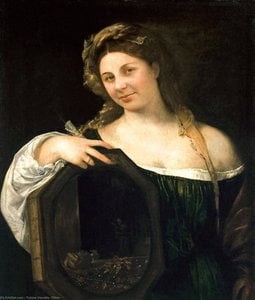
The Visionary Brush of Francesco Cairo
Born Pier Francesco Cairo in Milan on September 26, 1607, this Italian master emerged as a profound voice within the Baroque era, weaving together spiritual intensity and dramatic realism. While history often remembers the thunderous impact of Caravaggio or the psychological depth of Rembrandt, Cairo carved out a singular space for himself through a style that balanced mystical fervor with an almost hauntingly beautiful execution. His early works, deeply rooted in the traditions of Lombardy, were characterized by a preoccupation with the macabre and the morbid, yet they were elevated by a technical mastery that transformed grim subjects into profound meditations on mortality and faith.
The foundations of his artistry were laid under the guidance of Morazzone, a mentor whose influence is etched into Cairo’s early palette. From this tutelage, Cairo inherited a sophisticated use of luminous oranges, earthy browns, and deep greens—colors that would become hallmarks of his early devotional pieces. This stylistic lineage is most strikingly evident in his monumental altarpiece, Saint Teresa’s Vision of Saints Peter and Paul, created for the Certosa di Pavia. In this work, one can witness the burgeoning talent of a young artist capable of capturing the divine through light and color, reflecting the intense spiritual currents that defined Milanese Baroque art during the late 1620s.
Ascension to the Savoyard Court
A transformative chapter in Cairo’s life began in 1633, when he was summoned to Turin to serve as the court painter for Victor Amadeus I, Duke of Savoy. This appointment was not merely a professional milestone but a catalyst for international recognition. As a court painter, his scope expanded from intimate religious commissions to grand, sweeping narratives that captured the majesty and the underlying anxieties of the Savoyard aristocracy. It was during this period that he earned the prestigious title Il Cavalière del Cairo, having been honored with the Order of Saints Maurice and Lazarus in recognition of his immense merit to the state.
His tenure in Turin allowed for a remarkable stylistic evolution. While his early works focused on the intense, shallow pictorial spaces typical of Milanese painting, his later compositions began to embrace a newfound clarity of space and gesture, likely influenced by the burgeoning Bolognese school. This period produced some of his most emotionally charged works, such as Christ in the Garden of Gethsemane and the gripping Herodias with the Head of Saint John the Baptist. In these canvases, Cairo utilized dramatic chiaroscuro to sculpt figures out of shadow, creating a sense of theatrical tension that drew the viewer into the very heart of the biblical drama.
A Legacy of Light and Shadow
Throughout his nearly four-decade career, Cairo’s ability to navigate between the intimate and the monumental remained his greatest strength. His repertoire was vast, ranging from large-scale altarpieces for religious orders like the Carmelites to exquisite cabinet pictures that explored the darker recesses of the human psyche. Even as his style matured into a more balanced and classical approach, he never lost the ability to evoke the "mystical vision"—that precise moment where the earthly realm intersects with the divine.
The historical significance of Francesco Cairo lies in his role as a bridge between eras. He stood at the conclusion of the pestanti painters' tradition in Milan, yet his work looked forward, embracing the more expansive and structured compositions of the mid-17th century. When he passed away in Milan on July 27, 1665, he left behind a body of work that remains a testament to the power of the Baroque spirit: a legacy defined by:
- Psychological Depth: An unparalleled ability to imbue saints and martyrs with human vulnerability and intense emotion.
- Masterful Chiaroscuro: The use of dramatic light and shadow to create movement, volume, and spiritual atmosphere.
- Coloristic Brilliance: A sophisticated palette that transitioned from the earthy tones of his Lombard roots to a more luminous, courtly elegance.
- Narrative Intensity: A talent for capturing pivotal, often violent or miraculous, moments in history with profound dignity.



 Se i rommet
 Bytt til trykkversjon
 Del som digitalt kort
 Del
Del
 Detaljer
 Studentguide

 Last ned
 Liknende objekter
 Røntgen
 Lysbildefremvisning
 Besøksstatistikk

 Les mer