A Bold Embrace of Modernity: Exploring Fernand Léger’s “The Statuette Red”
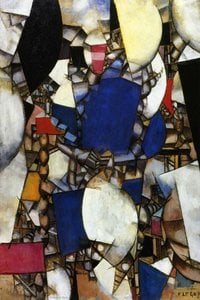
Fernand Léger’s “The Statuette Red,” painted in 1930, stands as a cornerstone of Cubism and Tubism—movements that fundamentally challenged the conventions of Western art at the time. More than just a depiction of form, it embodies Léger's unwavering conviction that art could – and should – reflect the dynamism and transformative power of industrial society.
- Subject Matter: The painting centers around a stylized female figure holding a baby, positioned against a striking crimson backdrop. This deliberate choice of color isn’t merely decorative; it symbolizes vitality, passion, and perhaps even a primal connection to the earth—a counterpoint to the mechanized world Léger sought to portray.
- Style & Technique: Léger's signature Tubism technique is evident throughout the canvas. Instead of attempting to represent objects realistically, he fragmented them into geometric planes and cylinders, simultaneously presenting multiple perspectives. This approach disrupts traditional notions of depth and illusion, prioritizing clarity and structural integrity.
- Historical Context: Created during the turbulent years following World War I, “The Statuette Red” reflects Léger’s profound engagement with the burgeoning industrial landscape of Europe. He witnessed firsthand the impact of technological advancements on human life and labor—themes that permeate his artistic vision.
- Symbolism & Emotion: The figure holding the baby represents fertility and nurturing – concepts antithetical to the perceived sterility of urban existence. Léger’s deliberate simplification of form aims to convey a sense of emotional resonance, bypassing intellectual contemplation in favor of direct sensory experience.
The Influence of Cubism: Breaking Down Representation
Léger's artistic trajectory was inextricably linked with the revolutionary ideas of Pablo Picasso and Georges Braque. Like his contemporaries, he rejected the pursuit of photographic realism, opting instead for a radically new visual language rooted in Cubist principles. This decision wasn’t driven by mere aesthetic preference; it stemmed from a conviction that art could communicate truths about the human condition beyond superficial appearances.
The fragmentation of form—a hallmark of Cubism—allowed Léger to explore multiple viewpoints simultaneously, capturing the essence of an object rather than its literal representation. This technique demanded meticulous attention to detail and precision, reflecting Léger’s fascination with engineering and industrial design.
A Celebration of Form and Color
"The Statuette Red" exemplifies Léger's masterful blending of geometric abstraction with expressive color palettes. The dominant crimson hue commands immediate attention, injecting energy and vibrancy into the composition. This bold chromatic choice underscores Léger’s belief that color could convey emotion and stimulate perception—a departure from Impressionist traditions.
Furthermore, Léger's use of cylindrical forms—characteristic of Tubism—creates a sense of stability and monumentality, contrasting with the perceived chaos of modern life. These forms are rendered with meticulous detail, emphasizing their materiality and reinforcing Léger’s commitment to capturing the physicality of the world around him.
Legacy & Inspiration
Fernand Léger's “The Statuette Red” continues to inspire artists and designers today. Its uncompromising embrace of abstraction—combined with its evocative color palette and masterful technique—serves as a testament to Léger’s enduring vision of art as a vehicle for exploring the complexities of the modern age. Reproductions of this iconic artwork offer a captivating glimpse into the artistic spirit of the 1930s, inviting viewers to contemplate the relationship between form, function, and emotion.
Spørsmål og svar
Hva er dateringen til "The statuette Red" av Fernand Léger?
"The statuette Red" av Fernand Léger ble skapt i 1930.
Hva har "The statuette Red" til felles med resten av Fernand Léger sin produksjon?
I Fernand Léger sitt kunstnerskap befinner "The statuette Red" seg innenfor Cubist Still Life-stilen, sammen med temaene influenced by cézanne & picasso, exploring industrial society, celebrating human form dynamism, key piece léger’s legacy.
Er Fernand Léger, skaperen av "The statuette Red", kjent under andre navn?
Fernand Léger er også kjent under navnene Joseph Fernand Henri Léger.



 Forhåndsvisning
 Bytt til trykk
 Send
Send Del
Del
 Vis detaljer
 Utskriftsvennlig guide

 Last ned bilde
 Liknende objekter
 Røntgenundersøkelse
 Lysbildefremvisning
 Q&A
Q&A Statistikk

 Vis hele teksten






































 Glassalternativet er kun tilgjengelig i størrelser under 110 cm