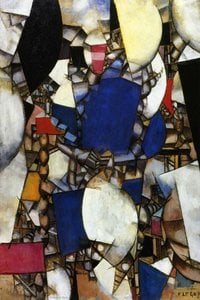
Fernand Léger: Capturing the Rhythm of Industry
Fernand Léger’s paintings represent more than just visual representations; they embody a profound engagement with the transformative forces reshaping Europe at the dawn of the 20th century. Born in Argentan, Normandy, in 1881, Léger initially pursued architecture but swiftly gravitated towards painting, establishing himself amidst the burgeoning artistic fervor of Paris.
- Early Influences: Léger’s formative years were marked by exposure to Impressionism and Post-Impressionism – movements that championed capturing fleeting moments of light and color. However, Léger quickly recognized the limitations of these approaches in conveying the burgeoning anxieties surrounding industrialization.
- Cubist Breakthrough: Léger's artistic breakthrough arrived with Cubism, spearheaded by Pablo Picasso and Georges Braque. Rejecting traditional perspective and embracing geometric abstraction, Léger sought to distill the essence of machine forms – pistons, gears, wheels – into simplified shapes that pulsed with rhythmic energy.
His technique involved applying thick layers of paint—often referred to as “impasto”—to create textured surfaces that mirrored the physicality of industrial machinery. Léger meticulously studied blueprints and photographs of factories, translating these observations into canvases dominated by bold reds, yellows, and blacks. These colors weren’t merely decorative; they served as symbolic representations of heat, fire, and the relentless drive of technological progress.
Notable Works:
- Composition VIII (1930): This iconic painting exemplifies Léger's Cubist style, presenting a fragmented depiction of industrial forms arranged in dynamic equilibrium.
- The City (1931): Léger’s monumental canvas captures the overwhelming scale and chaotic rhythm of urban life, conveying both apprehension and exhilaration.
Beyond its formal innovations, Léger's art possesses a palpable emotional resonance. He aimed to provoke contemplation about humanity’s relationship with technology – questioning whether progress inevitably leads to dehumanization or whether it can inspire awe and wonder. Léger’s paintings continue to resonate today as reminders of a pivotal moment in artistic history—a bold assertion that beauty could be found even amidst the clangorous machinery of the industrial age.
Symbolism Within Geometric Abstraction
Léger's use of color and form wasn’t arbitrary; it carried symbolic weight. Red, representing heat and passion, contrasted with yellow, symbolizing illumination and optimism. The repetition of geometric shapes—circles, squares, triangles—created a visual rhythm that mirrored the mechanical processes he observed in factories.
Technique: Impasto and Blueprint Studies
Léger’s distinctive technique involved applying paint thickly onto the canvas – “impasto” – creating textured surfaces that resembled industrial components. He meticulously studied blueprints and photographs of factories, translating these observations into simplified geometric forms.
Historical Context: The Rise of Industrialization
Léger’s artistic vision emerged during a period of unprecedented industrial expansion across Europe. Artists like Léger responded to this transformative era by rejecting traditional representational conventions and embracing abstraction as a means of conveying the anxieties and aspirations associated with technological advancement.
Emotional Impact: Reflection on Humanity's Future
Léger’s paintings invite viewers to confront questions about humanity’s role in shaping its own destiny. They convey both apprehension regarding the potential for dehumanization and exhilaration at the prospect of embracing technological progress—a legacy that continues to inspire artists and collectors alike.



 Forhåndsvisning
 Bytt til trykk
 Send
Send Del med andre
 Vis detaljer
 Veiledning

 Last ned bildet
 Liknende objekter
 Røntgenundersøkelse
 Lysbildefremvisning
 Statistikk
 Vis hele teksten






































 Glassalternativet er kun tilgjengelig i størrelser under 110 cm