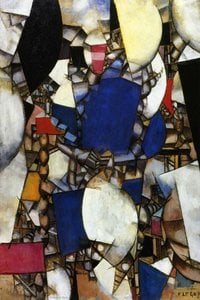
Giclée- eller lerretsprint av museumskvalitet med rask produksjon og fleksible valgmuligheter for etterbehandling. ( Kjøp håndmalt maleri Bytt til digitalt bilde)
Velg mellom våre forhåndsdefinerte størrelser som bevarer kunstverkets opprinnelige proporsjoner.

Skriv inn ønsket bredde og høyde for å tilpasse trykket til din ramme eller vegg. Et trykk kan kun beskjæres, aldri skaleres opp utover motivets opprinnelige størrelse, noe som betyr at et format med andre proporsjoner vil føre til tap av deler av bildet. Vi sender deg en digital mockup for godkjenning før vi starter trykkeprosessen. Bildet som vises på denne siden viser ikke den faktiske beskjæringen — det er kun mockuppen som viser dette.
Verdensomspennende levering () på 2 uker i stedet for standard 4/5 uker. (5 November)
'The album ''Circus''' (38)
Størrelse på reproduksjon
Fernand Léger's "The Album “Circus,” completed in 1950, stands as a cornerstone of early modern art—specifically, Tubism—a stylistic evolution born from Léger’s unwavering fascination with the burgeoning industrial landscape. Unlike many artists of his era who retreated into abstraction as an escape from representational concerns, Léger boldly embraced it as a vehicle for conveying the dynamism and geometric precision characteristic of the twentieth century.
Born Joseph Fernand Henri Léger in Argentan, Normandy, in 1881, Léger’s formative years were spent amidst rural labor—a stark contrast to the urban milieu that would become his artistic crucible. Initially drawn to architecture, he swiftly transitioned to painting after arriving in Paris around 1900, establishing himself as a supporter of avant-garde movements and forging connections with influential figures like Pablo Picasso.
Léger’s artistic breakthrough arrived with Tubism—a technique he developed alongside Picasso in 1907–8. Rejecting traditional perspective and anatomical accuracy, Tubism prioritized geometric simplification, reducing objects to fundamental forms—cubes, cylinders, and spheres—while simultaneously depicting them in overlapping planes. This approach wasn't merely stylistic; it reflected Léger’s conviction that art should capture the essence of industrial progress without resorting to illusion.
"The Album “Circus” exemplifies Tubism perfectly. The artwork eschews realistic depiction, opting instead for a flattened composition dominated by bold black and white lines and shapes. Thick, jagged lines delineate the contours of stylized birds—primarily a rooster-like figure—and surrounding foliage, creating an energetic visual rhythm that mirrors the movement of machinery.
Beyond its formal innovation, “The Album “Circus” carries symbolic weight. The rooster’s open beak serves as a potent emblem of proclamation and announcement – mirroring the sounds of factories and signaling Léger's desire to communicate the spirit of his time. The monochromatic palette—black and white—amplifies the artwork’s impact, emphasizing texture and form while stripping away distracting color variations.
Executed on paper using ink or charcoal, “The Album “Circus” embodies Léger’s commitment to capturing the transformative power of modernity. Its enduring appeal lies in its ability to distill complex ideas into elegant geometric shapes—a testament to Léger's genius as a pioneer of abstract art and his profound engagement with the visual language of the industrial age.
WahooArt offers exceptional reproductions of Fernand Léger’s “The Album “Circus,” meticulously crafted to preserve the artwork’s original tonal qualities and textural nuances. Enhance your interior décor or inspire artistic contemplation with a stunning print that embodies the spirit of Tubism—a legacy of innovation and visual eloquence.
Det anbefalte rommet for "'The album ''Circus''' (38)" av Fernand Léger er en Living Room. Forslaget kan selvfølgelig tilpasses ditt interiør.
Den Bold atmosfæren i "'The album ''Circus''' (38)" av Fernand Léger passer perfekt til det anbefalte rommet: et Living Room.
I "'The album ''Circus''' (38)" av Fernand Léger møtes Cubist Tubism-retningen og Moderne tid-epoken.

1881 - 1955 , Frankrike

Explore the vibrant world of Fernand Léger. Discover how his 'Tubism' and Machine Age aesthetics redefined modern art, offering profound inspiration for discerning collectors seeking geometric beauty and industrial dynamism.
 Forhåndsvisning
 Send
Send Del
Del
 Vis detaljer
 Utskriftsvennlig guide

 Last ned bilde
 Liknende objekter
 Røntgenundersøkelse
 Lysbildefremvisning
 Spørsmål og svar
 Statistikk

 Vis hele teksten






































 Glassalternativet er kun tilgjengelig i størrelser under 110 cm