Fernand Léger’s “The Mechanic”: A Dance of Industry and Introspection
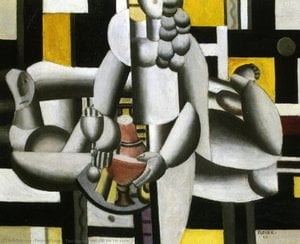
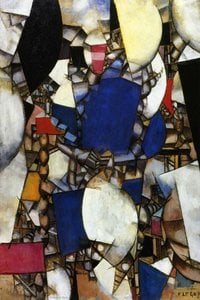
Fernand Léger's "The Mechanic," painted in 1920, isn’t merely a portrait; it’s a vibrant declaration of the modern age. This captivating artwork, housed within the Fernand Léger National Museum in Biot, France, offers a profound glimpse into Léger’s unique “Tubism” – a style that sought to capture the essence of industrialization not through romanticized depictions, but with bold geometric forms and a strikingly honest palette. The painting immediately draws the eye with its dynamic composition: a seated figure, seemingly lost in contemplation, dominates the scene, surrounded by a network of cylindrical shapes, sharp angles, and simplified planes – all rendered in a masterful blend of primary colors punctuated by stark black and white.
Léger’s artistic journey was deeply intertwined with the burgeoning industrial landscape of early 20th-century Europe. Having initially trained as an architect, he found himself increasingly drawn to the dynamism and mechanical precision of machines. This fascination manifested in “The Mechanic,” where the human figure is deconstructed into a series of interlocking geometric elements – cylinders, cones, and cubes – mirroring the very structures that defined the era. The artist deliberately flattened perspective, characteristic of Cubism, creating a sense of depth through overlapping shapes rather than traditional linear representation. This technique wasn’t about replicating reality; it was about distilling its core components into their most essential forms.
A Symphony of Color and Form
The painting's color palette is undeniably arresting. Léger masterfully employs a restricted range of primary colors – vibrant yellows, intense reds, and cool blues – alongside the grounding tones of black and white. These bold hues aren’t applied randomly; they are strategically used to emphasize form and create visual energy. Thick, deliberate brushstrokes outline the figure and geometric shapes, while thinner lines add subtle texture and detail. The contrast between these colors—the fiery reds against the cool blues, for instance—generates a powerful sense of movement and dynamism. Notice how the anchor symbol prominently displayed on the mechanic’s forearm – a seemingly simple detail – becomes a potent emblem of labor, strength, and perhaps even a touch of melancholy within this mechanized world.
Symbolism and the Human Element
While the geometric abstraction might initially appear cold or impersonal, “The Mechanic” is rich in symbolic meaning. The seated figure, often interpreted as an artist or intellectual, embodies the spirit of creative inquiry amidst the relentless march of progress. He’s not simply a worker; he's engaged in a process of reflection, suggesting that even within the heart of industry, there remains space for contemplation and artistic expression. The surrounding geometric forms can be viewed as representing elements of the environment – perhaps the machinery itself, or abstract concepts related to the figure’s thoughts. Léger isn’t simply depicting a mechanic; he's exploring the relationship between humanity and technology, suggesting that both are inextricably linked.
A Legacy of Modernity
"The Mechanic" stands as a pivotal work in Fernand Léger’s artistic development and a significant contribution to the broader movement of Cubism. Created during a period of intense experimentation and social change, it reflects Léger's desire to integrate modernity – its speed, its complexity, its mechanical nature – into a new visual language. The painting’s influence can be seen in subsequent generations of artists, particularly those who explored abstraction and the relationship between art and industry. It remains a powerful testament to Léger’s vision: a bold, innovative work that continues to resonate with viewers today, prompting reflection on the beauty and challenges of the modern world.
Spørsmål og svar
Er Fernand Léger, skaperen av "Den Mekaniker", kjent under andre navn?
Andre navn registrert for Fernand Léger, skaperen av "Den Mekaniker", inkluderer Joseph Fernand Henri Léger.
Hvor lys eller mørk oppleves "Den Mekaniker" av Fernand Léger som?
Når det gjelder oppfattet lysstyrke, er "Den Mekaniker" av Fernand Léger lyssterk.
Er "Den Mekaniker" et kjent kunstverk innen Cubist Innovation?
Innenfor Cubist Innovation-retningen har "Den Mekaniker" et Anerkjent popularitetsnivå.



 Forhåndsvisning
 Bytt til trykk
 Send
Send Del
Del
 Vis detaljer
 Utskriftsvennlig guide

 Last ned bilde
 Liknende objekter
 Røntgenundersøkelse
 Lysbildefremvisning
 Q&A
Q&A Statistikk

 Vis hele teksten