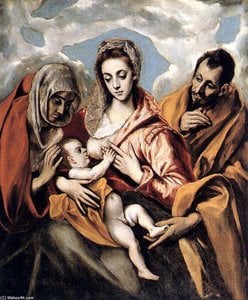
Retable and side altars (1577) av El Greco, håndmalt oljemaleri-reproduksjon av en mesterkunstner
Forhåndsvisning Se i AR Bytt til trykk Bytt til digitalt bilde Send
Vis detaljer Utskriftsvennlig guide Legg til i favoritter Last ned bilde Liknende objekter Røntgenundersøkelse Lysbildefremvisning Spørsmål og svar Last ned presentasjon Statistikk

Retable and side altars Håndmalt oljemalerireproduksjon

Explore El Greco’s ‘Retable & Side Altars’ (1577). A stunning Baroque masterpiece featuring elongated figures, dramatic lighting & religious symbolism. Discover this iconic artwork!

El Grecos manieristiske stil stråler i Begravelsen av greven av Orgaz. Oppdag hans åndelige mesterverk i dag.

Håndlaget oljereproduksjon

Håndmalt olje på lerret i din valgte størrelse og ramme, laget på bestilling av våre kunstnere. ( Bytt til trykk Bytt til digitalt bilde)

Corner sample of the P118B picture frame: støpt polystyren, 5 cm wide and 3 cm thick
P118B Nkr10
Corner sample of the P118H picture frame: støpt polystyren, 5 cm wide and 3 cm thick
P118H Nkr10
Corner sample of the P118W picture frame: støpt polystyren, 5 cm wide and 3 cm thick
P118W Nkr10
Corner sample of the P438Z picture frame: støpt polystyren, 5.5 cm wide and 3.5 cm thick
P438Z Nkr10
Corner sample of the P508JH picture frame: støpt polystyren, 7 cm wide and 3.5 cm thick
P508JH Nkr12
Corner sample of the P508YH picture frame: støpt polystyren, 7 cm wide and 3.5 cm thick
P508YH Nkr12
Corner sample of the P805H picture frame: støpt polystyren, 5 cm wide and 3.5 cm thick
P805H Nkr10
Corner sample of the P805Z picture frame: støpt polystyren, 5 cm wide and 3.5 cm thick
P805Z Nkr10
Corner sample of the P919BZ picture frame: støpt polystyren, 7 cm wide and 3.5 cm thick
P919BZ Nkr10
Corner sample of the P919G picture frame: støpt polystyren, 7 cm wide and 3.5 cm thick
P919G Nkr10
Corner sample of the P919XJ picture frame: støpt polystyren, 7 cm wide and 3.5 cm thick
P919XJ Nkr10
Corner sample of the P959ZH picture frame: støpt polystyren, 5 cm wide and 3 cm thick
P959ZH Nkr10
Corner sample of the P968JZ picture frame: støpt polystyren, 6 cm wide and 4 cm thick
P968JZ Nkr12
Corner sample of the W106C picture frame: massivt tre, 5 cm wide and 3 cm thick
W106C Nkr8
Corner sample of the W218G picture frame: massivt tre, 5 cm wide and 3 cm thick
W218G Nkr10
Corner sample of the W218JH picture frame: massivt tre, 5 cm wide and 3 cm thick
W218JH Nkr8
Corner sample of the W218Y picture frame: massivt tre, 5 cm wide and 3 cm thick
W218Y Nkr10
Corner sample of the W307PJ picture frame: massivt tre, 6 cm wide and 3 cm thick
W307PJ Nkr10
Corner sample of the W316G picture frame: massivt tre, 6 cm wide and 3 cm thick
W316G Nkr10
Corner sample of the W316PJ picture frame: massivt tre, 6 cm wide and 3 cm thick
W316PJ Nkr8
Corner sample of the W316Y picture frame: massivt tre, 6 cm wide and 3 cm thick
W316Y Nkr10
Corner sample of the W398PJ picture frame: massivt tre, 5 cm wide and 3 cm thick
W398PJ Nkr8
Corner sample of the W4111J picture frame: massivt tre, 6.5 cm wide and 3.5 cm thick
W4111J Nkr10
Corner sample of the W500HY picture frame: massivt tre, 7 cm wide and 5 cm thick
W500HY Nkr15
Corner sample of the W500JH picture frame: massivt tre, 7 cm wide and 5 cm thick
W500JH Nkr15
Corner sample of the W692G picture frame: massivt tre, 8 cm wide and 4 cm thick
W692G Nkr12
Corner sample of the W849H picture frame: massivt tre, 5 cm wide and 3 cm thick
W849H Nkr8
Corner sample of the W940BG picture frame: massivt tre, 7.5 cm wide and 4.5 cm thick
W940BG Nkr15
Corner sample of the W953PJ picture frame: massivt tre, 6 cm wide and 3.5 cm thick
W953PJ Nkr8

Standardformat
skreddersydd
CM
INCH

Velg mellom våre forhåndsdefinerte størrelser som bevarer kunstverkets opprinnelige proporsjoner.

bredde
høyde

Skriv inn ønsket bredde og høyde for å tilpasse bildet til din ramme eller vegg. Siden dette er håndmalt, kan kunstneren male litt mer rundt motivet eller beskjære det noe dersom du velger et annet format — valget er ditt. Vi sender deg en digital mockup til godkjenning før maleriet påbegynnes. Bildet som vises på denne siden representerer ikke det faktiske resultatet — kun mockuppen viser det endelige uttrykket.

Eksempler på hva som kan endres: Erstatt ansikt med bilde av kunden; Legg til kjæledyr (f.eks. bytt ut katt med hund); Inkluder en skjult melding i bakgrunnen; Endre bakgrunnslandskap eller elementer.
Etter bestilling vil WahooArt.com-teamet sende e-post til kunden for instruksjoner og sende et utkast (mockup) som forhåndsvisning.

Verdensomspennende levering () på 3–4 uker i stedet for standard 5 uker. (11 November). Ingen kompromisser med kvaliteten.

Gratis ekspressfrakt over hele verden
Lerretsduk av lin av høy kvalitet
Full transportforsikring
Garanti for refusjon av toll og importavgifter
Garantert fargegjengivelse
100 dagers returrett ved fabrikasjonsfeil
100% pengene tilbake-garanti
Rabatt ved flere kjøp

Totalpris

Nkr 2604

Retable and side altars

Trykkmetode

Størrelse på reproduksjon

-

Totalpris for valgte alternativer

Nkr 2604

Kort om verket

  • Artistic style: Expressionism, Cubism
  • Title: Retable and side altars
  • Subject or theme: Religious devotion
  • Movement: Baroque
  • Artist: El Greco

The Retable and Side Altars of El Greco – A Window into Faith and Fire

El Greco’s “Retable and Side Altars,” painted in 1577 for the Cistercian convent of Santo Domingo el Antiguo in Toledo, Spain, isn't merely a religious depiction; it’s a profound exploration of faith, emotion, and the burgeoning artistic spirit of the late Renaissance. Commissioned during a pivotal moment in El Greco’s career – his arrival in Spain after years spent honing his craft in Italy and Greece – this monumental altarpiece reveals a synthesis of influences, forging a uniquely powerful style that would resonate through art history. The work stands as a testament to El Greco's ability to imbue religious iconography with an intensely personal and dramatic sensibility, pushing beyond the established conventions of the time.

The core of the altarpiece centers around “The Assumption of the Virgin,” a breathtaking vision of Mary ascending into heaven. El Greco masterfully employs a dynamic composition, eschewing the static serenity often associated with religious art. Figures are elongated and distorted, their bodies contorted in expressions of anguish and ecstasy. The use of color is equally arresting – deep reds, blues, and ochres dominate, creating an atmosphere of heightened drama and spiritual intensity. The architectural setting, rendered with a subtle yet effective perspective, anchors the scene within the confines of Toledo’s Santo Domingo convent, grounding the divine in the earthly realm.

A Synthesis of Styles: Flemish Influence Meets Spanish Soul

El Greco's artistic journey is crucial to understanding this masterpiece. His early training in Crete exposed him to Byzantine iconography, characterized by its stylized figures and rich symbolism. However, his time in Italy, particularly Venice, introduced him to the innovations of the Renaissance – a fascination with perspective, naturalism, and the use of oil paint. Crucially, he was deeply influenced by Flemish artists like Jan van Eyck and Dirk Bouts, whose meticulous detail, dramatic lighting, and emotional intensity found their way into his work. This confluence of influences is most evident in the altarpiece’s composition, its use of chiaroscuro (the contrast between light and dark), and the expressive faces of its figures.

Yet, El Greco didn't simply mimic these styles; he transformed them, imbuing them with his own distinctive vision. The elongated figures, the heightened emotionalism, and the unsettling use of color are distinctly *El Greco*. He wasn’t interested in creating a purely realistic representation of religious subjects; instead, he sought to convey their spiritual essence through powerful visual metaphors.

Symbolism and Narrative: Unpacking the Layers of Meaning

The “Retable and Side Altars” is rich with symbolic detail. The figures themselves are not merely portraits but embodiments of theological concepts. The placement of saints, the gestures they make, and their expressions all contribute to a complex narrative that speaks to themes of faith, devotion, and salvation. Note, for example, the prominent role of Saint John the Evangelist in one of the side panels – a figure often associated with divine revelation and prophecy. The inclusion of classical elements, such as the architectural framework and the references to Roman mythology, further enriches the work’s symbolic landscape.

The choice of Toledo itself is significant. As a city steeped in religious history and a center of Spanish culture, it provided El Greco with a fertile ground for his artistic explorations. The depiction of the city's skyline, subtly integrated into the background, connects the divine realm to the everyday world.

Emotional Resonance: A Window into the Soul

Ultimately, “Retable and Side Altars” is a profoundly moving work of art. It’s not simply a depiction of religious events; it's an exploration of human emotion – faith, doubt, joy, sorrow, and ultimately, hope. The elongated figures, the dramatic lighting, and the intense colors all contribute to a sense of heightened emotional intensity. The viewer is drawn into the scene, invited to contemplate the mysteries of faith and the complexities of the human experience. It’s a testament to El Greco's ability to transform religious iconography into a powerful expression of the soul—a legacy that continues to captivate audiences centuries later.

Consider commissioning a high-quality reproduction to bring this extraordinary artwork into your home or office, allowing its evocative power and spiritual depth to enrich your surroundings.

Spørsmål og svar

Hvilken størrelse og orientering anbefales for et trykk av "Retable and side altars" av El Greco?

Large størrelse, Portrait orientering: dette er de anbefalte trykkinnstillingene for "Retable and side altars" av El Greco.

Hvilken stemning og følelse forenes i "Retable and side altars"?

"Retable and side altars" av El Greco formidler en Spiritual følelse innenfor en overordnet Elegant stemning.

Hvilken periode i El Greco sin karriere tilhører "Retable and side altars"?

"Retable and side altars" tilhører Mature Period i El Greco sin karriere. Denne klassifiseringen knytter verket til kunstnerens utvikling.


Om kunstneren

Det kretsiske fundamentet

Doménikos Theotokópoulos, kjent for historien som El Greco, begynte sitt liv i 1541 på øya Kreta. På den tiden var øya et venetiansk besittelse, et faktum som senere skulle tillate ham å bygge bro mellom østlige og vestlige tradisjoner. Han ble utdannet som ikonmaler innenfor den bysantinske tradisjonen, en disiplin som krevde en nitid oppmerksomhet på detaljer og et fokus på motivets åndelige essens fremfor bare fysisk likhet. Denne tidlige fordypningen i den kretsiske skolen ga ham en følelse av symbolsk presisjon som forble en konstant, selv mens stilen hans gjennomgikk radikale transformasjoner.

I en alder av tjuefire år flyttet han til Venezia for å utvide sin forståelse av den naturlige verden. I den venetianske republikken møtte han verkene til Tizian og Tintoretto, og absorberte deres mesterskap innen fargebruk og bruken av lys for å definere form. Han lærte å bevege seg bort fra ungdommens stive linjer ved å omfavne et mer flytende penselstrøk og en følelse av dynamikk. Denne perioden var ikke en avvisning av hans røtter, men en utvidelse av dem, idet han begynte å blande den disiplinerte ikonografien fra sin greske arv med den atmosfæriske sensualiteten fra den italienske renessansen.

Transformasjonen i Toledo

Etter en periode i Roma, hvor han stiftet bekjentskap med manierismens forlengede former og sofistikerte komposisjoner, slo El Greco seg ned i Toledo i Spania i 1577. Denne flyttingen viste seg å være avgjørende. Toledo var et sentrum for intens religiøs glød under motreformasjonen, og tilbød et landskap som var perfekt tilpasset hans stadig mer mystiske visjon. Det var her hans stil nådde sin mest særpregede fase, karakterisert av figurer som fremstod som strukket og forvridde, som om de ble trukket av en usynlig åndelig kraft. Han brukte farger ikke for å etterligne virkeligheten, men for å forsterke den emosjonelle effekten, ofte ved å bruke unaturlige nyanser for å fremstille det guddommelige.

Hans virke i Spania var preget av en spenning mellom det jordiske og det eteriske. I Begravelsen av greve Orgaz (1586-1588) satte han den realistiske fremstillingen av samtidige skikkelser opp mot forlengede, himmelske former, og skapte slik en visuell bro mellom det dødelige og det guddommelige. Hans evne til å manipulere lys og skygge gjorde det mulig å skape et drama som føltes både teatralsk og dypt personlig. Han malte ikke bare scener; han forsøkte å fremstille de emosjonelle og åndelige realitetene som eksisterer bortenfor den fysiske verdens overflate.

En arv av form og lys

De senere årene av hans liv var preget av en bevegelse mot enda større abstraksjon og mystikk. Komposisjonene hans ble mer komplekse og figurene mer forvrengte, noe som reflekterte en økende løsrivelse fra konvensjonelle kunstneriske normer. Selv om han oppnådde suksess og mottok betydelige oppdrag fra kirker og klostre i Toledo, ble ikke hans innflytelse umiddelbart følt av den bredere kunstverdenen etter hans død i 1614. I en lang periode ble han betraktet som en eksentriker, og hans verk ble i stor grad oversett av kunsthistoriens hovedstrøm.

Det var først i det 20. århundre at hans betydning ble fullt ut anerkjent. Modernistene fant i hans arbeid en forløper til fremtidens ekspressive og fragmenterte stiler. Hans evne til å forvrenge proporsjoner og bruke dristige, emosjonelle farger ga gjenklang hos dem som søkte å formidle indre psykologiske tilstander. I dag blir maleriene hans sett på som vinduer inn i menneskesjelen, hyllet for sin unike evne til å fange troens intensitet og kampen for transcendens.

Merkverdige verk inkluderer:

El Greco

El Greco

1541 - 1614 , Hellas

Kort om kunstneren

  • Artistic Movement Or Style: Mannerisme og Barokken
  • Artists Who Influenced This Artist:
    • Titian
    • Tintoretto
  • Date Of Birth: 1541
  • Date Of Death: 1614
  • Full Name: Doménikos Theotokópoulos
  • Nationality: Gresk-Spansk
  • Notable Artworks:
    • Begravelsen av Comte Orgaz
    • Toledos utsikt
    • El Espolio
    • St. Sebastian
  • Place Of Birth: Crete, Greece
Utforsk kunstverk organisert etter temaer, stiler og kjennetegn.