Forhåndsvisning Se i AR Kjøp håndmalt maleri Bytt til digitalt bilde Send
Vis detaljer Utskriftsvennlig guide Legg til i favoritter Last ned bilde Liknende objekter Røntgenundersøkelse Lysbildefremvisning Spørsmål og svar Last ned presentasjon Statistikk

Moonrise at Sunset

Dimensjoner
61.0 x 59.0 cm

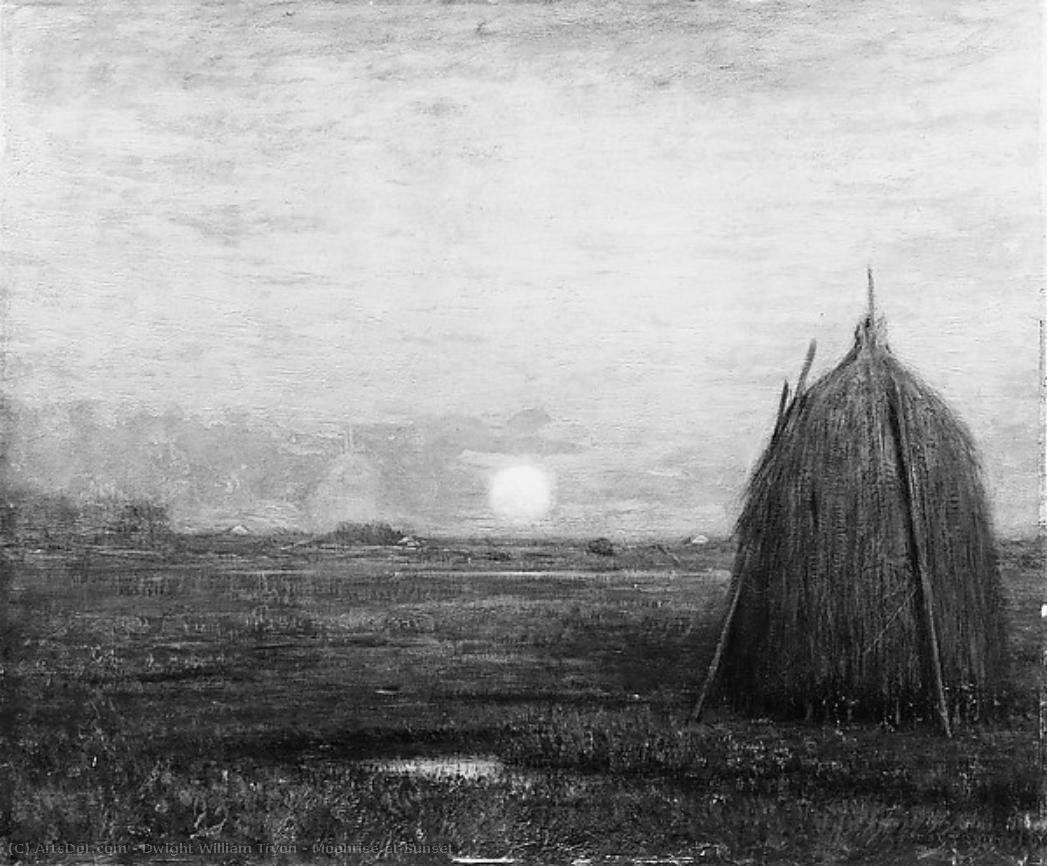
This ethereal grayscale landscape captures the profound tranquility of Dwight William Tryon’s Tonalist masterpiece Moonrise at Sunset, inviting you to explore and own this serene piece of art history.

Dwight William Tryon (1849-1925) var en fremtredende amerikansk tonalistmaler kjent for rolige landskap og haveskildringer. Inspirert av Whistler, skaper han fredelige naturopplevelser med subtile farger og atmosfære.

Giclée / Kunsttrykk

Giclée- eller lerretsprint av museumskvalitet med rask produksjon og fleksible valgmuligheter for etterbehandling. ( Kjøp håndmalt maleri Bytt til digitalt bilde)

Standardformat
skreddersydd
CM
INCH

Velg mellom våre forhåndsdefinerte størrelser som bevarer kunstverkets opprinnelige proporsjoner.

bredde
høyde

Skriv inn ønsket bredde og høyde for å tilpasse trykket til din ramme eller vegg. Et trykk kan kun beskjæres, aldri skaleres opp utover motivets opprinnelige størrelse, noe som betyr at et format med andre proporsjoner vil føre til tap av deler av bildet. Vi sender deg en digital mockup for godkjenning før vi starter trykkeprosessen. Bildet som vises på denne siden viser ikke den faktiske beskjæringen — det er kun mockuppen som viser dette.

Verdensomspennende levering () på 2 uker i stedet for standard 4/5 uker. (8 November)

Gratis ekspressfrakt over hele verden
Lerretsduk av lin av høy kvalitet
Full transportforsikring
Garanti for refusjon av toll og importavgifter
Garantert fargegjengivelse
100 dagers returrett ved fabrikasjonsfeil
100% pengene tilbake-garanti
Rabatt ved flere kjøp

Totalpris

Nkr 660

Moonrise at Sunset

Giclée / Kunsttrykk

Størrelse på reproduksjon

-

Totalpris for valgte alternativer

Nkr 660

Kort om verket

  • Subject or theme: Rural landscape
  • Medium: Oil on wood
  • Title: Moonrise at Sunset
  • Influences: Whistler
  • Artistic style: Dreamlike quality
  • Artist: Dwight William Tryon

Kunnequiz om kunst

Det er kun ett riktig svar på hvert spørsmål.

Spørsmål 1:
What artistic movement is Dwight William Tryon’s ‘Moonrise at Sunset’ associated with?
Spørsmål 2:
The painting predominantly utilizes what color palette?
Spørsmål 3:
What technique is Tryon employing to achieve the hazy atmospheric perspective in ‘Moonrise at Sunset’?
Spørsmål 4:
What symbolic element is represented by the haystack in the foreground?
Spørsmål 5:
Where was Dwight William Tryon born?

Dwight William Tryon’s Moonrise at Sunset: A Symphony of Tranquility

The artwork “Moonrise at Sunset” by Dwight William Tryon stands as a testament to the Tonalist movement's enduring fascination with capturing atmospheric mood and subtle tonal variations. Executed in 1890, this oil on wood painting transports viewers to a serene rural landscape bathed in the ethereal glow of twilight—a scene meticulously rendered with delicate brushstrokes and muted colors that evoke profound peace and contemplation.
  • Subject Matter: Tryon’s composition centers around a sprawling field dominated by a prominent haystack, positioned on the right side of the canvas. A distant horizon is punctuated by a luminous moon or sun rising above hazy hills—a motif frequently explored in Tonalist art to symbolize transition and cyclical renewal.
  • Style & Technique: Tryon’s approach aligns perfectly with the tenets of Tonalism, prioritizing tonal harmony over vibrant color palettes. He achieves this effect through painstaking layering of thin glazes – a technique that allows for gradual blending and subtle gradations of tone—creating an immersive experience for the viewer. Soft brushwork contributes to the painting's dreamlike quality, blurring edges and diffusing light to mimic the hazy atmosphere characteristic of dusk.
  • Composition: The horizontal format emphasizes stability while guiding the eye across the expansive field towards the horizon line. The haystack serves as a vertical anchor, grounding the scene and providing textural contrast against the smooth expanse of grass. Careful attention to perspective reinforces this sense of spatial recession, drawing the viewer into the tranquil landscape.
  • Color Palette: Employing a predominantly grayscale palette—ranging from deep blacks to pale whites—Tryon eschews bold hues in favor of tonal nuances that convey emotion and atmosphere. This restrained color scheme amplifies the painting’s contemplative mood, focusing on form and texture rather than visual spectacle.
  • Historical Context: Born in Hartford, Connecticut, in 1849, Tryon's artistic vision was deeply influenced by Whistler’s pioneering explorations of tonalism—a movement that sought to elevate landscape painting beyond mere representation, aiming instead for an emotional response from the audience. “Moonrise at Sunset” embodies this spirit, reflecting a broader cultural preoccupation with capturing the sublime beauty of nature and conveying feelings of serenity and introspection during the late Victorian era.

Detailed Analysis: Texture & Lighting

Tryon’s masterful manipulation of texture is particularly noteworthy in the depiction of the haystack—rendered with visible brushstrokes that convey its rough, layered surface. These textured strokes aren't merely decorative; they actively contribute to the painting's overall impression of materiality and depth. Simultaneously, Tryon skillfully utilizes diffused lighting to illuminate the landscape, creating a gentle glow around the moon/sun and softening the contours of distant hills. This subtle illumination enhances the atmospheric effect, fostering a sense of tranquility and inviting contemplation.

Symbolism & Emotional Impact

Beyond its aesthetic qualities, “Moonrise at Sunset” carries symbolic weight—the haystack representing harvest or abundance, while the moonrise/sunset symbolizing transition and renewal. Tryon’s artwork transcends mere visual representation, prompting viewers to consider themes of cyclical change and the profound beauty inherent in quiet contemplation. It's a piece designed to evoke feelings of peace, solitude, and connection with the natural world—a timeless reminder of the power of art to inspire emotion and elevate our understanding of the sublime.

Further Research & Artistic Inspiration

For those interested in delving deeper into Tryon’s artistic legacy, The Metropolitan Museum of Art houses a remarkable collection of his works, offering invaluable insight into his stylistic evolution and thematic preoccupations. Examining “Moonrise at Sunset” alongside other Tonalist landscapes provides a compelling framework for appreciating the movement's enduring influence on American art history—a testament to Tryon’s ability to capture not just what he saw but also what he felt.

Spørsmål og svar

Hvorfor er den opphavsrettslige statusen til "Moonrise at Sunset" slik den er?

"Moonrise at Sunset" av Dwight William Tryon er fritt tilgjengelig – opphavsretten har utløpt. Opphavsretten beregnes fra kunstnerens dødsår, og Dwight William Tryon døde i 1925.

Hvilken størrelse bør jeg velge for trykk av "Moonrise at Sunset" til rommet mitt?

For et Living Room anbefales det å trykke "Moonrise at Sunset" i størrelsen Medium.

Hvordan knytter "Moonrise at Sunset" av Dwight William Tryon Tonalist Landscape til kunstnerens hjemland?

"Moonrise at Sunset" knytter Tonalist Landscape-bevegelsen til USA gjennom skaperens fødested.


Om kunstneren

Early Life and Artistic Beginnings

Dwight William Tryon’s artistic journey began in the quiet, rural landscapes of Connecticut, born in Hartford in 1849 to Anson Tryon and Delia O. Roberts. The early years of his life were marked by a poignant loss – the untimely death of his father cast a long shadow, shaping his upbringing on the family’s farm in East Hartford. This immersion in the rhythms of rural life proved profoundly formative, instilling within him an enduring connection to nature that would become the very foundation of his artistic vision. Remarkably, Tryon's artistic inclinations emerged organically; he wasn’t formally trained at first, but rather discovered a passion for drawing through a local bookstore where he worked as an employee. It was there, amidst the shelves of instructional manuals, that he began to cultivate his talent independently. His early explorations weren’t confined to study alone – he spent countless hours sketching the surrounding countryside, meticulously translating the subtle shifts in light and shadow onto paper. This dedication culminated in his first sale in 1870, a modest beginning that nonetheless ignited his ambition and signaled the emergence of a burgeoning talent destined for wider recognition. His acceptance into the National Academy of Design in 1873 marked a significant milestone, providing him with formal training and a platform to showcase his work within the established art world.

European Influences and the Shaping of a Style

Driven by an intense desire for structured artistic education, Tryon embarked on a transformative journey to France in 1876. This pivotal move allowed him to immerse himself fully in the vibrant currents of European art, studying under Jacquesson de la Chevreuse at the École des Beaux-Arts in Paris. However, his education extended far beyond the confines of the classroom; he actively sought guidance from a constellation of influential artists, including Charles-François Daubigny, Henri Harpignies, and Jean Baptiste-Antoine Guillemet. These encounters exposed him to diverse techniques and philosophies, broadening his artistic horizons. Initially, Tryon’s style leaned towards Luminism – a movement characterized by its emphasis on atmospheric effects and the evocative use of radiant light. Yet, his artistic path soon diverged, drawn to the principles of the Barbizon School—a revolutionary movement that prioritized direct observation of nature and a more subdued, contemplative palette. The Barbizon School, emerging from the rural landscapes of France, offered an alternative to the grand scale and often theatrical compositions of academic painting. The influence of James McNeill Whistler proved particularly profound during this period. Whistler’s tonalist style—characterized by its subtle manipulation of color and tone to create a harmonious and emotionally resonant experience – deeply resonated with Tryon's artistic sensibilities, shaping his approach to composition and color harmony.

Mature Style and Atmospheric Landscapes

By the late 1880s, Dwight William Tryon had fully realized his distinctive artistic style—a signature approach that would define his legacy as a leading American Tonalist. His canvases frequently depict serene landscapes and seascapes rendered in soft, harmonious colors. A recurring compositional element is a carefully arranged grouping or broken row of trees positioned in the middle distance, acting as a visual bridge between a luminous sky above and a foreground marsh or pasture below. These scenes are often imbued with autumnal hues—ochres, browns, and muted greens—evoking a sense of tranquility, melancholy, and the passage of time. Beyond landscapes, Tryon also excelled at capturing the beauty of the sea, utilizing pastel to create evocative depictions of water, sky, and shoreline under varying weather conditions. His mastery lay not in dramatic brushstrokes or bold colors, but rather in his ability to convey atmosphere—the subtle shifts in light, the delicate interplay of color, and the overall mood of a scene. *Salt-Marsh, December*, which garnered first prize at the Tennessee Centennial Exposition in 1897, stands as a prime example of this skill, showcasing his talent for capturing the serene beauty of the natural world with remarkable subtlety and depth. His paintings were consistently exhibited nationally, gaining recognition at prestigious venues such as the Pennsylvania Academy of Fine Arts and the Montross Gallery.

Patronage, Recognition, and Lasting Legacy

The trajectory of Tryon’s career was significantly bolstered by his relationship with Charles Lang Freer, a discerning collector who became his most important patron. Freer acquired dozens of Tryon's works and even collaborated with the artist on interior design projects for his Detroit home. This generous support allowed Tryon to fully dedicate himself to his art, enabling him to produce a substantial body of work that continues to be celebrated today. Further recognition came in 1908 when he received the Carnegie Prize at the Carnegie Exhibition—a prestigious award recognizing outstanding achievement in American art. Throughout his career, Tryon remained an active member of several prominent art organizations, including the Society of American Artists, the American Watercolor Society, and the National Institute of Arts and Letters (now the American Academy of Arts and Letters). In 1887, he established a summer home in South Dartmouth, Massachusetts—a place that would serve as his primary residence for the remainder of his life. Notably, Tryon also dedicated himself to education, teaching painting and drawing at Smith College from 1886 to 1923, where he founded the Tryon Gallery of Art. Dwight William Tryon passed away in 1925, leaving behind a rich artistic legacy defined by his contribution to American Tonalism and his exceptional ability to capture atmospheric landscapes and seascapes with delicate color and refined feeling. His works continue to be exhibited and collected worldwide, ensuring that his vision endures for generations to come.

Dwight William Tryon

Dwight William Tryon

1849 - 1925 , USA

Kort om kunstneren

  • Artistic Movement Or Style: Tonalisme, Barbizon
  • Artists Or Movements Influenced By This Artist: ['Amerikansk Tonalisme']
  • Artists Who Influenced This Artist:
    • Daubigny
    • Whistler
  • Date Of Birth: 13. august 1849
  • Date Of Death: 1. juli 1925
  • Full Name: Dwight William Tryon
  • Nationality: Amerikansk
  • Notable Artworks:
    • Salt-Marsh, Desember
    • Vår
  • Place Of Birth: Hartford, USA