Håndmalt olje på lerret i din valgte størrelse og ramme, laget på bestilling av våre kunstnere. ( Bytt til trykkversjon
Gå til digitalt bilde)
Velg mellom våre forhåndsdefinerte størrelser som bevarer kunstverkets opprinnelige proporsjoner.
Du kan angi egne mål for å tilpasse en spesifikk ramme eller plass. Dersom den valgte størrelsen ikke samsvarer med originalbildets proporsjoner, vil vi enten beskjære kunstverket eller utvide maleriet med ytterligere håndmalte elementer. En digital mockup vil bli sendt til din godkjenning før produksjonen starter.
Vennligst merk at forhåndsvisningen på skjermen ikke gjenspeiler den faktiske beskjæringen eller utvidelsen. Kun mockuppen vil vise den endelige komposisjonen nøyaktig.
Selv om tilpassede størrelser er tilgjengelige, anbefaler vi å velge et mål fra den forhåndsdefinerte listen for å bevare de originale proporsjonene.
Verdensomspennende levering () på 3–4 uker i stedet for standard 5 uker. (25 September). Ingen kompromisser med kvaliteten.
Proserpine
Format på reproduksjon
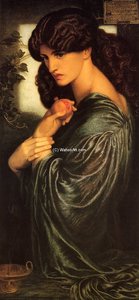
Dante Gabriel Rossetti's "Proserpine," painted in 1874, is more than simply a portrait; it’s a poignant meditation on loss, longing, and the bittersweet nature of eternal beauty. The canvas, measuring a modest 6 x 125 cm, holds within its depths a scene both arresting and profoundly melancholic. Jane Morris, Rossetti's muse and wife, embodies Proserpine herself – a figure tragically caught between two worlds, forever bound to the shadowy realm of Pluto while yearning for the sunlit joys of Earth.
Rossetti’s style is undeniably rooted in Pre-Raphaelite aesthetics, a movement he helped pioneer. The painting revels in rich, saturated colors—deep blues and purples dominate the background, evoking the oppressive atmosphere of the underworld, contrasted sharply with the vibrant red of the pomegranate fruit held delicately in Proserpine's hand. The brushwork is meticulous yet fluid, creating an almost tactile quality to the fabrics and skin tones. Notice how Rossetti masterfully employs sfumato – a subtle blurring of lines and colors – to soften the edges of Morris’s features, lending her an ethereal, dreamlike appearance.
The central image—Proserpine consuming a pomegranate—is laden with symbolic weight. The pomegranate, a fruit associated with both fertility and death, represents Proserpine's forced captivity. Each seed symbolizes a year spent in the underworld, a constant reminder of her separation from her beloved husband, Zephyr. The red color itself is significant; it’s the hue of blood, hinting at the pain and sacrifice inherent in her fate. The apple, held aloft, further emphasizes this theme of temptation and consequence – a symbol of the forbidden fruit that led to her downfall.
Furthermore, the setting—a shadowy, undefined space—is deliberately ambiguous. It’s not a specific location but rather a representation of the underworld itself: a realm of perpetual twilight and muted colors. This reinforces the feeling of isolation and despair that permeates the painting. The careful arrangement of objects – the pomegranate, the apple, even the folds of Morris's dress – all contribute to a complex visual narrative.
"Proserpine" offers a rare glimpse into the emotional landscape of Victorian England, a period grappling with themes of mortality, beauty, and the constraints placed upon women. Rossetti’s choice of Jane Morris as Proserpine is particularly revealing; she herself was deeply connected to the Pre-Raphaelite movement and possessed an innate understanding of its aesthetic principles. Morris's pose—looking directly at the viewer—creates a powerful sense of intimacy, drawing us into Proserpine’s sorrowful gaze.
The painting’s enduring appeal lies in its ability to evoke a profound emotional response. It is not merely a depiction of a mythological figure but rather an exploration of universal themes – love, loss, and the yearning for connection. It's a testament to Rossetti’s skill as a painter and his capacity to imbue his work with layers of meaning and feeling. A reproduction captures this exquisite detail and emotional depth, offering a beautiful addition to any collection or interior space.
WahooArt offers meticulously crafted hand-painted reproductions of "Proserpine," ensuring that the painting’s original beauty and nuance are faithfully preserved. Our artists utilize traditional oil painting techniques, replicating Rossetti's rich color palette and delicate brushwork with exceptional precision. We offer a range of sizes to suit your individual needs and preferences, from smaller pieces suitable for intimate settings to larger formats ideal for grand spaces.
Explore our collection today and bring the haunting beauty of “Proserpine” into your home or studio. A WahooArt reproduction is more than just a print; it's a tangible connection to one of the most evocative works of Victorian art.
1828 - 1882 , Storbritannia