A Moment Frozen in Time: Charles Marion Russell’s “Roping a Wolf”
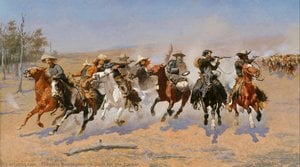
Charles Marion Russell's "Roping a Wolf," painted in 1901, isn’t merely a depiction of a Western scene; it’s a vibrant distillation of the American spirit – a potent blend of rugged individualism, frontier adventure, and a deep respect for the untamed wilderness. This watercolor masterpiece captures a fleeting moment of intense action, a cowboy skillfully maneuvering his horse to corral a wolf in the vast expanse of Montana's landscape. The painting immediately draws the viewer into its dynamic composition, dominated by diagonal lines created by the galloping horse and rider, guiding our eye through the scene with an undeniable sense of momentum.
Russell’s genius lies not just in his technical skill but in his profound understanding of the West – a realm he experienced firsthand as a working cowboy for over a decade. He didn't simply paint what he *saw*; he painted what he *felt*, imbuing each brushstroke with the dust, the heat, and the spirit of the frontier. The muted earth tones—ochres, browns, and blues—evoke the arid landscape, while subtle variations in color suggest atmospheric haze and the play of light on the rough terrain. The painting’s flattened perspective, a hallmark of watercolor techniques, lends it an almost dreamlike quality, transporting us to this specific moment in time.
The Cowboy Artist: Russell's Vision of the West
Charles Marion Russell (1864-1926) was more than just an artist; he was a quintessential embodiment of the Western myth. Born in St. Louis, his early life was far removed from the landscapes he would later immortalize. He abandoned formal schooling at sixteen to become a cowboy, immersing himself fully in the life and culture of the American West. This experience profoundly shaped his artistic vision, informing his depictions of Native Americans, cowboys, wildlife, and the dramatic beauty of the frontier. Russell’s work is deeply rooted in observation and storytelling, often drawing upon Native American folklore and legends.
Russell's commitment extended beyond painting; he was a passionate advocate for Native American rights and worked tirelessly to preserve their culture and traditions. His art served as a powerful voice for the West’s indigenous peoples, offering a nuanced perspective that challenged prevailing stereotypes. His legacy is one of artistic integrity, cultural sensitivity, and a profound connection to the land.
Technique and Style: A Watercolor Masterpiece
“Roping a Wolf” exemplifies Russell's mastery of watercolor techniques. The artist skillfully employs wet-on-wet washes to create soft edges and blended colors, lending the scene an ethereal quality. The loose brushstrokes are visible throughout the painting, adding to its sense of immediacy and authenticity—a testament to Russell’s direct approach to his craft. Note the careful attention to detail in rendering the textures of the horse's coat, the rider's clothing, and the ruggedness of the landscape. The use of light is particularly effective, creating a dramatic contrast between the bright sunlight illuminating the foreground and the hazy atmosphere in the background.
The painting’s composition—a dynamic interplay of diagonals and curves—further enhances its visual impact. The central figure of the cowboy, poised with determination, anchors the scene while the movement of the horse and wolf creates a sense of thrilling action. The subtle integration of Native American elements – the wolf itself – speaks to Russell's deep respect for the land and its inhabitants.
Symbolism and Emotional Resonance
Beyond its surface depiction, “Roping a Wolf” is rich in symbolism. The act of roping represents control over nature, a fundamental theme in Western art and literature. However, Russell doesn’t portray this as a simple conquest; the cowboy's skill is tempered by respect for the animal, suggesting a more nuanced relationship between humans and the wilderness. The wolf itself can be interpreted as a symbol of both danger and beauty, embodying the untamed spirit of the West. The painting evokes feelings of adventure, resilience, and the enduring allure of the frontier—a timeless reminder of America’s pioneering past.



 Forhåndsvisning
 Bytt til trykk
 Send
Send Del med andre
 Vis detaljer

 Last ned bildet
 Liknende objekter
 Røntgenundersøkelse
 Lysbildefremvisning
 Statistikk


 Vis hele teksten