Kjøp et høyoppløselig, forbedret digitalt bilde som er langt bedre enn forhåndsvisningen på nettet.
Hver fil er omhyggelig klargjort av våre egne spesialister ved hjelp av avanserte verktøy og profesjonell manuell retusjering. Vi sørger for at hvert bilde har eksepsjonell klarhet, presis fargegjengivelse og fine detaljer.
Den endelige filen leveres via e-post innen 72 timer, optimalisert for umiddelbar bruk i profesjonelle, redaksjonelle og trykte miljøer. Dette er den samme kvaliteten som benyttes av ledende designstudioer, utgivere og gallerier.
Last ned en høyoppløselig fil for personlig bruk, utskrift og kreative prosjekter. ( Kjøp trykk Kjøp håndlaget maleri)
Når du velger WahooArt.com, får du ikke bare et bilde – du mottar et profesjonelt forbedret digitalt kunstverk, skapt med presisjon og med en garantert tilfredshetsgaranti. Her er alt som automatisk følger med din bestilling:

Din høyoppløselige digitale bildefil sendes til din e-post innen 72 timer etter bestilling – klar til umiddelbar bruk.

Ditt kunstverk blir profesjonelt optimalisert ved hjelp av avanserte AI-verktøy og manuell redigering, noe som sikrer maksimal detaljrikdom, klarhet og fargegjengivelse.

Har du ved et uhell slettet eller mistet filen din? Ingen bekymring – vi sender den på nytt når som helst, helt gratis.

Nyt ditt kunstverk umiddelbart uten toll, avgifter eller leveringskostnader – digitale nedlastinger er alltid avgiftsfrie.

Vi sikrer at ditt digitale bilde gjenspeiler de originale fargene så nøyaktig som mulig ved hjelp av profesjonelle verktøy og fargehåndtering.

Hvis du ikke er fornøyd med ditt digitale bilde, vil vi revidere det eller refundere 100% innen 100 dager – uten spørsmål.

Ikke fornøyd? Få full refusjon innen 100 dager etter at du har mottatt din digitale fil – uten spørsmål.

Kjøp 3 bilder, spar 10% - Kjøp 5, spar 15% - Kjøp 10+, spar 20%. Ideelt for kreative prosjekter, gallerier og byråer.

In the vibrant, shifting landscape of the late Italian Renaissance, few artists captured the tension between classical order and Mannerist artifice as delicately as Carlo Urbino. Born in the Lombard town of Crema around 1525, Urbino emerged from a period of profound intellectual ferment, where the rigid structures of the High Renaissance were beginning to dissolve into the more expressive, elongated, and dramatic forms of Mannerism. His journey was one of both artistic refinement and scientific inquiry, a path that saw him move through the influential circles of Venice and Milan, leaving behind a trail of frescoes and drawings that bridge the gap between the grace of the 16 th century and the burgeoning energy of the Baroque.
Urbino’s early development was deeply rooted in the aesthetic currents of the Veneto. Training amidst the luminous traditions of Venice, he absorbed a mastery of light and color that would later define his approach to composition. However, it was his connection to the Campi family—specifically the masters Antonio, Bernardino, and Giulio Cambi—that provided the stylistic scaffolding for his career. This lineage instilled in him a penchant for complex, often crowded arrangements and a fascination with the human form in motion. His work does not merely depict a scene; it orchestrates a visual drama, utilizing sfumato and dynamic gestures to guide the viewer’s eye through intricate religious narratives.
What truly distinguishes Carlo Urbino from his contemporaries was his profound intellectual curiosity, which extended far beyond the boundaries of the canvas. He was a true Renaissance man, possessing a mind that sought to find the underlying geometry in all things. This passion for structure led to a remarkable collaboration with the mathematician and engineer Camillo Agrippa. Together, they worked on the Codex Huygens, a monumental endeavor that explored the intersection of art, proportion, and the science of armaments. Through this work, Urbino demonstrated that his interest in perspective was not merely a tool for illusion, but a way to understand the very mechanics of the physical world.
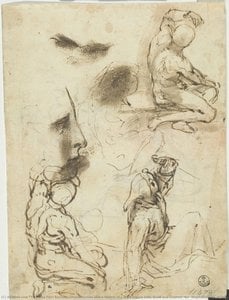
This scientific rigor is often visible in his preparatory drawings and sketches. Whether working with ink, sanguine, or pen, Urbino possessed an ability to distill complex anatomical truths into elegant lines. His studies for religious compositions were not merely blueprints but explorations of weight, balance, and tension. This duality—the ability to be both a dreamer of divine visions and a student of mathematical precision—allowed him to create works that felt both spiritually transcendent and physically grounded.
As his reputation grew, Urbino’s career found its most significant momentum in Milan, where he secured prestigious commissions from the era's most influential patrons. His work for Vespasiano Gonzaga and Alessandro Sforza placed him at the heart of Lombard political and religious life. In the sacred spaces of Milan, such as the Church of Santa Maria della Passione, his frescoes breathed life into the walls, showcasing a command of perspective that could transform a flat surface into an expansive, heavenly realm. His contributions to the St. Joseph’s Chapel remain a testament to his ability to handle large-scale religious iconography with both solemnity and grace.
The breadth of his artistic output can be seen in several key areas of his career:
By the time of his death in 1585, Carlo Urbino had helped establish a stylistic bridge that would support the weight of the coming Baroque era. He left behind an oeuvre that serves as a vital link in the history of Italian art—a legacy defined by the seamless integration of the eye's beauty and the mind's logic. His ability to navigate the transition from the balanced ideals of the Renaissance to the emotive complexity of Mannerism ensures his place as a pivotal figure in the evolution of European painting.

1525 - 1585 , Italy

 Forhåndsvisning
 Send
Send Del med andre
 Vis detaljer

 Last ned bildet
 Liknende objekter
 Røntgenundersøkelse
 Lysbildefremvisning
 Vis hele teksten