


Kunstverket som vises på denne siden er beskyttet av opphavsretten, noe som betyr at vi ikke har juridisk tillatelse til å lage eller selge identiske reproduksjoner. Denne beskyttelsen håndheves i henhold til internasjonale avtaler som for eksempel Bernerkonvensjonen og av nasjonale lover, inkludert de som er fastsatt i Amerikansk lov om opphavsrett – Tittel 17.
Denne metoden er i fullt samsvar med opphavsrettslige regler, da den ikke innebærer kopiering eller duplisering av det beskyttede kunstverket. I stedet er det snakk om en kreativ nytolkning – et nytt maleri som er inspirert av originalen, men ikke identisk med den.
Giclée- eller lerretsprint av museumskvalitet med rask produksjon og fleksible valgmuligheter for etterbehandling. ( Kjøp håndmalt maleri Bytt til digitalt bilde)
Velg mellom våre forhåndsdefinerte størrelser som bevarer kunstverkets opprinnelige proporsjoner.

Skriv inn ønsket bredde og høyde for å tilpasse trykket til din ramme eller vegg. Et trykk kan kun beskjæres, aldri skaleres opp utover motivets opprinnelige størrelse, noe som betyr at et format med andre proporsjoner vil føre til tap av deler av bildet. Vi sender deg en digital mockup for godkjenning før vi starter trykkeprosessen. Bildet som vises på denne siden viser ikke den faktiske beskjæringen — det er kun mockuppen som viser dette.
Verdensomspennende levering () på 2 uker i stedet for standard 4/5 uker. (15 November)
Packaging Post for the War
Størrelse på reproduksjon

Born Hermann Wilhelm Brandt in Hamburg, Germany, the man who would become known to the world as Bill Brandt possessed a lens capable of capturing the profound complexities of the human condition and the stark beauty of the natural world. His journey was one of movement and transformation, shaped by the turbulent winds of early twentieth-century Europe. After spending much of his youth in a sanatorium in Switzerland, Brandt found himself drawn to the artistic pulse of Paris in the late 1920s. It was here, within the legendary studio of Man Ray, that he encountered the surrealist movement—a profound influence that would later manifest in his celebrated, distorted studies of the human form.
Moving to London in 1933, Brandt began a period of intense social documentation. Inspired by the socio-political writings of figures like George Orwell, he turned his camera toward the deep contrasts of the British class system. He traversed the landscapes of the United Kingdom, from the bustling West End and the sprawling suburbs to the gritty, industrial slums. His work for influential magazines such as Lilliput and Picture Post allowed him to capture the raw emotion of the era, documenting everything from the heavy atmosphere of the 1930s depression to the ghostly, blackout-shrouded streets of London during the Second World War.
As his career progressed, Brandt’s focus shifted from the social realism of the streets to more experimental and evocative territories. He became a master of the monochrome landscape, finding a haunting rhythm in the textures of the earth. His photographic studies of places like the Isle of Skye, the Giant's Causeway in Ireland, and the rugged terrain of Connemara showcase an incredible ability to use light and shadow to evoke isolation and timelessness. In these works, the landscape is not merely a setting but a character, imbued with a sense of drama and scale.
Beyond his landscapes and photojournalism, Brandt achieved significant renown for his later explorations of the human figure. His series Perspective of Nudes remains a cornerstone of twentieth-century photography, utilizing unique techniques—such as working with a pinhole aperture set to infinity—to create images that challenge perception and celebrate the sculptural qualities of the body. Through this diverse body of work, Brandt established himself as one of the most important photographers of his century, leaving behind a legacy defined by:

1904 - 1983 , Germany

Explore the profound drama of warfare through fine art. From heroic battle scenes to intimate portraits of valor, discover museum-quality oil reproductions and bespoke commissions curated for the discerning collector by WahooArt.

Explore how military art evolved from imperial propaganda to raw realism. Discover the profound human truth behind every brushstroke.

Explore how masters like Vereshchagin and Bellows captured the visceral truth of war. Discover the profound power of visual history today.
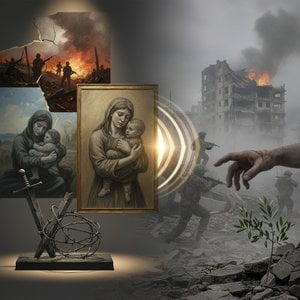
Explore a profound collection of historical war art. From visceral realism to poignant depictions of human resilience, discover museum-quality oil reproductions and expert insights for the discerning collector seeking to preserve history's most powerful echoes.

Explore the visceral visual language of battle art through masters like Rosa and Matejko. Discover the profound truth behind conflict on canvas.
 Forhåndsvisning
 Send
Send Del
Del
 Vis detaljer
 Utskriftsvennlig guide

 Last ned bilde
 Liknende objekter
 Røntgenundersøkelse
 Lysbildefremvisning
 Spørsmål og svar
 Statistikk
 Vis hele teksten






































 Glassalternativet er kun tilgjengelig i størrelser under 110 cm


